Pre-Exam Routines That Research Links to Better Test Performance
Retrieval practice with feedback and sleep beats cramming for lasting test gains.
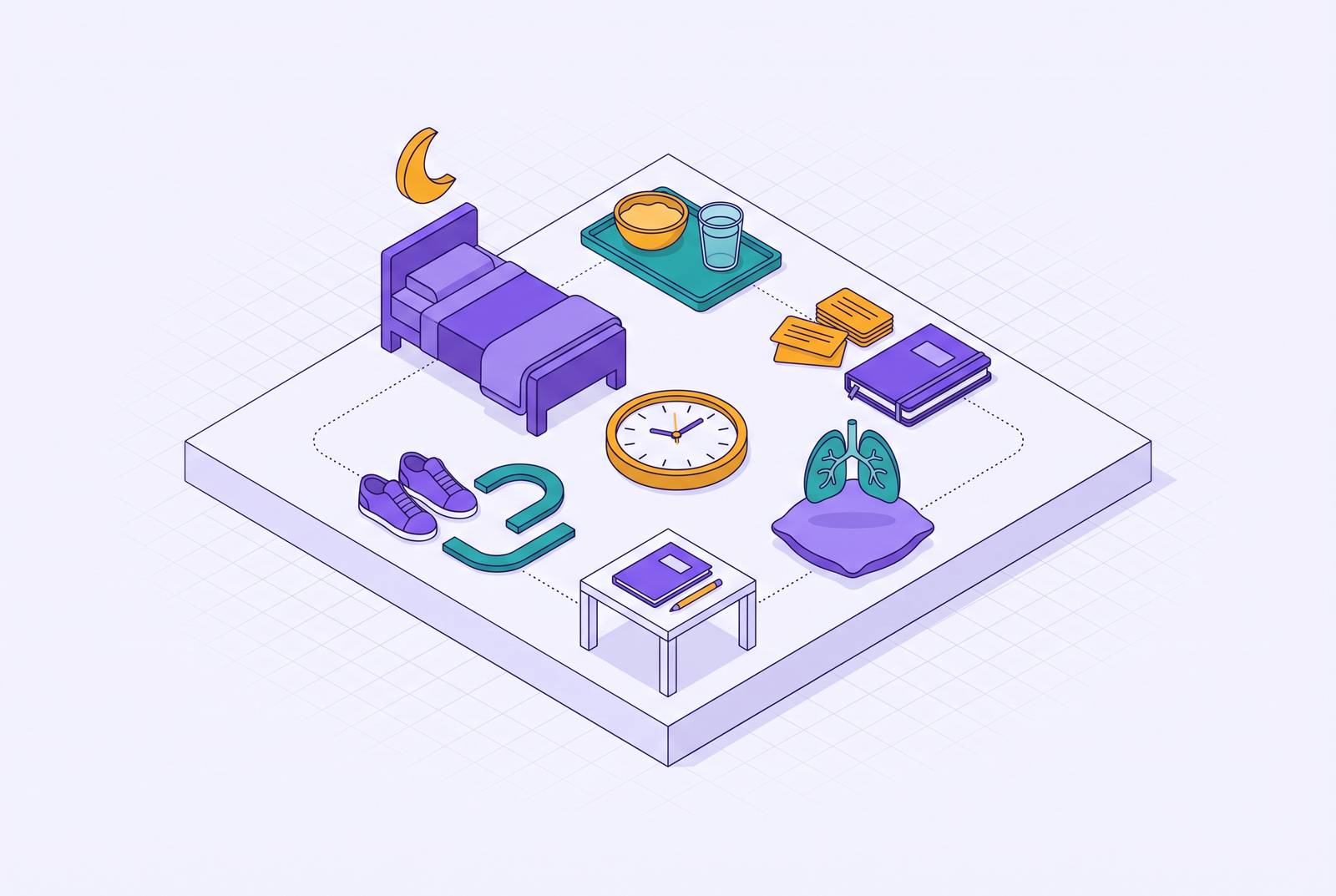
Pre-exam routines work best when they change what students do with knowledge. Research links better performance to a sequence of retrieval with feedback, strategy instruction, and sleep across the preparation period.
Why students who study more don't always score better
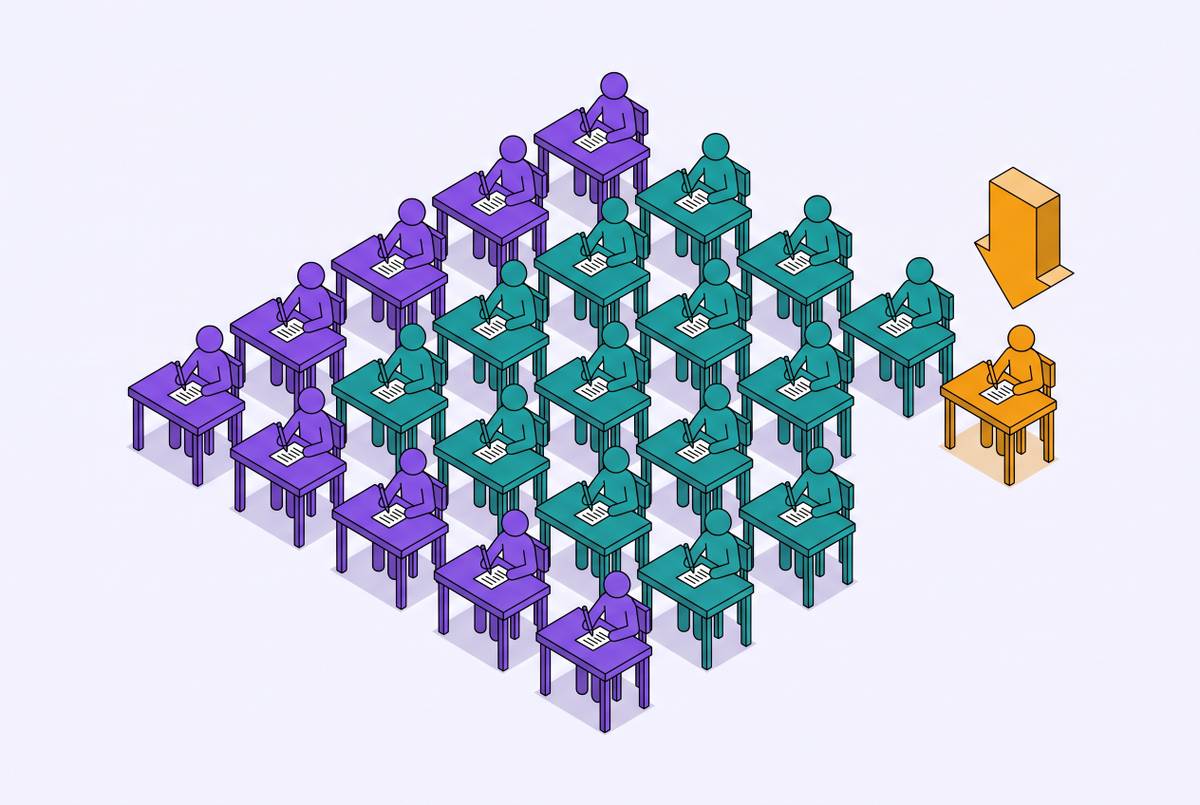
A student can cram longer than a classmate and still score worse. That feels unfair if studying is measured in hours. But hours record only attendance. Recognizing a familiar explanation, recalling it unaided, and using it to answer an unfamiliar question are different jobs. A full evening of the first does not guarantee success at the other two.
Hao et al.’s meta-analysis of test preparation experiments found that preparation can improve performance, but that results vary widely with its design. Developing socio-affective strategies, teaching test-taking skills, and using workbooks were significant moderators, but there was little evidence that seeing sample items and taking practice tests alone explained the gains. Practice is not a single, uniform treatment. Students can also know the content yet lack the skills to break down questions, evaluate choices, or choose an approach to an unfamiliar task. That changes the diagnosis from insufficient effort to a mismatch between the work students do and the work the exam demands.
Why retrieval practice outperforms re-reading by a significant margin
Retrieval practice asks students to reconstruct an answer from memory. When students are re-reading, they can follow the explanation with it still in front of them. Retrieval takes that support away, so students have to rebuild what they know and find what is missing. Feedback then shows where that reconstruction went wrong.
Hao, Baird, and El Masri (2026), researchers from the University of Oxford and Tsinghua University, tested this distinction in three experiments published in the Oxford Review of Education. The students in their experiments were preparing for real high-stakes tests. Testing with feedback produced significant gains on course tests conducted two days and seven days after the intervention, while restudy alone did not sustain those gains. There was an important boundary to the result. The effect appeared only when students were preparing for a genuinely high-stakes assessment, so the finding should not become a claim that every quiz works equally well everywhere.
What separates this from simply doing more practice questions? Feedback helps students correct the gaps they discover. Even brief retrieval sessions can outperform traditional review when feedback is built in, which helps explain why a stack of completed papers is not enough. Re-reading feels easier because the material flows smoothly past. Retrieval interrupts that flow, but its difficulty can be part of the learning.
How sleep consolidates what retrieval practice builds
Memory consolidation happens during sleep, with slow-wave sleep and REM sleep contributing to the process. Students remember what they practiced through retrieval better when they get enough sleep afterward. Cutting sleep to buy extra study time therefore trades against the retention of what the student has just practiced. The brain is not simply clocking off.
The sleep findings also change the relevant timescale. Sleep quality, duration, and consistency over the weeks and month before an exam correlate with academic performance much more strongly than sleep on the single night before it. Sleep measures accounted for nearly 25% of the variance in performance. That association leaves the causal role of sleep alone unproven. It nevertheless places the preparation period, rather than a last-minute bedtime rescue, at the center of the evidence.
How does this connect to retrieval in practice? Sessions spaced apart give students more than one chance to recall, get feedback, and sleep before they return to the material. A student who retrieves effectively but sleeps poorly undermines that sequence. Protecting the night before still belongs in preparation, but it cannot substitute for the preceding weeks. One good night is not a memory laundering service for a month of curtailed sleep.
Why strategy instruction is the third pillar, not an optional add-on
Remembering the content does not by itself tell students what a complicated question asks them to do. A student may retrieve the relevant knowledge yet choose an unsuitable approach, misjudge the answer choices, or spend too long on one response. Knowledge needs a way into the answer. Strategy instruction builds that bridge by teaching students how to break down question types, check what they understand, and change their approach under pressure.
The meta-analysis found that programs aimed at broad cognitive skills yielded the largest effects, substantially exceeding short sessions focused only on familiarity with the test format. It also identified socio-affective strategies as significant moderators of preparation outcomes. These include ways to manage anxiety, check what students understand, and change their pacing. They help students use what they know when the task is unfamiliar or the clock becomes distracting.
AP free-response questions make the distinction especially clear. They typically account for a substantial portion of the total score and demand different skills from multiple choice. Knowing the topic is only part of the task. Timed FRQ practice develops experience with the response format, while rubric self-scoring forces students to compare their work with what graders reward. Because that comparison takes repeated practice to internalize, strategy instruction belongs within preparation while there is still time alongside content review.
Why cramming persists even when evidence says it underdelivers
If there is better evidence for other ways to study, why is cramming still so appealing? Because it answers an immediate emotional need. When an exam is near, a long review session lets students see how many pages and topics they have covered. Retrieval, by contrast, can produce the distinctly unwelcome discovery that yesterday’s beautifully clear explanation has vanished. One method reassures the student while the other exposes uncertainty.
When review flows smoothly, students can think they know more than they do, while massed study leaves little time between rounds with the same material. A long session can displace sleep and the intervals through which spaced preparation works.
There is another reasonable objection to a more demanding routine. Will repeated testing and focused work on strategy make students less keen to learn? Longitudinal research found that increased emphasis on test-related thinking did not reduce motivation and was sometimes associated with greater perceived importance and utility of the subject as exams approached. Although the finding leaves open whether every rigorous routine prevents burnout, it challenges the assumption that serious exam preparation must make students disengage and leaves room for demanding practice that serves learning.
How in-person, high-stakes exam formats make physical and psychological preparation more consequential
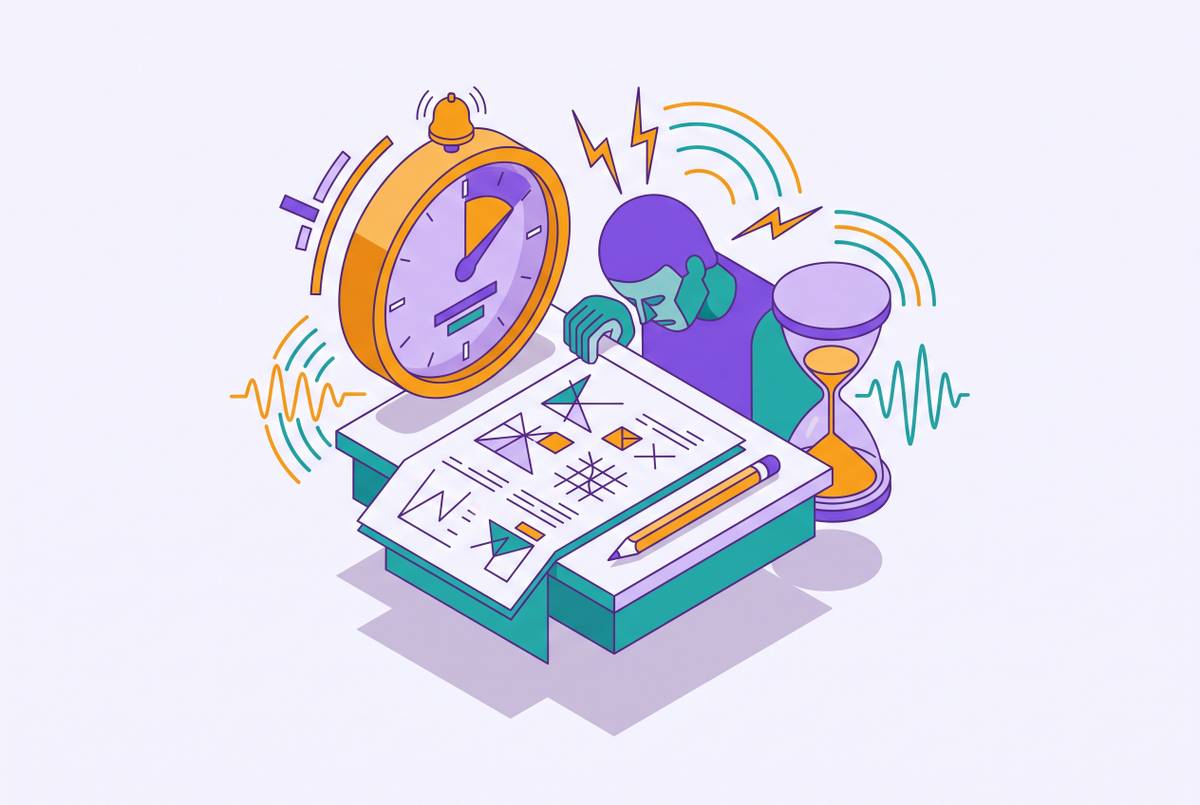
A return to proctored, in-person assessment makes independent performance harder to avoid. Institutions moving away from take-home formats in response to AI-assisted cheating concerns are changing the conditions under which students must demonstrate knowledge. A polished answer produced with tools available is not the same task as an unaided answer under time pressure. The room changes what preparation must deliver. Recall, pacing, anxiety regulation, and sustained focus all become visible in the result.
Topaz and Bahl (2026) examined a widely reported episode at Brown University in which near-perfect average scores on a take-home midterm fell dramatically on a subsequent proctored, in-person final. The episode illustrates a gap between performance when AI assistance was available and performance without that access. It does not prove that every student whose score fell used help that was not allowed. Exam difficulty and anxiety were among the alternative explanations raised. The structural lesson concerns what the two settings ask students to do, rather than a verdict on every student involved.
The number of Princeton’s scheduled take-home final examinations fell by 71% between spring 2025 and spring 2026 as worries about AI-assisted cheating grew. Students who outsource practice answers can miss both the retrieval needed for content mastery and the strategy work needed for proctored performance. More content review alone does not address that double gap, because the exam also demands that students manage their own attention and decisions without a digital lifeline.
How AI tools can support the right preparation routines without replacing the cognitive work
AI can support independent performance if it takes over the right part of preparation. Generating questions, identifying gaps, and adjusting pacing can make retrieval with feedback more available. The useful dividing line is whether the tool creates an opportunity for the student to think or removes that opportunity.
Isley et al.’s large-scale field study (Harvard/Stanford, 2025) found that AI-generated questions performed comparably to expert-created questions for standardized AP exams in psychometric quality. That supports AI as a source of practice material. It does not, by itself, establish learning gains. The student still has to attempt retrieval, and the feedback still has to help correct the response. Question supply is an input to the routine.
Adaptive tutors can also use response patterns to identify missing prerequisites rather than move students toward content they cannot yet use. A January 2026 study in Applied Sciences examined AI-generated personalized learning pathways and found that a meaningful share of students achieved optimal performance with no gaps in the assessed cognitive categories. The homogeneous classroom strategy did not achieve that outcome for those same students. But personalization does not make feedback infallible. AI grading systems can misdiagnose errors and underperform with struggling students at the margins, where precision is especially valuable.
Students and teachers evaluating these tools should judge the feedback loop. An AP tool that generates practice FRQs, grades against rubric criteria, and identifies a reasoning gap can support the mechanism behind retrieval with feedback. AI feedback is therefore best treated as a first pass that a teacher reviews and adjusts.
A practical sequence — what the evidence-backed routine actually looks like week by week
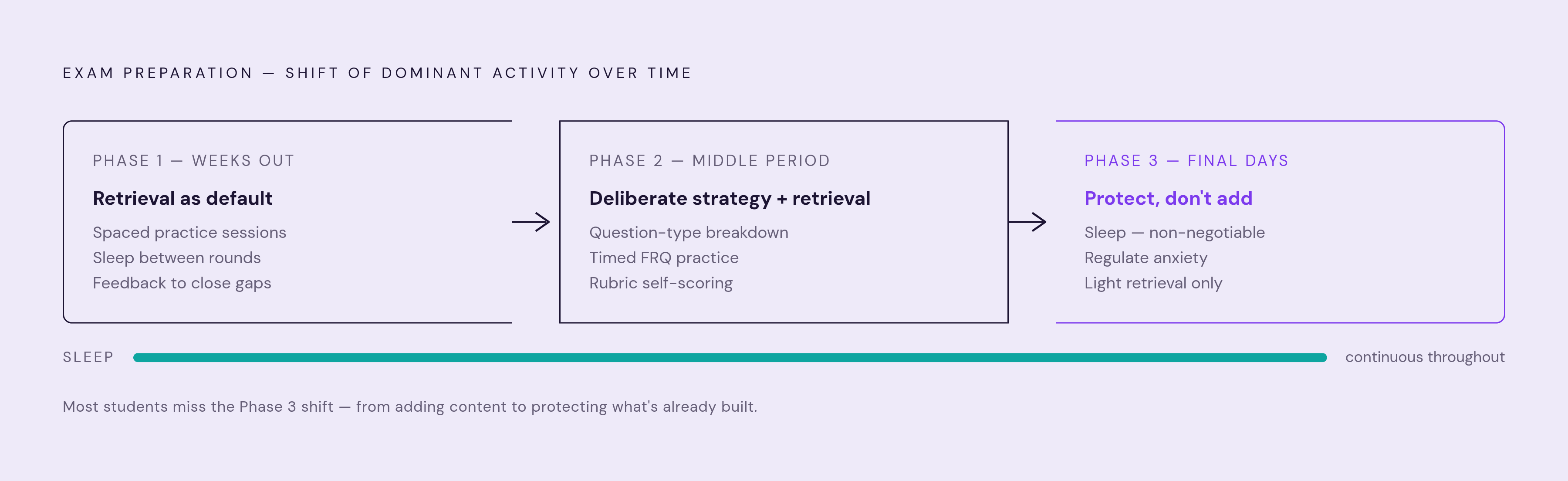
Preparation should begin weeks out with retrieval as the default study activity. Students should attempt to recall or explain material before returning to the source, then use feedback to correct what was missing or wrong. Students should spread their sessions over several days. Sleep belongs between those rounds. This gives the routine its basic rhythm of retrieval, correction, and consolidation.
During the middle of preparation, students should add deliberate work on how questions are built and answered. That means breaking down complex tasks, weighing the answer choices, and practicing with the formats and timing of real exams. Pacing needs rehearsal. For AP students, this is the time for repeated FRQ self-scoring, so they can use rubric criteria to shape their later answers. Retrieval continues during this phase, but strategy work helps students transfer remembered content into answers that meet the task.
In the final days, the priority should shift toward protecting sleep and regulating anxiety rather than adding review sessions that displace rest. This is a recommendation to change what preparation is for, from extending coverage to preserving and using what has already been practiced. The earlier rhythm of sleep remains important, so the final approach should not become a late attempt to compensate for weeks of inconsistency.
The night before should involve light retrieval of key concepts rather than new material, followed by a complete wind-down and full sleep. That night supports consolidation, but it is not uniquely responsible for everything learned in the preceding weeks. The larger sequence has already done its work. By then, the student’s task is not to win an endurance contest against the textbook, but to arrive able to retrieve knowledge, interpret the questions, and turn both into an answer.
Sources
- Full article: Test preparation in a high-stakes setting: experiments with testing and restudy strategies
- What exam scores can and cannot prove about unauthorized AI assistance: Evidence from a highly public classroom episode
- The Impact of Test Preparation on Performance of Large-Scale Educational Tests: A Meta-analysis of Experimental Studies - Zhanxin Hao, Jo-Anne Baird, Yasmine EI Masri, Kit Double, 2026
- Assessing the Quality of AI-Generated Exams: A Large-Scale Field Study