Feedback Specificity and Knowledge Gap Closure Rates
Specific feedback closes learning gaps faster than vague or lengthy comments.
Not all feedback is created equal, and the difference isn't about being nice versus harsh, or long versus short. The difference that actually predicts whether a student learns anything is specificity, and the research on this is more precise than most people realize.
Specificity in Feedback Research (and Why the Distinction Matters)
Specificity gets mistaken for a vague quality, like feedback is either "detailed" or "not detailed," the way a coffee order is either "fancy" or "not fancy." That's not what researchers mean. Specificity is a structural feature of the message itself, something you can point to and measure, not a vibe.
Wu and Schunn (2021) drew a hard line between general suggestions and specific solutions, and found that general suggestions were less likely to get acted on at all. Not less effective when used. It's less likely to be used in the first place, coming before it can even be judged less effective. That's a big distinction. A vague comment doesn't just underperform, it often gets ignored.
The feedback message must explain why an answer is wrong and include concrete direction on how to fix it. (2025): explain why the answer is wrong, and give concrete direction on how to fix it. Flagging the error alone doesn't count. Think about a tennis coach who watches a student net a serve and says, "you hit it into the net." That sentence tells the player nothing they don't already know, they can see the ball in the net themselves. Now compare that to a coach who says, "your head drops at contact, and that's pulling the ball down." That second comment hands the player something they couldn't have figured out on their own by just watching the result. The same principle carries over to a paper covered in red ink that says "unclear" versus one that says exactly which sentence collapsed and why.
Yang and Schunn's 2026 paper in Instructional Science gives this idea a formal structure, coding feedback along two dimensions: focus (is the comment about the content of the work, or its form, meaning grammar and structure) and specificity (how precisely does it locate and explain the problem). In 2018, research found that specific explanations led to deeper processing and more meaningful revisions, while vague suggestions produced surface-level responses.
Specific feedback versus vague feedback in closing gaps
Closing a knowledge gap requires three steps in sequence: the learner has to understand what the gap is, understand why it exists, and understand how to cross it. Vague feedback interrupts that process at step one. If a student doesn't know what's actually wrong, nothing downstream can happen, no matter how motivated they are.
This is why so many students skip straight to the grade and ignore the comments. It's a rational response, honestly, when the comments arrive too late to matter and don't tell you anything you can act on. Why read three paragraphs of commentary if none of it tells you what to actually change next time?
This problem's scale is visible outside classrooms too. Research cited in HR Daily Advisor, drawing on Borderless research, found that 96% of employees believe regular feedback helps them improve, but nearly half say they don't get it often enough. Almost everyone already believes in the value of feedback. The failure isn't belief, it's delivery. Specificity and frequency turn out to be coupled problems, because specific feedback takes real time and effort to produce, which is exactly why it happens less often than people want.
Prior knowledge complicates this further. The less a student already knows about a topic, the more they depend on specific feedback to even locate their own errors, because you cannot self-correct a mistake you can't diagnose. A student who's shaky on a concept doesn't have the internal map needed to interpret a vague comment. Ironically, the students who need feedback most are the ones least equipped to extract meaning from feedback that isn't precise.
Timing adds another wrinkle. Immediate feedback tends to support motivation, keeping a learner engaged in the moment. Delayed feedback can deepen reflection, giving a student space to think before reacting. Both of those benefits collapse if the actual message is vague. Speed doesn't save a comment that says nothing. Neither does patience.
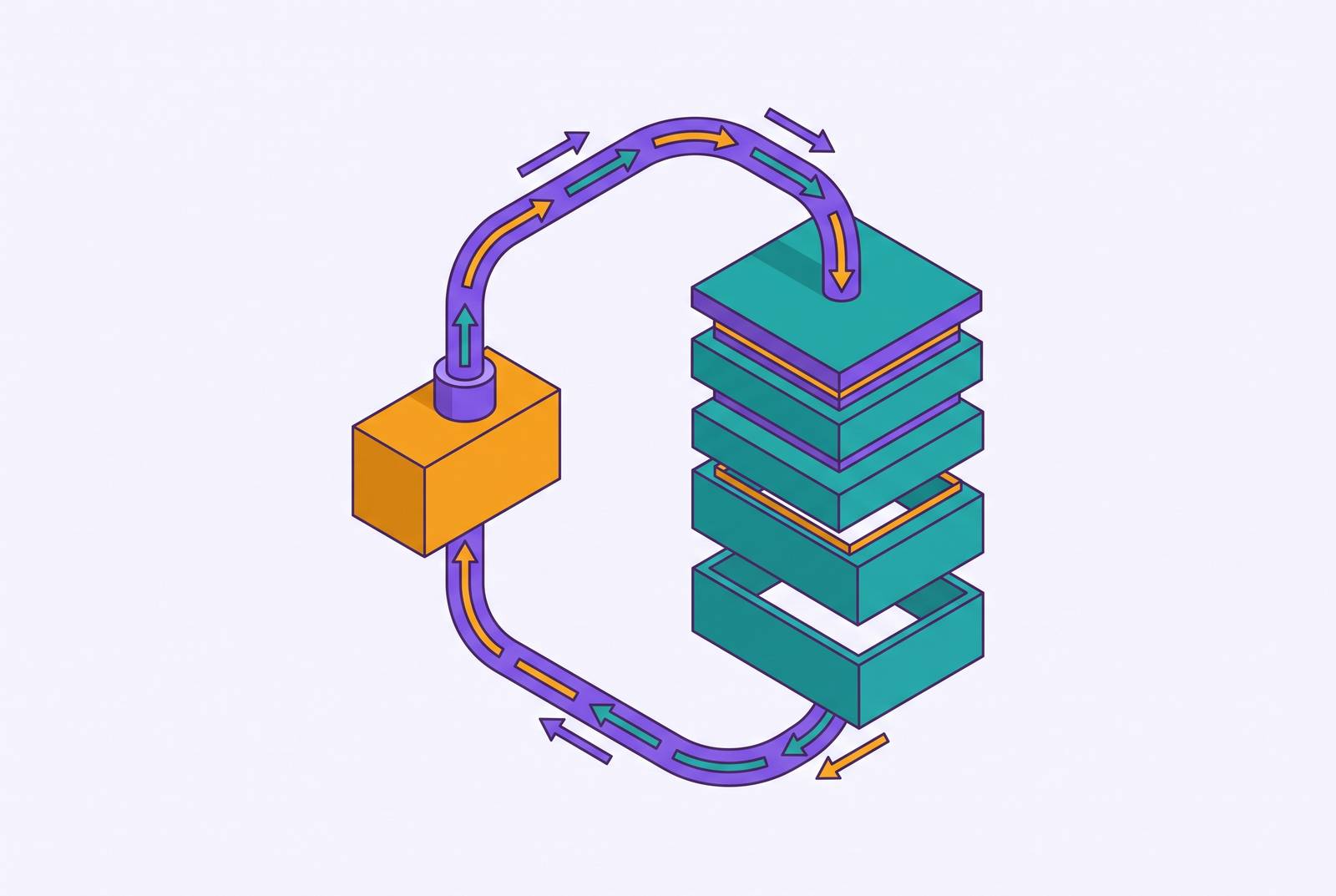
The REFLECT model, published in Contemporary Educational Psychology by Daumiller and Meyer, frames feedback as a dialogic and interpretive process. In plain terms: feedback isn't a one-way delivery of information, it's something the learner has to actively interpret and process internally. Gap closure doesn't happen when feedback is written. It happens (or fails to happen) inside the learner's head, in the moments after they read it. If the message doesn't give their brain something to work with, the whole loop stalls.
The peer feedback evidence on specificity and learning outcomes
Yang and Schunn's 2026 study didn't rely on a small classroom sample. It drew on a large dataset from an online peer feedback platform, examining 12 assignments deliberately chosen to represent a spread from weak to strong learning outcomes.
The finding is the kind of result that should reshape how a lot of people think about feedback. The difference between weak and strong outcomes wasn't the volume of content-focused comments. It was their specificity, specifically the ratio of specific content-focused comments to form-focused comments. Weak-outcome assignments were dominated by long comments about grammar and surface structure. Strong-outcome assignments were full of clarifying questions, concrete suggestions, and direct content revisions.
That's a genuinely important distinction. Length was never the variable that mattered. Specificity was.
This challenges something that's baked into a lot of classrooms and test-prep platforms: the assumption that more feedback equals better feedback. It's an easy assumption to make, because more feedback feels like more effort, more care, more attention paid. But if that feedback is aimed at form instead of content, all that effort produces very little transfer. A teacher can spend an hour marking up a paper and still leave the student without a single usable insight, if the comments never get past the surface.
If human-generated feedback already shows this tight relationship between specificity and outcome, what happens when feedback gets generated by AI, at a scale no teacher could sustain by hand?
AI grading and specific feedback at scale
The bottleneck was never that teachers don't want to give specific feedback. It's that writing genuinely specific, individualized comments on every student response, for every assignment, is prohibitively time-consuming. There are only so many hours in an evening, and a teacher with five sections of students doesn't have enough of them.
A national study from Gallup and the Walton Family Foundation found that teachers who used AI tools weekly saved an average of 5.9 hours per week, roughly six weeks of instructional time across a school year. That's time freed up, at least in theory, for the higher-order work of actually engaging with what a struggling student needs.
A 2025 narrative review synthesizing 77 studies published between 2018 and 2025 found that AI technologies show real potential for consistent grading and personalized feedback with faster turnaround. A 2026 PRISMA systematic review, covering 60 peer-reviewed studies from 2015 to 2025, reached a similar conclusion: AI-driven systems, including adaptive testing and intelligent tutoring, offer scalable, data-informed ways to reduce instructor workload.
The capability that matters most for this discussion is pattern detection. It's pattern detection. AI can scan patterns across thousands of student responses in a way no individual teacher reading through 30 papers could ever manage, surfacing recurring misconceptions instead of treating every mistake as a one-off. Research from Khlaif et al. (2025) found that AI algorithms can evaluate student responses with a high degree of reliability, in some cases exceeding human ability to pinpoint specific strengths and weaknesses across different subjects. A ResearchSquare preprint makes a related point about generative AI specifically: it can identify strengths and weaknesses and guide students toward the areas that need more attention, which is a targeting function, not just a grading function.
That targeting function is the whole ballgame. Grading tells a student they got something wrong. Targeting tells them what to do about it.
One example of this in the market: Essay Grader AI was named "#1 Best Overall AI Grading Tool for Teachers" in an independent educational technology expert review released April 7, 2026, covering 7 best AI grading tools for 2026. The tool is reportedly used by more than 100,000 teachers across over 1,000 schools and colleges, with educators reporting time savings of five to six hours per week. It supports AP, IB, and Common Core frameworks, and maintains a library of more than 500 ready-to-use rubrics, evaluated across categories including standards alignment, feedback quality and specificity, bulk processing, academic integrity, and integration with learning management systems. Passionfruit is built on unlimited high-quality practice problems with AI-powered grading that goes beyond flagging wrong answers, identifying where a student's thinking breaks down, what the specific gap is, and what to do about it, applying the same specificity principle the research demands, delivered at scale for AP and SAT students.
Just-in-Time feedback as the frontier of gap detection: the Purdue LLM framework
If AI grading is about specificity at scale, Just-in-Time feedback is about specificity at the right moment.
This is a sneaky kind of knowledge gap, because it hides. A student who's pattern-matching formulas can pass quizzes and look competent right up until exam pressure exposes that there was never any real understanding, produced by the pattern-matching itself. Familiarity with a topic and understanding of a topic are not the same thing, and Plug-and-Chug is what happens when a student (or a system grading that student) confuses the two.
The framework works like this: students write "strategy essays," explaining their reasoning logic before they even try to solve a problem. An LLM, grounded in domain-specific expert knowledge, analyzes that essay for specific error types and misconceptions. The feedback that comes back is deliberately non-intrusive: it doesn't hand over the answer, it redirects the student's attention to the deep structure of the problem they're wrestling with. Then an iterative conversation inside the system helps shift the student from misconception toward correct understanding.
The scale of the deployment matters. This ran in a large university course with more than 1,000 students, across four consecutive semesters from Fall 2024 through Spring 2026 Lee, Bralin, Rebello, and Goldwasser (2026) / BEA 2026 Purdue University. Fall 2024 alone produced 11,948 strategy essays from 1,418 students across 11 quizzes Lee, Bralin, Rebello, and Goldwasser (2026) / BEA 2026 Purdue University. The result: student performance improved by more than 80% compared to previous semesters Lee, Bralin, Rebello, and Goldwasser (2026) / BEA 2026 Purdue University.
It would be easy to assume the improvement came from students simply getting more content, more practice, more exposure. It didn't. The framework didn't add volume, it redirected attention to the exact concept a student had misapplied Lee, Bralin, Rebello, and Goldwasser (2026) / BEA 2026 Purdue University. That's specificity of targeting doing the work, not specificity of quantity.
A separate study at the LAK 2026 conference in Bergen, Norway, found something that reinforces this. LLM-based multimodal feedback achieved learning gains equivalent to educator feedback, while significantly outperforming educator feedback on perceived clarity, specificity, conciseness, motivation, satisfaction, and reduced cognitive load. Students didn't just learn as much, they experienced the feedback as clearer and less mentally taxing to process.
There's also a benchmark called FeedType, a preprint from September 2026, which takes an older feedback taxonomy from researcher Narciss and refines it into seven feedback focus types, specifically to test whether LLMs can adapt their feedback across different draft stages and student performance levels the way an expert human instructor would. That project matters less for its results and more for what it signals: the field isn't just building AI feedback tools, it's actively building the measurement infrastructure needed to evaluate whether those tools are actually specific in the way the research demands.
Specificity failures in AP exams and the pass rate gap
Nowhere does a specificity failure cost more than in AP exam prep. The scale of the AP program itself sets up the stakes: 497,799 traditionally underrepresented students in the Class of 2025 graduated having taken at least one AP exam, up 167,412 students from 2015. More students than ever are sitting in these classrooms, but plenty of teachers are covering the material for the first time themselves, and school budgets for supplemental tutoring keep shrinking.
In every one of those exams, more than a third of test-takers walked away without qualifying credit. And remember, these are specific students. These are kids who chose to enroll in the course.
What's actually going on here? The knowledge gap in AP prep is rarely about missing information. It's the distance between recognizing an explanation when you read it and producing accurate analysis under real exam pressure. Familiarity masquerades as understanding, the same trap the Purdue researchers found with Plug-and-Chug Lee, Bralin, Rebello, and Goldwasser (2026) / BEA 2026 Purdue University. A student can nod along with a review packet and still freeze on the actual free-response question.
Free-response questions are exactly where this gap gets exposed, and exactly where rubric-specific AI feedback becomes transformative. Tools like Jenova's AP Exam Tutor score responses against the official AP rubric criteria, showing precisely which points were earned, which were missed, and what a top-scoring response actually looks like. That's specificity applied directly to the rubric, giving precise detail beyond "good effort, needs more detail.""
The gap AP students actually need closed is targeted feedback, not a shortage of practice problems. It's feedback that names which rubric elements their thinking fails to reach, and why, then builds a real path to fix it. On the teacher side, this mirrors a dynamic found in one workplace study, where 90% of senior leaders wanted more constructive feedback from their teams but hesitated to ask for it. Swap "senior leaders" for "AP teachers managing five sections," and the same hesitation and capacity problem occurs, just applied to giving specific written feedback on every FRQ attempt instead of receiving it. A pass rate of 58.6% is recorded for AP Latin. A pass rate of 60.3% is recorded for AP Statistics. AP Music Theory has a pass rate of 60.5%. AP Computer Science Principles has a pass rate of 61.9%. AP Human Geography has a pass rate of 64.7%. AP World History has a pass rate of 64.3%. AP Physics 1 has a pass rate of 67.3%.
The digital SAT's adaptive structure and gap detection
The SAT has been fully digital since 2024, and that format continues into 2026. The test is adaptive by design: how a student performs on Module 1 determines how hard Module 2 gets.
Think about what that structure actually implies. The exam is already sorting students by demonstrated competence, in real time, as they take it. A student who can't tell the difference between a genuine concept gap and a careless slip will get routed into a harder or easier second module without ever understanding why they landed there.
Effective prep has to mirror that same logic. That means tracking recurring error patterns to separate real concept gaps from careless mistakes and pacing problems, treating mock tests as diagnostic checkpoints rather than just volume drills, and running targeted recovery work only after a specific miss has actually been diagnosed. AlphaTest's diagnostic approach is one example built around this idea: it maps a student's readiness in roughly 20 questions by mimicking the College Board's own adaptive logic, with the explicit goal of skipping review a student doesn't need and focusing only on genuine gaps.
The principle connecting AP and SAT prep is the same one running through this entire piece: generic practice volume is not the same thing as targeted practice. A student can burn through hundreds of problems and still waste most of that time on material they already know cold, if nothing in the system routes them toward what they actually don't know. The same AI grading infrastructure built for specific AP feedback can, in principle, tell the difference between an SAT error that's conceptual, one that's procedural, and one that's just a pacing failure under time pressure, three distinct problems that call for three distinct fixes.
Requirements for a feedback system's specificity (and where most tools fall short)
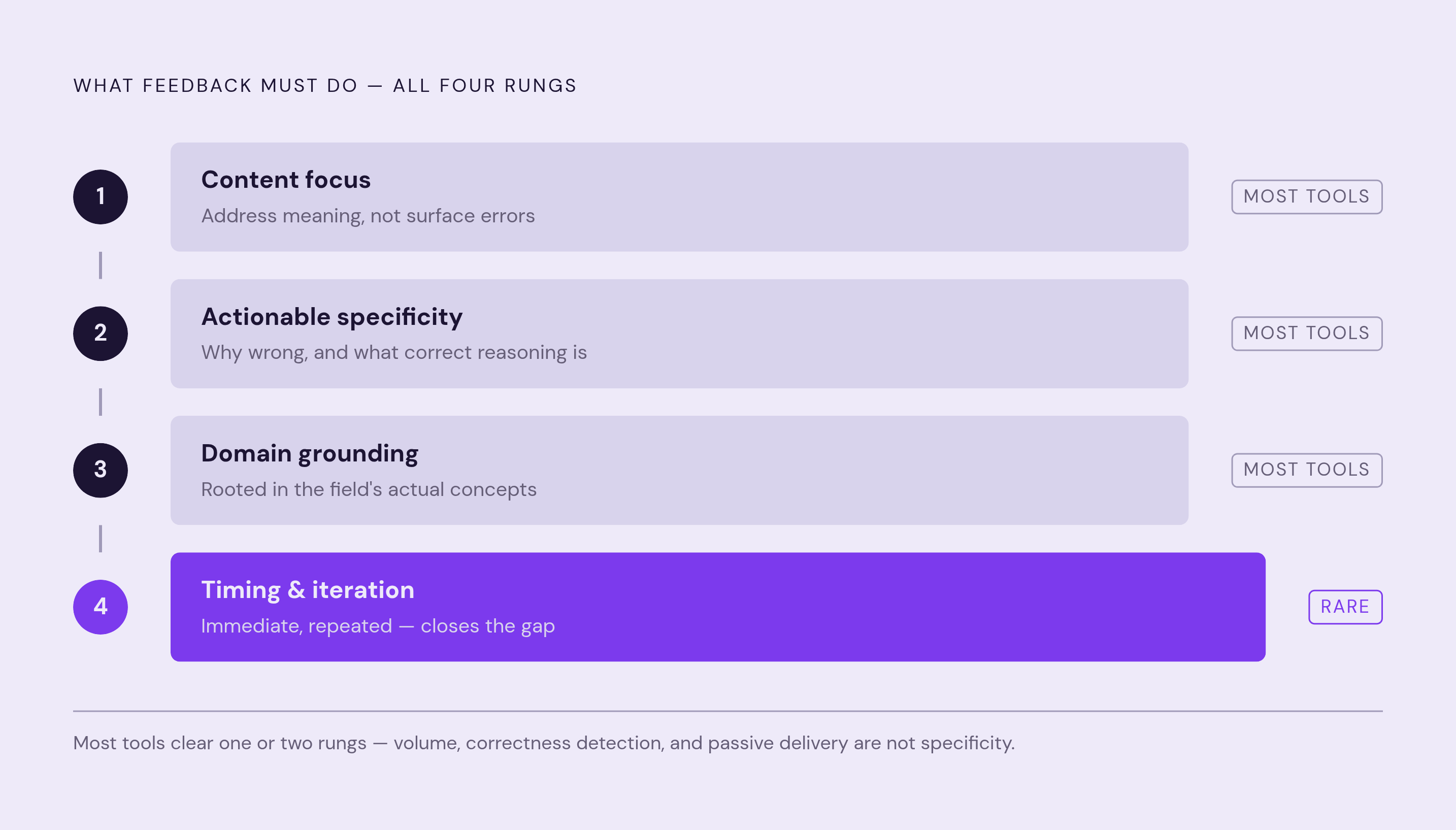
Pulling all of this together, the research converges on four requirements for feedback that actually closes a gap.
First, content focus over form focus. Yang and Schunn's finding holds regardless of how much feedback gets written: form-heavy comments produce weak transfer, no matter the length. Second, actionable specificity. The feedback has to explain why an answer was wrong and what correct reasoning actually looks like. Third, domain grounding. Fourth, timing and iteration. The LAK 2026 finding tied AI feedback's edge in perceived clarity and motivation directly to its availability; delays that students tolerate from a human teacher become real friction the moment an AI could have responded immediately instead.
Most tools on the market still fall short of all four at once Lee, Bralin, Rebello, and Goldwasser (2026) / BEA 2026 Purdue University. Some optimize for volume, more problems to grind through. Plenty optimize for correctness detection, a simple right or wrong. Plenty optimize for content delivery, explanations a student reads passively and probably skims. None of those three things is the same as specificity, and mixing them up is exactly how a program ends up feeling productive while producing very little actual gap closure.
There are signs the field knows this and is building toward something better. The ALIGNAgent framework, a 2026 preprint, describes adaptive learner intelligence for gap identification and next-step guidance, drawing on knowledge tracing research from Shen et al. (2024) as infrastructure for gap-identification pipelines. That's a signal the field is moving toward continuous, model-based tracking of what a student understands, instead of one-off scoring that resets after every assignment.
Khanmigo, from Khan Academy, offers one working example of a specificity mechanism at the concept-tracking level: it guides students through Socratic questioning instead of handing over direct answers, and integrates with Khan Academy's mastery system to know which concepts a given student has and hasn't mastered. Gaps between strategy and actual practice still remain in tools like this, which is a fair thing to note rather than gloss over.
The design logic the research keeps pointing toward is one where AI grading learns not just what a student got wrong, but what they actually understand, building a real map of where their thinking breaks down. That's the gap-identification pipeline the research describes, and it's a meaningfully higher bar than most tools clear today.
Even the strongest systems out there haven't fully cleared it. The FeedType benchmark, from September 2026, is still actively testing whether AI can adapt its feedback across different draft stages and different student performance levels the way an expert human instructor instinctively does. That's an open question. Which is, in its own way, the most honest place to land on this: specificity is the ingredient that makes feedback work, the research on that point is about as settled as education research gets, but building systems that reliably deliver it, at scale, to every student who needs it, is still very much a work in progress. The Purdue JiT framework shows that LLMs grounded in expert knowledge outperform generic models, demonstrating that domain grounding and domain structure matter as much as the model's fluency.
Sources
- Closing the Feedback Gap: Why Leadership Development Is Falling Short - HR Daily Advisor
- Towards Just-in-Time Adaptive Feedback: Enhancing Student Learning via Knowledge-Grounded LLM
- LLM-based Multimodal Feedback Produces Equivalent Learning and Better Student Perceptions than Educator Feedback
- ORIGINAL RESEARCH Instructional Science (2026) 54:59
- Feedback complexities interact with prior knowledge - ScienceDirect
- Investigating the impact of immediate vs. delayed feedback timing on motivation and language learning outcomes in online education: Perspectives from Feedback Intervention Theory - ScienceDirect
- Artificial Intelligence Driven Grading and Personalised Feedback in Higher Education Assessment | Research Square
- A systematic review on the future of educational assessment: AI-driven grading and personalised feedback in higher education | Artificial Intelligence in Education | Emerald Publishing