AI Grading Accuracy for AP Free-Response Questions
Rubric quality matters more than the AI model when grading AP free-response questions.

Every AP exam has two halves en.wikipedia.org How Well Do AI Systems Solve AP Physics? fiveable.me. Multiple-choice gets scored by a machine, instantly, no drama. Free-response is a different animal entirely. Those questions get read, one at a time, by an actual human being trained on a rubric.
That human effort is bigger than most people realize. More than 31,000 high school and college teachers show up every June for the AP Reading, spread across four cities plus a remote contingent, grinding through the work over several weeks en.wikipedia.org Best AI Grading Tools for Teachers (2026) | Fiveable. Between them, they score more than 20 million student responses, essays and problems and even artwork, all measured against detailed College Board rubrics en.wikipedia.org. The 2025 Reading was the biggest one yet en.wikipedia.org.
20 million responses is a scale that demands attention, not a rounding error en.wikipedia.org. It's the reason AI grading tools exist in the first place. And the system is already mid-shift on another front, too.
The human grading baseline isn't as steady as it sounds. Research on operational essay scoring (Leckie & Baird, 2011) found raters drifting toward the middle of the scale and shifting in how harsh or lenient they were over time en.wikipedia.org. A separate study (Ling et al., 2014) found that graders working longer shifts got measurably less consistent than those on shorter ones en.wikipedia.org. Put those together and you get an uncomfortable but important fact: "human accuracy" isn't a fixed target sitting still, waiting to be matched. It moves: fatigue moves it, time of day moves it. Fatigue moves it. Time of day moves it.
Underneath all of it sits the rubric. Every scoring decision, human or machine, runs through that document. Rubric quality is the first variable to check before comparing any accuracy claim, full stop. Keep that in mind. It's going to come up again. As of May 2025, 28 of the 36 AP subjects had moved to the Bluebook digital testing platform, with 16 fully digital and 12 hybrid, the latter retaining paper for subjects involving graphic or symbolic notation en.wikipedia.org. FRQ types are not uniform, as Short Answer Questions (SAQs), Long Essay Questions (LEQs), and Document-Based Questions (DBQs) each demand different cognitive tasks from the grader, whether human or AI.
What AI grading accuracy figures actually measure
"Accuracy" sounds like one clean number. It isn't. A published accuracy figure could be measuring at least three different things, including whether AI scores and human scores look similar in aggregate even if individual scores diverge.
That third one is the sneaky one. Durham University research from March 2026 found exactly this: aggregate-level agreement between human and LLM grading can hide significant item-level discrepancies, with two graders able to arrive at similar class averages through very different paths en.wikipedia.org. So a tool can look accurate from a distance and be wrong constantly up close.
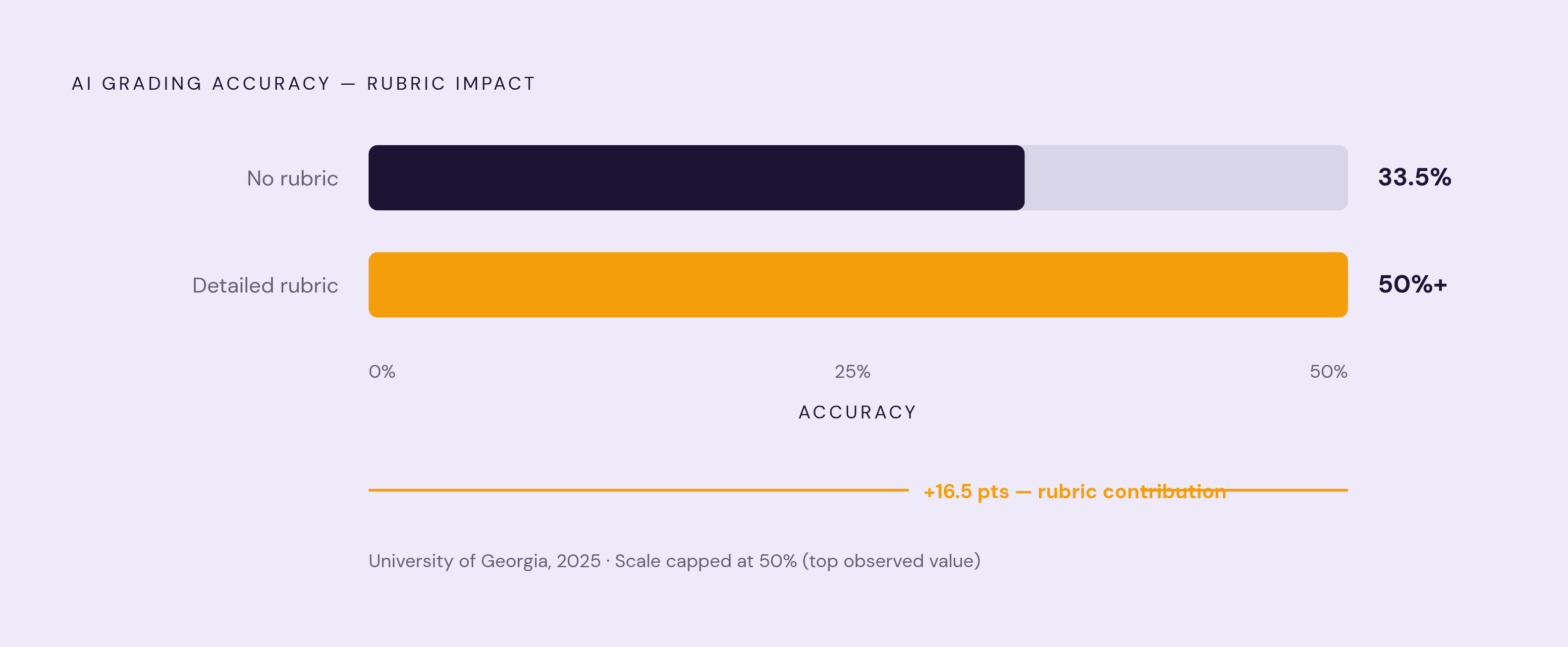
Then there's the rubric problem, which turns out to be foundational rather than a side note. A 2025 University of Georgia study found AI grading accuracy was just 33.5% when no rubric was provided, and jumped past 50% once a detailed rubric was in the mix en.wikipedia.org ask-maeve.com. That's before anyone even compares one AI model to another. The rubric alone is doing more work than the model.
And here's a twist that should make anyone pause: more detail in a rubric doesn't always help. Durham University's research found that more granular, partial-credit rubrics sometimes hurt AI scoring accuracy on physics explanations. More criteria just means more places for the model to slip up. One might expect the opposite, that spelling everything out in more detail would make scoring cleaner. It doesn't always work that way.
There's a useful byproduct buried in all this friction, though. An ACM SIGCSE 2026 study built on the PrairieLearn platform found that even experienced teachers struggle to write rubrics that are both specific and easy to interpret consistently en.wikipedia.org. When an AI grader disagrees with a human, that disagreement can actually flag where the rubric language itself is vague en.wikipedia.org. So the mismatch isn't only a failure. Sometimes it's a diagnostic.
Accuracy is partly about the model and partly about the rubric feeding it. Before trusting a headline accuracy number, ask what rubric conditions produced it.
What the research shows about AI scoring accuracy on physics FRQs specifically
Start with the topline number, because it's a decent one. A March 2026 study out of SUNY Farmingdale had four widely available AI systems score algebra-based AP Physics 1 and Physics 2 FRQs pulled from exams between 2015 and 2025, with three independent physics experts checking the work against the official College Board scoring guidelines en.wikipedia.org How Well Do AI Systems Solve AP Physics? fiveable.me. Mean scores landed between 82% and 92% en.wikipedia.org How Well Do AI Systems Solve AP Physics? fiveable.me.
That range sounds solid. But averages flatten out the interesting stuff. AP Physics 1 results bounced around a lot from year to year, and no single model consistently beat the others. AP Physics 2 told a clearer story: Gemini 2.5 Flash and DeepSeek R1 were more consistent performers than Claude 4.0 Sonnet, and the gap was statistically real, not noise.
Where do these models actually mess up? The same study logged the error patterns, and they're the kind of mistakes a first-year physics grader would recognize: misreading diagrams and graphs, drawing graphs wrong, getting vector direction backwards, misreading circuit layouts, and struggling with anything three-dimensional, the right-hand rule being the classic offender. Add in explanations that sound right but are only partly there, and you've got a pattern: these models are decent at the math and shaky at the visual and spatial reasoning that physics FRQs lean on constantly.
A separate Durham University study, also March 2026, put a psychometric lens on the same question, running models against 771 blind university physics exam questions en.wikipedia.org arxiv.org. The result: fractional mean absolute errors around 0.22, with a Spearman correlation above 0.6 en.wikipedia.org arxiv.org. Translation: the models can generally tell a strong answer from a weak one, but they're not precise enough to be trusted for tight, point-by-point scoring en.wikipedia.org arxiv.org. That's an important distinction. Being able to rank answers roughly correctly is not the same as being able to assign the exact right score.
There's a genuine improvement story here too, one that deserves acknowledgment rather than being glossed over. A May 2026 study on university-level physics found the newest model versions holding steadier, with less swing in performance en.wikipedia.org arxiv.org arxiv.org Best AI Grading Tools for Teachers (2026) | Fiveable. ChatGPT-o3 kept its standard error at 2.30% or lower across every physics topic tested en.wikipedia.org arxiv.org arxiv.org Best AI Grading Tools for Teachers (2026) | Fiveable. DeepSeek-V3 matched that overall but actually beat it in one specific area, Quantum Mechanics, where its standard error dropped to 0.64%, the lowest of any model in the group en.wikipedia.org arxiv.org arxiv.org Best AI Grading Tools for Teachers (2026) | Fiveable.
So what's the practical fix while spatial reasoning catches up? A research study found AI can achieve R² ≈ 0.91 when handling half the grading load, suggesting a human-AI split outperforms full AI grading alone en.wikipedia.org arxiv.org. Split the work rather than handing it all over. That's the model the research actually backs. Hybrid grading emerges as the practical implication of a 2025 Phys..
How accuracy shifts across AP subject types and FRQ formats
Subject matters, obviously. But format matters almost as much, and it's easy to overlook. Short Answer Questions tend to score well with AI graders, because the claims inside them are discrete and checkable, they either match the rubric or they don't. Long Essay Questions do fairly well too, since thesis and evidence criteria are structured enough to follow, though judging the actual quality of an argument or how well a student contextualizes it is a tougher ask for a model. Document-Based Questions are the hard case. Sourcing points and complexity points require the grader to reason about why a document exists, who it was written for, and what situation produced it, and that's a kind of judgment current models handle unevenly.
Why the split? STEM FRQs, think physics, chemistry, calculus, usually have one correct path to the answer, so rubric criteria map onto verifiable steps an AI can check, like algebra or unit conversions. Humanities FRQs don't work that way en.wikipedia.org How Well Do AI Systems Solve AP Physics? fiveable.me. A valid argument in history or English can take several different shapes, and a model trained to expect one canonical answer can wrongly penalize a student who reasoned their way to a correct but unusual conclusion. That's a known failure mode, not a hypothetical one. Subjective rubric language, "insightful analysis" being the classic example, makes this worse, since there's no clean checklist behind a word like "insightful".
There's also a basic technical hurdle that gets skipped in most marketing copy: a lot of AP FRQs come with document sets, graphs, images, or data tables attached. Not every AI grading tool can actually read those inputs. A tool that can't process the stimulus material is, functionally, only grading part of the question. Did the tool even see the graph the student was responding to?
EduSageAI's 2026 calibration work across history subjects found that tools accepting the exact College Board rubric descriptors, word for word, hit 85% to 92% agreement with human graders on individual criterion scores en.wikipedia.org edusageai.com. Rubric fidelity and subject fit together set the ceiling on how accurate any tool can get en.wikipedia.org edusageai.com.
Which leads to the real question readers should be asking. Not "is AI grading accurate," but "is this tool accurate on this FRQ type, in this subject". That's a much narrower, much more answerable question, and it's the one that published evidence actually needs to address. STEM FRQs and humanities FRQs require different evaluation standards.
What the available AI grading tools actually do
Not every tool that claims to grade AP FRQs is doing the same job. Broadly, there are two categories: tools built specifically for AP FRQ scoring by question type, and general essay graders or comment generators that offer AP rubric presets. Those are not equivalent products, even when they're priced similarly.
A generic chatbot used raw, the kind anyone can open and start typing into, is fine for brainstorming a revision or checking grammar. It's not built for rubric-aligned scoring, and it has no reliable way to determine whether a student actually earned a specific thesis point or correctly explained a data trend. That's a meaningful gap, not a minor one.
Among the purpose-built tools, the published evidence varies a lot in both quality and honesty about its limits. FRQuick ran a June 2026 benchmark against 141 human-graded essays and landed within one point of the human score 94.7% of the time, with a quadratic weighted kappa of 0.88 and a mean absolute error of 0.50, grading in about 30 seconds with no signup and no cost, covering AP Lang, Lit, US History, European History, and World History DBQ/LEQ essays en.wikipedia.org Best AI Grading Tools for Teachers (2026) | Fiveable. EssayGrader AI was named the top overall AI grading tool in an April 2026 independent review of seven tools, and reports being used by more than 100,000 teachers across over 1,000 schools, though its self-reported "less than 4% variance" claim comes with no subject-by-subject breakdown en.wikipedia.org Best AI Grading Tools for Teachers (2026) | Fiveable. GradeWithAI builds in automatic rubric selection by course, line-level feedback that cites specific parts of an essay, support for both handwritten scans and typed work, and a FERPA-aligned policy against training on student data, covering AP Lang, Lit, APUSH, AP World DBQs and LEQs, AP Seminar, and AP Physics FRQs, though it has no published scoring evidence en.wikipedia.org. EduSageAI's teacher-input rubric approach reports 85% to 92% agreement with human scores on individual criteria for AP history subjects, though that figure hasn't been checked by an outside party edusageai.com. CoGrader positions itself around formative feedback before a final grade lands, covering AP Lang, Lit, and History formats, with no published scoring evidence yet en.wikipedia.org fiveable.me.
Two more differ significantly in how they're built en.wikipedia.org. One AP-focused study tool, Passionfruit, leans on unlimited high-quality practice problems paired with AI-powered grading designed not just to score responses but to identify where a student's reasoning breaks down, the gap between getting a point wrong and understanding why, which matters for anyone who wants grading tied to a learning diagnosis rather than just a score. And Gradescope, built by Turnitin, isn't an automated scorer at all in the way the others are: a human assigns every point, and the AI's job is just to cluster similar answers together so grading goes faster, with no published AP-specific accuracy data.
The question to ask before trusting any of these is whether the published evidence is broken out by subject and FRQ type, or whether it's just one aggregate number sitting on a marketing page. An aggregate figure tells you very little about how the tool handles the specific subject in front of you. Fiveable covers 37 AP subjects with subject-specific scoring workflows, is benchmarked against 7,800+ official College Board released exam samples, publishes a classroom quality signal showing that 96.2% of AP FRQ responses teachers reviewed one at a time kept Fiveable's score exactly as given, reflecting teachers' real-classroom decisions rather than an independent accuracy study or College Board comparison, was founded by a former AP teacher in 2018, and as of August 2026 prices its service with the first three assignments free, then $29/mo en.wikipedia.org Best AI Grading Tools for Teachers (2026) | Fiveable Best AI Grading Tools for Teachers (2026) | Fiveable. FRQ Atlas is free with no paid plans as of August 2026, covers AP Physics 1, Physics 2, Physics C: Mechanics, and Physics C: E&M, is built for students practicing released FRQs, and has no published scoring evidence en.wikipedia.org.
Why teacher oversight is a functional requirement, not an optional safeguard
None of this works as a fully automated system, and the industry reporting on this is blunt about it: consequential grading decisions need a teacher who can monitor and override what the AI produces. That's not a nice-to-have bolted on for optics. State-level guidance on AI grading has gotten specific enough on this point that it functions as a requirement.
One workflow example shows how this gets built into the process rather than left as a policy line nobody reads: AI scores an entire class set point by point, shows its reasoning for every criterion it applied, and nothing goes to a student until a teacher has actually reviewed and signed off. That's the difference between oversight as a rule on paper and oversight as a step the software physically requires.
Most school AI grading policies boil down to four moving parts, including whether AI feedback may reach students directly or only after teacher review.
The time savings here are real. Grading one Long Essay Question properly, working through the full College Board rubric, takes 15 to 20 minutes en.wikipedia.org Best AI Grading Tools for Teachers (2026) | Fiveable. Multiply that by 30 students and a teacher has lost an entire evening to a single assignment en.wikipedia.org Best AI Grading Tools for Teachers (2026) | Fiveable. Tools in this space claim to cut a full class set down to under 10 minutes, and one vendor reports teachers saving 5 to 6 hours a week en.wikipedia.org Best AI Grading Tools for Teachers (2026) | Fiveable. It's a teacher getting an evening back. That's a teacher getting an evening back.
But speed without a check on accuracy just creates a faster version of the same problem: students calibrating their entire study plan around a score that might be wrong. So certain situations call for a human to step in no matter which tool is running: nonstandard correct answers the AI may penalize for not matching expected response patterns, and any FRQ that required interpreting an image, graph, or document set that the tool may not have processed. Whether it trains its models on student submissions is worth checking before adopting any tool. Some tools explicitly rule that out, a feature that should be checked rather than assumed by default.
How students should use AI grading scores without over-trusting them
Treat it as a strong estimate, not a verdict. The research says these tools are genuinely useful for catching the obvious stuff, a missing thesis statement, a skipped step in a physics derivation, a citation point left on the table. That's real value, and it's fast.
The same research shows where the shakiness lives: DBQ sourcing, spatial and visual reasoning in physics, humanities arguments that don't follow the expected shape, and any rubric written in fuzzy language en.wikipedia.org fiveable.me. If a practice score comes back low on exactly one of those fronts, that's the moment to pause and ask a teacher, rather than accepting the number and moving on. And if a tool won't say how it was tested, or only offers one aggregate accuracy figure with nothing broken out by subject, that silence is itself useful information. It means the score in front of a student is an estimate built on a smaller foundation than it looks like from the outside.
Sources
- AI-Supported Grading and Rubric Refinement for Free Response Questions | Proceedings of the 57th ACM Technical Symposium on Computer Science Education V.1
- How Well Do AI Systems Solve AP Physics? A Comparative Evaluation of Large Language Models on Algebra-Based Free Response Questions
- AP Psychology - Wikipedia
- edusageai.com
- tandfonline.com