Feedback Frequency Effects on AP Exam Performance
Frequent feedback on specific rubric criteria matters far more than practice volume alone.
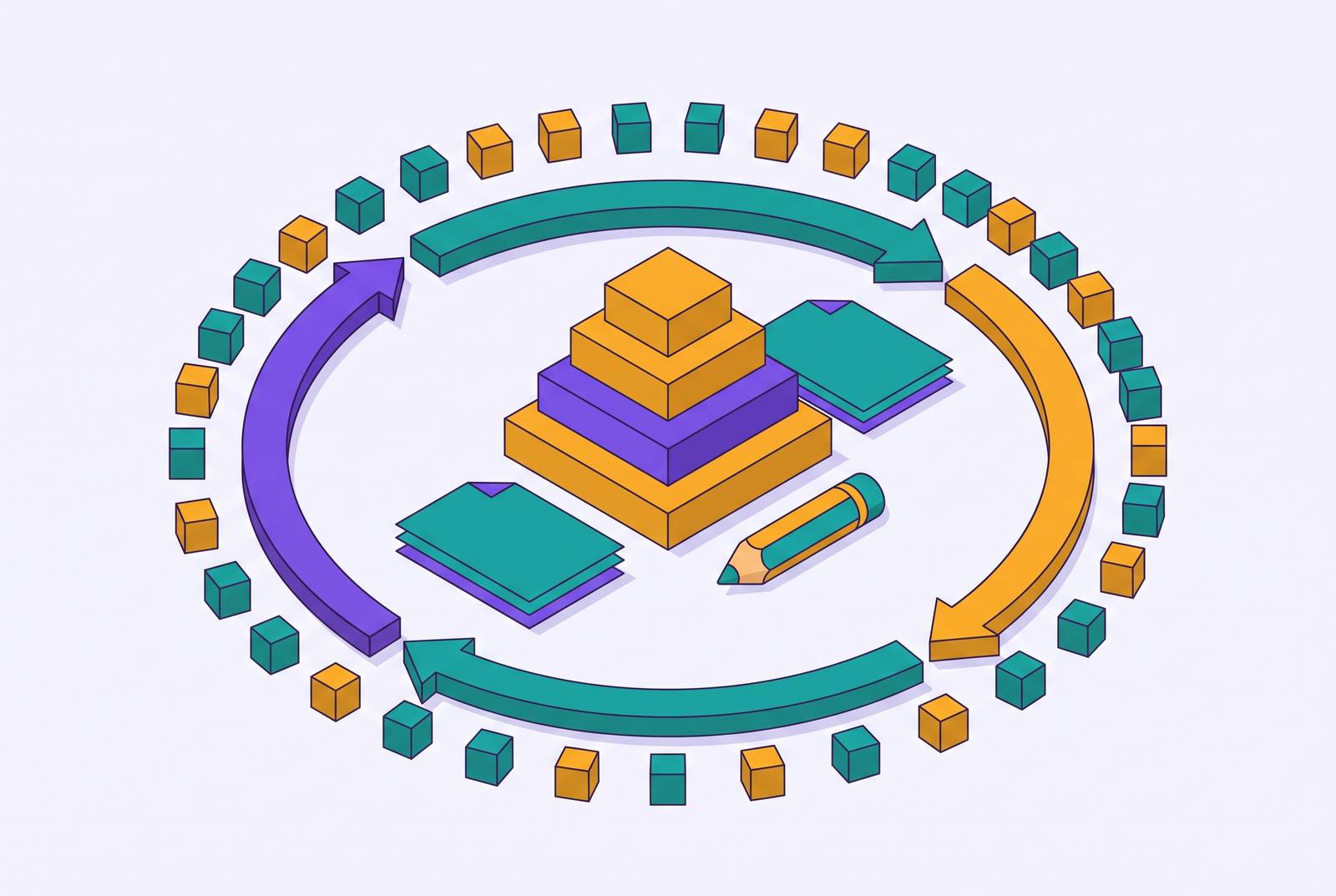
Two students prep for the same AP exam. The other does half that volume but gets specific, rubric-based feedback after almost every attempt: what the argument was missing, where the evidence was thin, what the grader actually wanted to see. Ask which student walks into the exam room better prepared, and the honest answer has less to do with hours logged and more to do with how often each one learned something actionable about their own thinking.
That is the core claim here. How often a student gets targeted feedback while prepping affects mastery more than how many problems they've plowed through. It is a simple idea, but it cuts against the instinct most students (and plenty of teachers) default to: more reps equals more mastery. More reps without correction just means more reps of whatever you were already doing, right or wrong. The rest of this piece unpacks why that's true, what breaks when the feedback loop is too slow, and what a schedule built around fast correction actually looks like.
Formative feedback and the self-regulation skills AP exams demand
Why does feedback frequency matter so much more than volume? Because feedback does something practice alone cannot: it tells a student where their thinking is breaking down, right when it's still fixable. Correction is the only thing that does that job.
Frequent feedback also builds a habit, not just a correction. Over time, a student who keeps getting pointed feedback starts to internalize the question themselves: "Is this actually right? What am I missing here?" That's the self-regulation skill that separates a student who can catch their own errors from one who needs someone else to catch them first. And a multi-hour AP exam, where nobody is checking your work mid-test, is precisely the environment that rewards a student who can do that checking on their own.
This isn't just intuition. A 2025 study in the Journal of Computer Assisted Learning (Bulut and colleagues) tested this directly in higher education, looking at whether the frequency and stakes of online formative assessments shape student achievement. The hypothesis was straightforward: frequency shapes how much real test preparation and feedback a student ends up getting, and that in turn shapes outcomes. The same mechanism appears in a controlled setting.
The effects of a slow, infrequent, or late feedback loop
So what happens when that loop breaks down? Slow feedback actively works against the student. It's not just "less good" than fast feedback; it actively works against the student, because every practice session between the mistake and the correction reinforces the mistake a little more. A misunderstanding that gets forty repetitions before anyone flags it doesn't stay a small misunderstanding. It calcifies.
Look at the AP program's own scoring apparatus. The annual AP Reading is, by any reasonable measure, the gold standard for how free-response questions get scored: tens of thousands of educators, tens of millions of student responses, rubrics applied with real rigor. Nobody's questioning the quality of that process. But it reports results months after students sit the exam. For the student who needs to know, right now, whether their argument actually addressed the rubric's second point, a scoring system that answers months later is a postmortem. It's a postmortem.
The best feedback system in the entire AP ecosystem is also one of the slowest. Which means the quality of feedback a student gets while it can still change their trajectory has to come from somewhere else, earlier and faster.
College Board's 2025 removal of older FRQs and the feedback burden it shifted onto teachers and tools
The gap just described used to have a workaround, and it closed in the summer of 2025. College Board pulled public access to most older AP free-response questions, leaving only the three most recent years available on AP Central for anyone studying on their own. More questions live inside AP Classroom, but that access is gated to verified teachers, not to students prepping independently.
Before that change, a motivated student had a real, if unglamorous, feedback loop available for free: pull a decade of past FRQs, work through them, check answers against the official scoring explanations, repeat. It wasn't fast, but it was self-directed, high-frequency, and it cost nothing. That option is now structurally narrower than it used to be.
What fills the gap? Solo archival study, the old fallback, isn't the wide-open option it used to be. And that shift raises the stakes on whatever replaces it. A tool that gives vague or wrong feedback actively misleads a student in place of the old FRQ archive. It's worse than nothing, because it teaches a student to calibrate against the wrong standard.
The evidence on AI-supported feedback as a high-frequency alternative
That's the opening AI feedback tools are trying to fill, and there's now real evidence behind the idea, not just marketing copy. A meta-analysis in Computers & Education, led by Wang and colleagues, found that AI-supported personalized feedback produces a moderate effect on learning outcomes and a notably strong effect on motivation. As of now, it's the strongest peer-reviewed, quantified evidence on the table for this question.
Why would AI feedback move the needle on motivation especially hard? Probably because of what it does to the timing described earlier. AI can respond the moment a student submits an answer, shrinking the gap between practice and correction from days or weeks down to seconds. That's the mechanism that makes real frequency possible at scale. No teacher, however dedicated, can turn around individualized feedback on every submission from every student within seconds. A model can.
But "AI feedback" isn't one uniform thing, and that matters. Research out of Purdue (Sirnoorkar and Rebello, posted to arXiv) looked at introductory physics students and found they strongly preferred feedback generated from carefully engineered prompts over generic AI output, identifying twelve distinct features that separated useful feedback from filler, spanning evaluation, content, presentation, and depth. In plain terms: how the AI is prompted changes what a student actually gets back. Quality isn't automatic.
That nuance matters even more for AP specifically. Take AP Biology's free-response section: question types like Interpreting Experimental Results, Scientific Investigation, Conceptual Analysis, and Analyze Data each carry their own skill demands and their own rubric logic. Feedback that isn't tied to the specific criteria a grader is scoring against, feedback that's just "nice try" or "needs work," doesn't do the job no matter how fast it arrives.
There's a useful precedent for what happens when personalized, diagnostic-driven feedback gets paired with real practice volume. In SAT prep, a well-known account-linking feature once let students automatically surface their weak areas and get matched to targeted practice, before that specific integration was discontinued in December 2023 when the Digital SAT launched. The data behind that older system, from 2017, found that a moderate amount of personalized practice correlated with a substantial average score gain. That's an SAT finding, not an AP one, and it shouldn't be stretched further than that. But it illustrates the general principle well: feedback that's personalized, frequent, and tied to an actual diagnosis of weak spots outperforms generic practice, even at moderate volume.
The reliability problem with AI feedback requires teacher-in-the-loop grading
The case for high-frequency AI feedback depends on reliability the technology does not yet guarantee on its own, which is why the most defensible model pairs AI speed with human review, not AI autonomy. A systematic review of AI grading systems flagged a familiar list of problems: inaccurate content, hallucinated details, gaps in subject knowledge, citations that don't hold up. Those are documented patterns in the research literature. They're documented patterns in the research literature.
Real-world usage backs that up. A large majority of teachers who use AI-generated rubrics report editing them before use, rather than accepting them as-is. That's a meaningful signal: the "plug it in and walk away" version of AI grading doesn't match how it's actually being used by the people responsible for the grade. LLM-based scoring approaches typically focus on a single domain and dataset, leaving generalizability largely unevaluated (an AI tool validated on one AP subject may not perform equally on another).
So what's the workable model? Not AI autonomy, but AI plus a human in the loop. Let the AI produce a fast first-pass draft of feedback, then have a teacher review it before anything gets recorded as a grade. As of now, that's the defensible standard: no AI tool should be the final word on a high-stakes mark. On the student side of that same principle, Passionfruit takes an approach built around AI-powered grading anchored to rubrics, designed to identify where thinking breaks down rather than just marking answers right or wrong, with the explicit aim of flagging knowledge gaps before they compound, not replacing the judgment of teachers who know their students. The goal is to keep a person's judgment in the loop rather than hand a machine the final say. It's to make the correction cycle faster while keeping a person's judgment in the loop where it counts.
Rising AP scores since 2021 do not settle the question of whether feedback is working
AP scores have gone up since 2021, so isn't the current system, feedback gaps and all, clearly working fine? That reasoning has a problem, and it's the most tempting counterargument in the whole piece.
Much of that rise traces back to a change in how the exams are scored. Starting in recent years, a new scoring system called Evidence-Based Standard Setting, or EBSS, replaced the older expert-panel method for nine of the most commonly taken AP exams: English Language and Composition, U.S. History, English Literature and Composition, World History, U.S. Government and Politics, Psychology, Biology, Human Geography, and Chemistry. Under that new system, the share of students earning a 5 on those nine exams rose meaningfully between 2021 and 2025. That jump did not occur on the less commonly taken exams still scored the old way, where distributions held steady over the same period.
That's a strange pattern if the story were simply "students are learning more." Independent measures of student achievement don't back up a broad knowledge gain either. NAEP scores in 8th-grade math and reading were already sliding before Covid; science scores held roughly steady pre-Covid before dropping afterward and dropping further since. PISA results for 15-year-olds in the U.S. show stagnation or decline over the same stretch. None of that lines up with the idea of a real, broad-based leap in what students know.
To be fair, this isn't a settled argument. College Board's Trevor Packer has pushed back directly, calling the "dumbed down" characterization "entirely false" and attributing the score changes to a more accurate, evidence-based scoring method rather than lowered standards. That disagreement is genuinely live and on the record, and this piece isn't the place to adjudicate it.
What matters for the argument here is simpler: if the score itself might be a confounded signal, shaped partly by scoring methodology and not purely by mastery, then a student who treats their AP score as the main feedback they need is relying on a number that may not tell them much about where their actual gaps are. That's the strongest argument for frequent feedback. It's the strongest argument for it. When the scoreboard gets noisy, the only reliable signal left is the one that comes from checking the work itself, early and often, against the rubric that actually matters.
A high-frequency feedback practice across a realistic AP prep timeline
So what does actually building this into a study schedule look like, in practice, rather than in theory?
Start with the timing rule: feedback needs to land before the next practice session, not after the next unit test. For FRQ practice specifically, now constrained by the removal of most older past questions from public access, the three most recent years' past FRQs available on AP Central are the highest-quality anchors, and AP Classroom provides additional questions for teachers to assign. The gap between the mistake and the fix has to be short enough that the fix is still useful.
On raw materials, work with what's actually available now. The three most recent years of released FRQs on AP Central are the strongest anchor points for self-study, since they're official, rubric-scored, and freely accessible. AP Classroom gives teachers a wider set of questions to assign, extending that pool for students working with an instructor.
Take AP Biology as a working example of why generic feedback falls short. Its free-response section spans six distinct question types (Interpreting and Evaluating Experimental Results, that same skill with graphing added, Scientific Investigation, Conceptual Analysis, Analyze Model or Visual Representation, and Analyze Data) layered against six core science practices, each scored on its own logic. A comment like "good job" or "try again" doesn't tell a student which of those six practices they're actually weak on. Feedback has to be specific to the criterion being tested, or it isn't really feedback at all, just a grade with extra steps.
There's a classroom-level payoff here too. Teachers using AI grading tools report getting meaningful time back each week, according to a Gallup study. What matters is where that recovered time goes: toward spotting patterns across a whole class and adjusting instruction accordingly, which is itself a form of feedback, just aimed at the group instead of the individual.
Short, frequent, low-stakes, rubric-anchored feedback builds the map of what a student actually knows, and that map is what makes the high-stakes exam day survivable. The AP exam was never supposed to be the place where a student finds out what they don't know. It's supposed to be the place where they prove the gaps are already closed. Passionfruit is built around unlimited practice with AI-powered, rubric-anchored grading designed to reveal where thinking actually breaks down, so students and teachers have a continuously updated map of what is understood and what needs work (not a score to chase, but a gap to close).
Which leaves the real question for any student reading this: not "how many more practice sets should I do," but "how fast is my feedback loop actually running right now?" Volume was never the variable that mattered most. Speed of correction was.
Sources
- Feedback That Clicks: Introductory Physics Students' Valued Features in AI Feedback Generated From Self-Crafted and Engineered Prompts
- Admissions Officers Beware: Some Advanced Placement Scores Are Inflated - Education Next
- The Effectiveness of AI-Supported Personalized Feedback on Students’ Learning Outcomes and Motivation: A Meta-Analysis - Wenxuan Wang, Yiting Wang, Jiahua Chen, Xudong Wang, Hui Zhang, Chunli Guo, Yan Peng, 2026
- The impact of frequency and stakes of formative assessment on student achievement in higher education: A learning analytics study - Bulut - 2025 - Journal of Computer Assisted Learning - Wiley Online Library
- AP FRQs Removed in 2026? How to Prep for AP Free Response Questions Effectively
- Implementation Considerations for Automated AI Grading of Student Work