Format Familiarity and Perceived AP Exam Difficulty
Format familiarity reduces cognitive load and helps students show what they know on test day.
AP exam difficulty is partly a test of knowledge and partly a test of knowing how the test works. Format familiarity cannot replace subject mastery, but it can keep unfamiliar question types, timing demands, and digital tools from getting in the way of it. Treating that familiarity as a learnable skill changes both preparation and the experience of exam day.
Why AP exam difficulty is not a fixed property of the subject
Picture a student who has studied hard, opens the exam, and freezes because the task looks nothing like the practice. The student recognizes the material but is unfamiliar with how they are being asked to use it. Before answering, the student must work out what to produce and how much time to spend producing it. That extra work feels like not knowing the subject, even when the problem is partly not knowing the exam.
The mechanism is cognitive load, which is the demand placed on the student's available mental bandwidth. Attention spent decoding question types, pacing rules, and interface requirements is attention unavailable for reasoning. Tasks students have not seen before can also make them more anxious than ones they know, making it harder to show what they know. Two students who know the subject equally well can thus find the same exam very different. The subject has not changed, but one student is solving the problem while the other is also trying to find the instruction manual.
What the 2025 digital shift added to the format-familiarity problem
Beginning with the May 2025 administration, many AP exams moved to fully digital or hybrid digital formats. There are now 16 fully digital exams taken through Bluebook and 12 hybrid exams with digital multiple-choice and handwritten free-response in paper booklets. Math, science, and economics subjects use the hybrid format, while world language exams continue to use digital audio components. Preparation must therefore account for both how an answer is produced and what belongs in it.
Bluebook's on-screen annotation uses a special highlighter and note tool. Students who have not practiced with those tools must learn their behavior while also working through the exam. For AP Calculus and AP Physics, moving from a digital prompt to a handwritten response adds a transition cost of its own. Timing, typing stamina, and device familiarity become performance variables that content review alone cannot develop.
Students' perceptions of digital requirements improve with experience, and initial concerns about fairness and technical problems can diminish as the system becomes familiar. Time to prepare for 2026 runs out when exams begin on May 4–8 and May 11–15, 2026. Those dates give format rehearsal a deadline rather than leaving it as something to squeeze in after studying.
How pass-rate variance across AP exams reflects format exposure, not only content
The 2025 AP results show wide differences in pass rates, with AP Latin at the low end and AP Chinese Language and Culture at the high end. Those differences do not isolate the effect of format. Fluent Mandarin speakers dominate AP Chinese enrollment, so student self-selection accounts for some of the gap. AP Latin also moved to fully digital Bluebook delivery, so students working on a hard classical language had to learn how to use a new interface too. Its result cannot separate those demands from the difficulty of the content.
AP English Literature shows how the exam shapes practice without the need to rank subjects by how easy they seem. Section I has 55 timed multiple-choice questions and counts for less than half of the score. Section II has 3 free-response essays, allows more time, and counts for more than half of the score. Strong reading and a command of literary terms do not, by themselves, prepare a student to deliver those essays under time pressure.
Students who overlook the essay-heavy weighting can devote too much practice to multiple-choice questions and too little to timed writing. Pass-rate comparisons suggest why format deserves attention, but direct research on familiarization offers a stronger test of what practice can accomplish.
What active format familiarization does to performance, compared to passive exposure
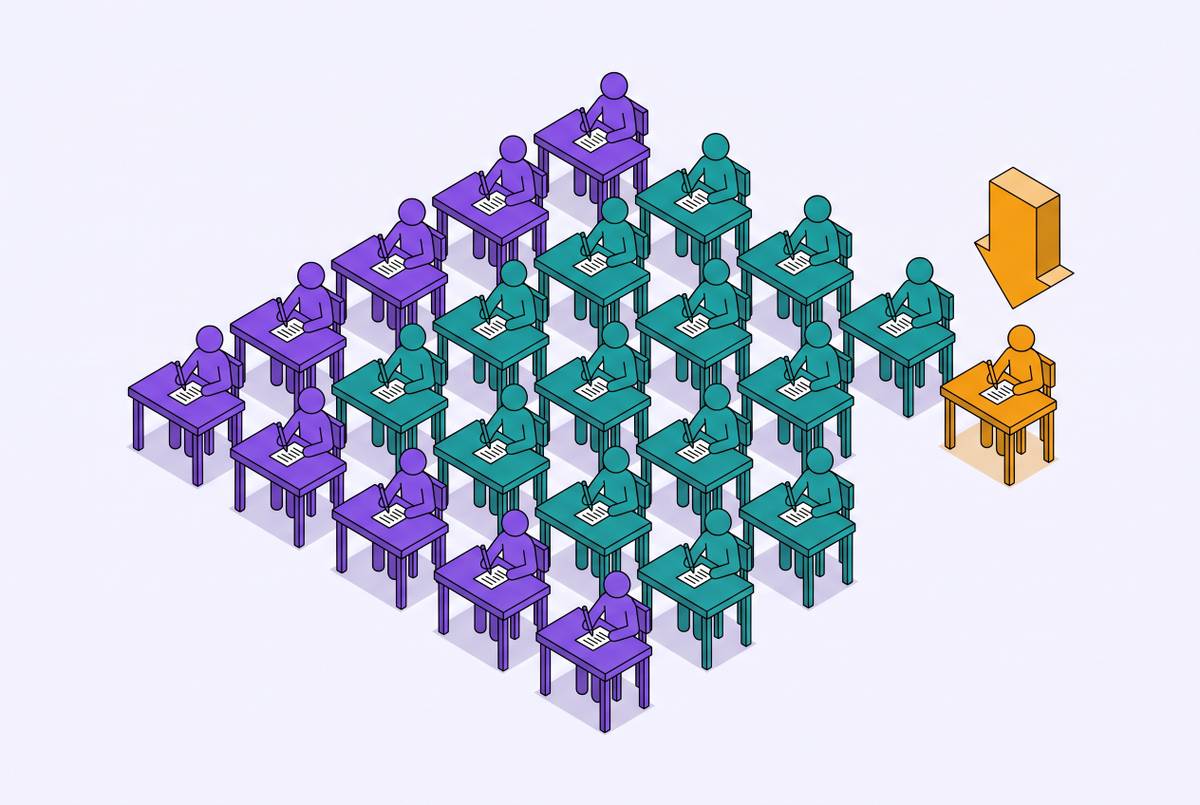
The four-year Innsbruck interventional study provides the argument's pivot. Students who actively familiarized themselves with an exam format significantly outperformed both a passive comparator group and a control group. The effect was large against the passive comparator, with Cohen's d = 0.857, and medium against the control group, with Cohen's d = 0.473. These are direct evidence that doing format practice differs meaningfully from merely encountering information about a format.
For AP preparation, active familiarization means trying full sections under time limits in the same setting students will use for the exam. It means writing free-response answers under exam conditions and using official rubrics to score them. For hybrid exams, it includes rehearsing the digital-to-handwritten transition, while Bluebook practice includes using its annotation tools. Reading a description of these tasks is useful orientation, but orientation is not rehearsal.
The study does not show how much familiarization works best, so it gives no basis for replacing every content lesson with a mock exam. Format practice competes with content review for time, and more is not automatically better. The recommended sequence is to finish core content by March, use April for practice exams, and reserve May for review. By then, students know enough of the subject for practice to show where they need help.
How format unfamiliarity and anxiety interact, and the limit of that relationship
The evidence does not show that familiarity always lowers anxiety or that less anxiety always leads to higher scores. A study of high-school students found no statistically significant link between how anxious they were about exams and how well they did. That matters because feeling distressed and performing poorly are not interchangeable outcomes. A student can feel calmer without scoring more points, and a student who knows the subject can do well even when anxious.
Format familiarity has at least two distinct routes to benefit. Reducing cognitive load leaves more attention available for the task, while reducing anxiety may help in ways whose effect on scores varies by student. Keeping those routes separate prevents a useful preparation method from turning into a promise of emotional or academic rescue.
AI-assisted practice introduces a related limit. With help, a student may learn to write answers that fit the rubric yet fail to remember the reasoning when that help is gone. Feedback should help students understand why an answer is wrong. Substantial content gaps still require content work, and time spent rehearsing format cannot also be spent reviewing the subject. Within those limits, format familiarity reduces cognitive load, improves pacing, and makes the exam more predictable.
Why free-response grading is where format practice most often breaks down for teachers
Those benefits depend on practice that is frequent, rubric-grounded, and specific to the student's response. That requirement creates a demanding job on the other side of the desk. A teacher with several sections, assigning four to six FRQs per unit, can accumulate well over a thousand rubric-scored responses by April. Every response needs more than a verdict if the student is to understand which part of the answer worked and which part failed.
The resulting workload pushes teachers to cut practice frequency in half by spring, just when sustained rehearsal becomes most valuable. Students then lose opportunities to connect an exam-condition attempt with meaningful individual feedback. Completing an answer still provides experience, but without that feedback, the student has less help interpreting what the experience revealed.
Effective preparation asks for repeated attempts and close attention to each one, while a single teacher has limited grading time. The bottleneck is therefore not simply access to more questions. It is the capacity to return useful feedback often enough that students can apply it to the next attempt.
AI grading tools that make high-frequency FRQ practice sustainable in AP classrooms
AI FRQ graders address that bottleneck by shortening the feedback cycle. Their practical value is that they make repeated rubric-based practice more manageable. With faster feedback, students can learn from an answer before the next unit begins. The relevant standard is whether the tool helps identify the missed reasoning or rubric requirement.
EduSageAI focuses on AP History writing and is reported to achieve strong alignment with human grader scores on LEQ rubrics. The complexity point remains the element that benefits most from human review. Help with routine scoring can leave teachers less to mark while keeping the harder judgment in their hands.
GradeWithAI offers a class-level dashboard that shifts attention from individual totals to shared patterns. Instead of seeing 90 separate scores, a teacher can see which rubric points students are missing across the class. That turns a pile of papers into a diagnosis of what needs explanation or further practice. At the individual level, the same feedback principle applies. AI-graded practice is most useful when it shows where a student's thinking broke down, connecting the returned score to the next piece of work.
How knowledge gap detection extends format familiarity into subject-level diagnosis
Once feedback identifies a recurring miss, the next task is to distinguish a content gap from a format gap. A student may know the subject but misunderstand what a question requires, or understand the required answer structure while lacking the knowledge to fill it. Both can produce an unsuccessful response, but they call for different preparation. A total score compresses those differences when the student needs to see them separately.
Research on personalized sequencing found better outcomes on written exams when the next problem depended on demonstrated understanding, compared with a fixed order. Those gains did not require more instruction time or teacher workload. Practice becomes diagnostic when it helps determine what to work on next.
Logs of student–AI interactions can help show what to work on next by tracking the errors students make, the reasoning they give, and the rubric elements they keep missing. In AP History writing, for example, students who struggle with an advanced rubric requirement may know the historical material yet be unsure what their answer needs to show. More content review would not directly resolve that misunderstanding. Conversely, a well-shaped answer can still expose a gap in the underlying subject. Effective preparation follows the evidence in the response instead of treating every lost point as the same problem.
Building a format-familiarity practice plan that works across different AP subjects
A useful plan begins with the demands of each exam. For fully digital exams, practice belongs in Bluebook, with its annotation tools and timed digital passages. For hybrid exams such as AP Calculus and AP Physics, students should practice the switch from digital to handwritten work.
Essay-heavy exams require a different emphasis. In AP English Literature and AP History, practice time should reflect free-response scoring weight, with timed writing followed by rubric scoring after every attempt. Class-level or AI-generated feedback can then reveal the specific rubric elements that keep going missing. The purpose is not to perfect a generic essay shape, but to understand what each response must accomplish.
The calendar gives these subject-specific choices a workable order. Working backward from the exam dates at the start of the school year, aim to complete core content by March. Spend more of April taking full-length practice exams under the same conditions and time limits as the exam, then use May to work on the question types and rubric points that caused trouble. This sequence balances knowledge, rehearsal, and correction rather than letting any one of them consume the whole preparation period.
The endpoint is an exam whose demands no longer compete with the student's reasoning for attention. The student who once froze at an unfamiliar task can recognize the structure, understand the timing, and begin with a plan. The challenge remains, but finding out how to face it is no longer part of the test.