Stereotype Threat and Underrepresented Students on the SAT
Anxiety about confirming stereotypes drains working memory students need to perform well.
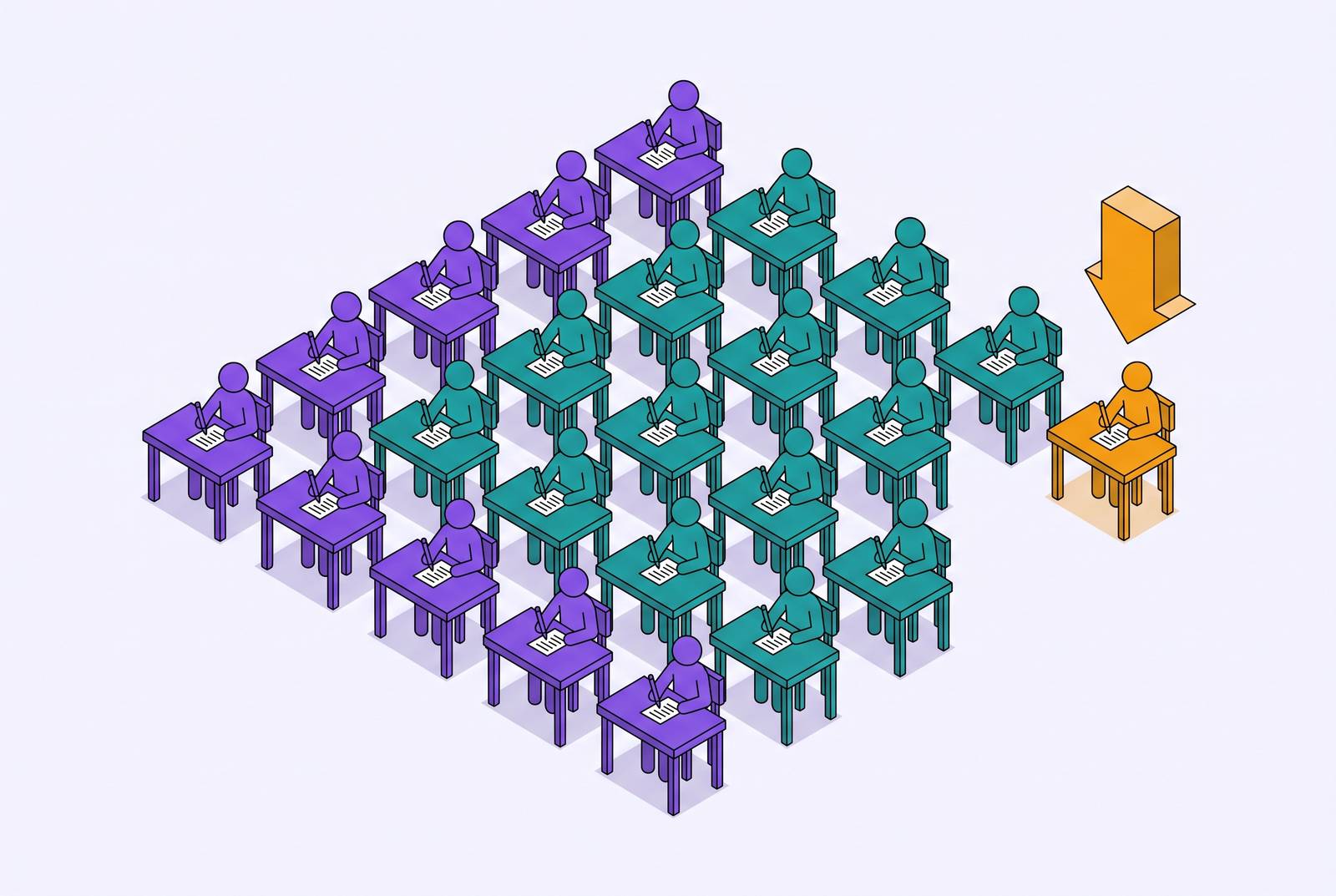
Stereotype threat can cost underrepresented students points on the SAT by using up working memory they need for the questions themselves. Understanding how it works points toward practical ways to reduce its grip, through better framing, self-regulation and preparation that finds gaps before test day does.
What stereotype threat actually is and what it is not
Steele and Aronson (1995) defined stereotype threat as “being at risk of confirming, as self-characteristic, a negative stereotype about one's group”. The key is the risk a student feels in the moment. A student may worry that a poor performance will seem to confirm a judgment about their group. That adds another task to the test. The student is now trying to answer questions while managing what their answers might appear to mean.
Isn’t that just ordinary test anxiety with a longer name? Not quite, because the worry has a particular social target. A student need not believe the stereotype for it to interfere with performance. The effect can also be strongest among skilled students who care deeply about doing well, because confirming the stereotype would threaten something they value.
The original study showed that making a stereotype salient could widen an existing Black–White performance gap. Scores still differed in the non-diagnostic condition before statistical adjustment for prior SAT scores. Nor does the concept describe a fixed kind of student. The same person can experience threat under one presentation of a task and not another, which makes the situation itself a possible point of intervention.
How stereotype threat consumes working memory during a test
Working memory holds the information a person is using as they work through a problem. The SAT’s demanding verbal and quantitative questions need that limited capacity for sustained attention and multi-step reasoning. Under stereotype threat, some of it goes elsewhere. Stress, monitoring performance and trying to suppress anxious thoughts compete with the work of answering the question. The mind has picked up an unwanted supervisor who keeps interrupting.
That competition explains why trying harder is not always enough. A student can want very much to do well while using up attention to check whether they are failing, worry about what failure means and try to push those thoughts away. None of that helps solve the problem. What feels like a sudden loss of ability may instead be less mental capacity available for using the ability already there. This is why the mechanism is more specific than “stress is bad”.
Holden, Goodwin, and Conway (2025) examined working memory capacity as a possible mediator or moderator of racial and ethnic stereotype threat across two experiments. Their study, first released as a preprint and later published in Memory & Cognition (2025), used GRE verbal and quantitative items, a close analog to the SAT. For Black students under race-related threat, higher trait working memory capacity was associated with higher scores. Capacity appeared to moderate the effect of threat. That finding suggests that some students withstand pressure better than others and gives a reason to protect cognitive resources as well as offer encouragement.
Which students carry this burden on the SAT, and why the pressure is unequal
Stereotype threat is most likely when a demanding task, a relevant and salient stereotype, and strong identification with both the group and the subject converge. The SAT can bring those conditions together. Presented as a measure of academic aptitude, it asks students to perform while the meaning of that performance may feel unusually large. For an invested student from an underrepresented minority group, the task can become more than solving the questions on the screen. It can feel like having to disprove a judgment that should never have been assigned to them.
Lewis (2019) describes how societal expectations and the personal and financial consequences of assessment differ, with students from underrepresented minorities and underserved schools especially vulnerable to stereotype threat and inherited math anxiety. Her work on math placement also shows how the language around a test can affect students. The questions are only part of the experience. An institution’s presentation of an assessment can prompt vigilance about stereotypes before the assessment begins. Placement testing is an institutional analog here.
Gender stereotypes about math ability create a parallel pressure, even for students who reject those stereotypes. First-generation and lower-income students may also arrive with demands from jobs, family responsibilities and constrained study time already drawing on their resources. Those pressures are not all stereotype threat. They can, however, leave less spare capacity for managing it when it arises. The unequal burden comes from the combination of test demands and surrounding conditions.
Why the science is genuinely contested and what that means for students
A 2022 pre-registered UK replication found no evidence of stereotype threat in mathematics testing. It also concluded that simply moving demographic questions on an answer sheet was unlikely to solve systemic gender inequalities in mathematics education. A tidy theory does not get a free pass.
The broader picture is an effect that appears smaller and more variable than early research suggested, with its strength depending on specific conditions. Holden and colleagues acknowledge replication problems and statistical power as active concerns, and call for more research on racial and ethnic stereotype threat. The science is developing, not finished. That leaves room neither for treating threat as the master explanation of demographic score gaps nor for treating every failed replication as proof that social pressure never disrupts cognition.
What does that uncertainty mean for one student? An average effect across a population does not decide whether a particular student is experiencing the combination of conditions described earlier. Equally, feeling anxious does not establish that stereotype threat is the cause. The useful response is proportionate to the evidence, taking the mechanism seriously without making it explain everything. Students do not need a settled estimate of its population-wide size before addressing anxious self-monitoring or an unhelpful interpretation of the test.
What the evidence shows actually reduces stereotype threat's grip
Steele and Aronson’s experiments showed that describing a difficult verbal test as non-diagnostic rather than diagnostic sharply reduced the performance gap. The questions had not become easier. Their meaning had changed, reducing the pressure attached to what performance supposedly revealed about the student. That finding supports reframing an SAT sitting as a problem-solving exercise involving trainable skills. It does not imply that a student can simply pretend a consequential test has no consequences.
Teaching students about stereotype threat can also ease the strain that comes from how they read their own anxiety. When students know that social pressure can use up attention, they have another way to explain difficulty besides taking it as proof that they lack ability. The distinction can interrupt a self-defeating explanation. Growth mindset training and self-affirmation exercises also have supporting evidence, although they should not be treated as interchangeable cures. Aronson, Fried, and Good (2002) found that a mindset intervention appreciably reduced a Black–White achievement gap relative to a control group at a selective, predominantly white university.
Positive role models work on the setting: exposure to people who share a student’s identity and have succeeded in the subject can make the negative stereotype less salient before testing begins. Lewis’s work points to another part of that setting, the language institutions use when they tell students about assessments. Supportive framing can reduce stereotype vigilance and math anxiety. With either approach, students can take the test without having to argue a stereotype out of existence while the clock runs.
Holden and colleagues describe mindfulness and self-regulation as candidate protective factors because there is evidence that these practices can improve working memory capacity and help students do better on standardized tests. The word “candidate” deserves to stay in view. Their finding about trait capacity does not by itself prove that training working memory removes stereotype threat on the SAT. Still, these approaches fit the proposed mechanism by targeting the resources that anxious monitoring consumes.
How preparation quality and personalization affect the psychological conditions for threat
Even students who prepare seriously can face stereotype threat, because those who care deeply about doing well can be especially vulnerable. What preparation can change is how accurately a student understands their own knowledge. Confidence needs something solid underneath it. Knowing which skills are secure and which still need work is different from being told that everything will be fine. That knowledge can reduce the surprise when a difficult question appears, without pretending that difficulty will disappear.
Hidden knowledge gaps are a separate problem, but they can interact with threat. A gap the student did not expect can feed the self-doubt that starts the monitoring spiral and draw attention away from the work still to do. Adaptive preparation targets that point of contact. Diagnosis asks where the student’s understanding broke down, rather than treating every wrong answer as the same event. The aim is to make the next difficulty more recognizable and less likely to be mistaken for evidence about fixed ability.
A 2026 study using Bayesian Knowledge Tracing reported that the gap between groups with high and low prior knowledge shrank by 77.1%. That is evidence about a preparation approach, with the measured gain confined to narrowing a prior-knowledge gap. The distinction keeps the result in its proper lane. Personalized practice can help with differences in what students already understand, while the psychological argument explains why having fewer gaps catch them by surprise may also help under pressure. Academic preparation and threat reduction can support each other without being the same intervention.
Underrepresented students unable to afford high-cost traditional prep are disproportionately likely to reach test day with undetected gaps, compounding cognitive and psychological disadvantage. Tools available at any hour can address more than convenience. AI-powered preparation can help students get the preparation they need when study time has to fit around other responsibilities. The useful design principle is diagnosis of where thinking breaks down, rather than a running tally of correct and incorrect answers.
What students and teachers can do starting now
For students, the practical response starts with learning the mechanism and choosing a more accurate frame for the SAT. Treat it as a problem-solving exercise built from known, trainable skills. Mindfulness and self-regulation practices offer ways to support the cognitive resources that pressure can drain, without a guarantee that anxiety will vanish. Preparation should also find misunderstandings before the test does. The goal is accurate self-knowledge, so that a difficult question signals a problem to work on.
For teachers, the parallel task is to shape the setting and the feedback students receive. Frame practice tests and mock SATs deliberately, using language that supports engagement. Then prioritize feedback quality over volume, naming where a student’s thinking breaks down instead of merely increasing the number of corrections. Specific feedback gives students a usable map. AI grading tools that provide consistent, rubric-grounded feedback can help increase its frequency for all students, including those most at risk, without proportionally increasing grading time.
A student who understands stereotype threat has an alternative explanation when anxiety intrudes, rather than automatically reading it as proof of fixed inability. That understanding is itself a first intervention.