Time Management Strategies During the SAT Under Test Conditions
Skipping a question strategically beats rushing through it when the module timer won't roll over.

Time management during the Digital SAT means using each module’s time where it does the most good, while protecting the accuracy that shapes what comes next. The useful plan is section-specific, deliberate, and rehearsed under test conditions. “Pace yourself” is a nice sentiment, but a sentiment is not much help when the clock is eating your Math module.
Why the Digital SAT's module structure makes generic time advice useless
On the Digital SAT, finishing early does not let you bank time for a later module. Each module has its own timer, and when that timer ends, the module locks. Unused seconds cannot move from the verbal section’s Module 1 into Module 2, or between the Math modules. Time saved in one block is available only within that block. The bank does not merely charge a fee. It closes your account.
That makes advice borrowed from older, fixed-format tests misleading when it depends on moving time between parts of the exam. The adaptive structure adds another reason to reject it. How well you do in Module 1 decides whether you get the harder or easier Module 2, which affects your scoring ceiling. Rushing the first module can therefore cost accuracy without buying any time for the next one. A useful pacing plan must respect both boundaries, namely where your time can go and what your answers decide.
What Module 1 of each section actually decides
Module 1 is a decision gate. Accuracy controls the route through that gate. A strong performance leads to the harder Module 2, with higher scoring potential, while a weaker performance leads to the easier variant and a lower ceiling. Even if you do well afterward, the routing decision stays the same.
The practical response is an accuracy-first pace in Module 1 of both sections. Keep paying attention even when a question looks easy, without lingering over every answer until it feels beyond doubt. Careless errors on material you know still affect the route, even if you know exactly how to solve the question.
Module 2 allows a more aggressive pace because the routing decision is behind you. How aggressive that pace should be depends on the difficulty you face. The distinction is between protecting the first module’s accuracy and managing the second module’s demands. Both call for deciding which questions deserve more of the time you actually have.
Reading and Writing pacing: how to use 71 seconds per question deliberately
The verbal section’s average of 71 seconds per question is a budget. Standard English Conventions questions often take well under a minute because grammar and punctuation can turn on a fixed rule. Craft and Structure questions require you to read a logical or rhetorical relationship, while Expression of Ideas questions also warrant more time.
As you work, take the quick points when you recognize the rule and can apply it cleanly. Then allow more room for questions that require closer reading. If a question resists a clear answer after a short interval, flag it and move on rather than letting uncertainty become an open-ended appointment. The review screen gives you a way back if the module timer allows.
On inference and evidence questions, keep your reasoning close to the passage. An answer that reaches beyond what is explicitly stated can draw you into second-guessing because you are now defending a claim the text does not support. Before moving on from an unresolved question, give it an answer, since there is no penalty for guessing and no question in the verbal section should remain blank. Use the “14 and 12” checkpoint to judge your progress, aiming to reach question 14 with 12 minutes on the countdown clock.
Math pacing: the three-pass system and the Desmos decision
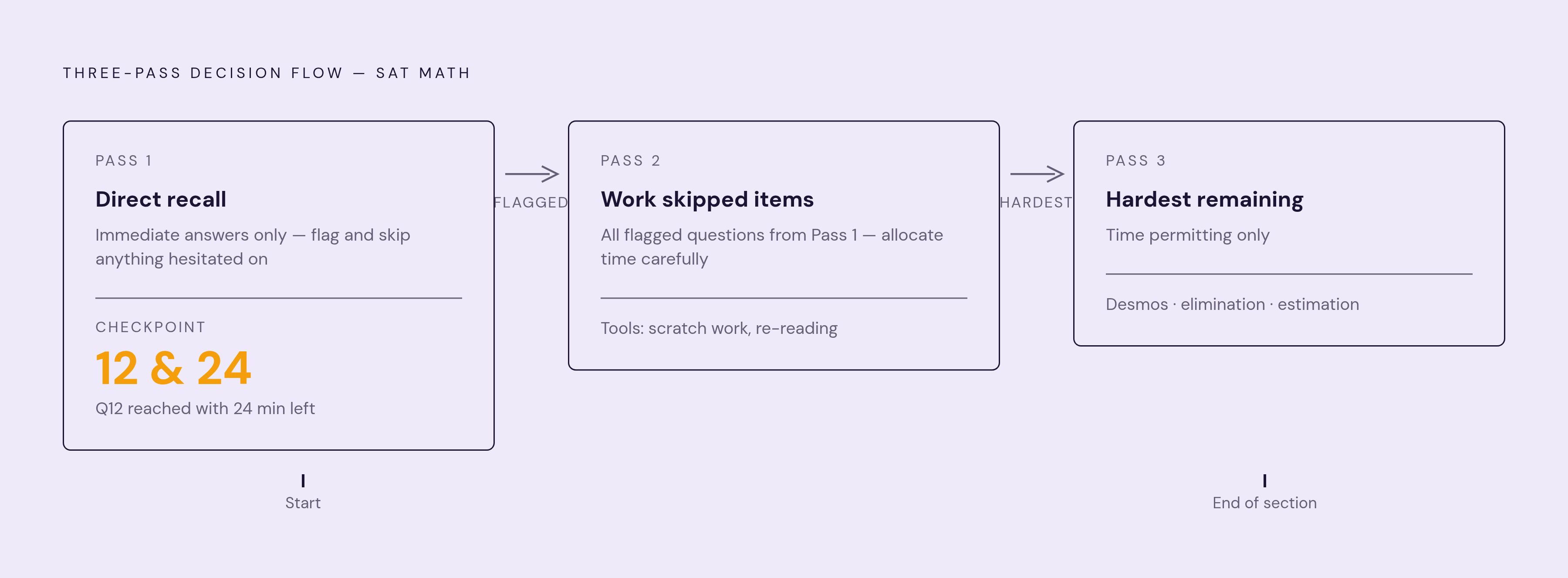
Math’s roughly 95 seconds per question can look generous until a hard question swallows the buffer. Harder questions later in the module make a straight read-through risky if you give each problem as long as it wants. The three-pass system separates questions that can be done quickly from those that need more time.
On the first pass, answer questions you recognize immediately and can solve through direct recall or a simple calculation. Move past questions that need more time, since some will take longer to solve. Work on those in the second pass, and leave the hardest flagged questions for the third pass. Return to those only with time left, using Desmos, elimination, or estimation where they help. As a checkpoint, use “12 and 24,” reaching question 12 with 24 minutes remaining, well over half the module time.
Desmos supports this system, but deciding to use it is itself a time decision. The calculator is built into Bluebook and free to use, yet opening a tool is not automatically faster than doing the calculation. Mental math and estimation are faster for basic algebra and simple calculations. Desmos earns its time cost on graphing, systems of equations, and complex calculations where manual work risks errors.
Keep Math Module 1 slightly more conservative than Module 2, especially on easy questions where a careless arithmetic error can damage routing. Every unanswered question should receive a response before time expires because there is no penalty for guessing. After the second pass, balance any attempt at the hardest flagged items against checking error-prone work rather than reopening answers you already felt confident about. Once those attempts are done, use the time left to check signs, units, and setup.
Where pacing actually breaks down: the three failure modes students repeat
The first failure mode is treating every question as though it deserves an equal claim on your time. Spending two or three minutes on a hard question before flagging it steals time from easier questions you could answer correctly. You can recognize this pattern when the rush begins after one stubborn problem receives far more attention than it earned.
The second failure mode is Module 1 complacency. Here, the student does not necessarily feel pressed for time at all. The module seems manageable, so attention loosens and familiar questions collect careless mistakes. Those mistakes can lead to an easier Module 2 with a lower scoring ceiling.
The third failure mode is practicing content without practicing timing. Untimed drills can build knowledge without training the decision to flag and move. Under test conditions, that decision must happen while you still want to solve the problem in front of you. Full-length timed practice is the rehearsal that builds this pacing reflex. If untimed accuracy is strong but timed modules repeatedly unravel, more content drills alone may be solving the wrong problem.
Across these three patterns, there is another diagnostic check, which is whether your pacing target fits your score goal. A student targeting 1150 who adopts an aggressive 60-second ceiling suited to a 1400+ target may skip questions that a little more time would make answerable. Faster advice is not automatically better advice. Identify which pattern explains your lost points.
How to identify whether a timing problem is a knowledge gap or a pacing habit
Bluebook Analytics tracks how well you do by domain, skill, and difficulty over several practice tests, but it does not give you per-question timing data. It can help you find the areas where you keep struggling, though it cannot tell you on its own exactly where the seconds went. That distinction matters because a wrong answer and a slow answer are not the same diagnosis. Performance patterns identify where to look. Looking at how you reached those answers helps show what needs to change.
For a consistently slow question type, the central test is whether removing the timer makes you reliably correct. Take Standard English Conventions as an example. If grammar and punctuation remain uncertain without time pressure, the problem is not merely pace. If accuracy becomes reliable without the clock, the issue is more likely recognition that has not become automatic or a habit of spending too long deciding.
Math makes the distinction equally clear. A student struggling with quadratics may not understand which form is fastest to work with. Another may understand the concept but lose time setting up an equation from a word problem. A review that records only right or wrong flattens those differences into one mark. A useful review instead identifies where the reasoning slowed, failed, or took an unnecessary detour.
AI-powered tools built to find reasoning patterns and specific skill gaps can help look more closely at that work. Personalized practice then has a clear purpose, which is to target the gap the diagnosis found. The principle matters more than the tool. A knowledge gap calls for teaching and practice on the concept, while a pacing habit calls for practice using what is known under the clock.
How to build a practice routine that trains pacing, not just content
Start with a full timed practice test in Bluebook under real test conditions to expose what happens when the actual module boundaries and time pressure apply. Review which question types repeatedly cause difficulty and where your time was going. Diagnosis starts with the evidence available.
Next, revisit the types of questions that take you longest without a timer. Reliable untimed accuracy points toward a pacing habit, while low untimed accuracy points toward a knowledge gap that needs attention before timing practice resumes. Identify whether a pacing habit or a knowledge gap is costing you the most points and work on it in targeted blocks. Then re-test to see whether the fix holds before moving to the next issue. Changing one thing at a time makes the result easier to interpret.
Once that gap is addressed, return to full timed practice and bring back the module checkpoints. Use “14 and 12” for the verbal section and “12 and 24” for Math, together with the flag-and-return method. This is where a targeted improvement has to survive contact with the rest of the test. Solving a problem alone is one skill. Solving it without using up the module’s time is another.
While the timer runs, your job is to execute the benchmarks and decisions you have rehearsed. Confidence then has something firmer beneath it than encouragement. It comes from having practiced when to stay, when to move, and when to return. The clock is still there, but it no longer gets to make all the decisions.