Digital SAT Interface Familiarity and Score Effects
Confusion with on-screen tools can limit your score ceiling before you finish Module One.

The digital SAT makes interface familiarity a scoring issue. Its adaptive structure gives early performance lasting consequences, so confusion with on-screen tools can limit what a student can score later. Effective preparation therefore has to address two distinct problems, namely using the test fluently and knowing the material it tests.
How the digital SAT's adaptive structure turns interface unfamiliarity into a scoring problem
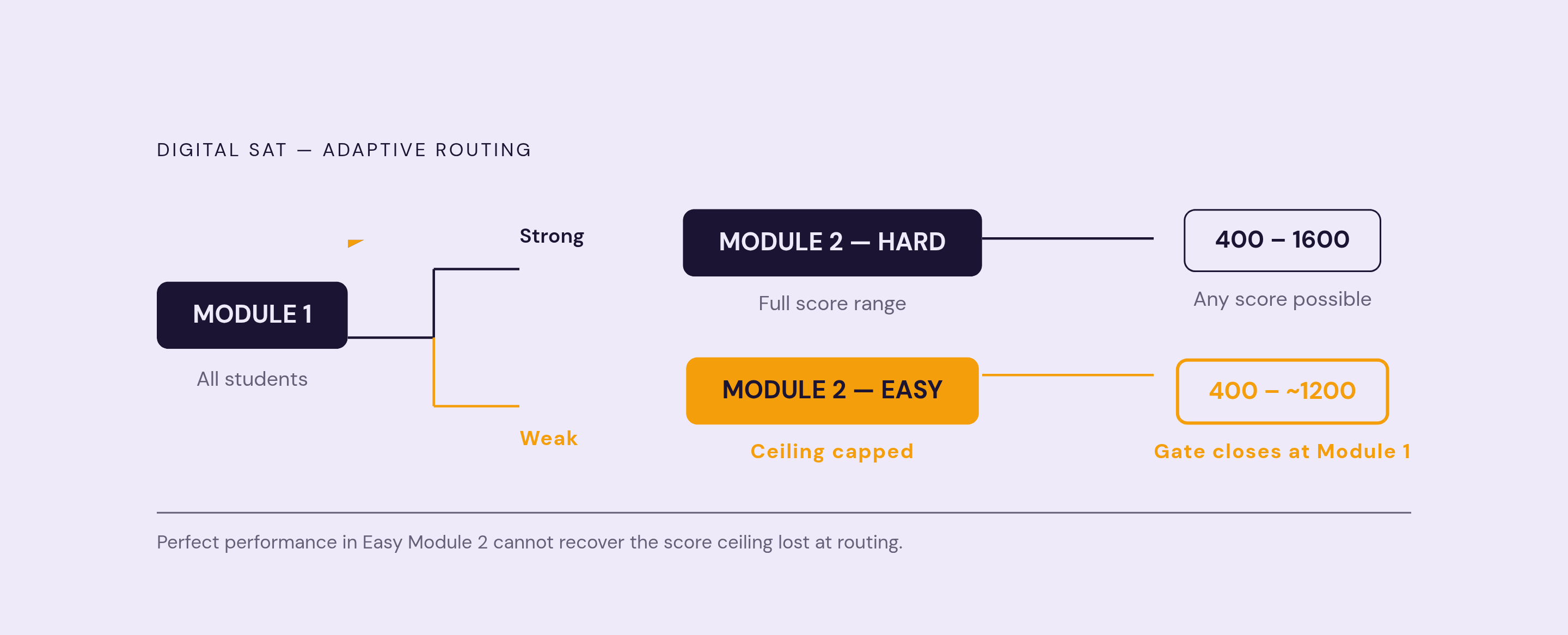
Students and families may hear “digital” and imagine a test that is easier to access and simpler to take. But a smoother delivery system does not mean a more forgiving scoring structure. The digital SAT uses multistage adaptive testing, and Reading & Writing and Math each have two modules with their own timers. Stronger performance in Module 1 leads to a harder Module 2, while weaker performance leads to an easier one. The first module is therefore both an assessment and a routing decision.
That routing matters because the easier second module limits the score ceiling. A student whose first-module performance leads there cannot erase that limit by answering everything correctly afterward. The system responds to what the student shows early, whether that performance reflects weak content knowledge or difficulty using the interface. It cannot give credit for knowledge the student was too confused to show. In that sense, the interface is part of the measurement even though it is not the subject being tested.
Once a module ends, a student cannot return to it, even to review an answer. Time lost navigating the screen cannot be recovered by working faster in the next module, because the timers are separate. The test runs entirely inside Bluebook, lasts just over two hours, and has no paper option remaining as of 2026. For students taking it, familiarity with that environment is not an optional finishing touch.
The specific Bluebook tools that produce interface friction in Module 1
Interface friction becomes clear when a student has to find a control while also solving a question. Bluebook’s text highlighter and annotation tool can help organize a reading passage, but using them requires decisions about what to mark and how much marking is worthwhile. Reading & Writing presents short passages with one question each, moving rapidly among tone, inference, punctuation, transitions, and vocabulary. The habit of annotating a long passage can therefore lead students to spend more time reading than they need to answer the question. The highlighter should not turn a compact question into a decorating project.
Math presents a different judgment through the built-in Desmos graphing calculator, which is available throughout the section. There is no separate no-calculator portion, but constant access does not make constant use efficient. Desmos can solve many problems, yet opening and using it on every question can hurt pacing. The useful skill is deciding when it is faster to check in Desmos and when it is faster to solve by hand. Knowing how to use the calculator and knowing when to use it are separate achievements.
The countdown timer adds another decision because students can hide it, although a five-minute warning appears near the end of each module. The flag-for-review function and in-module navigation map likewise offer useful control only when the student knows how to flag, leave, and return to a question. Learning that workflow during Module 1 spends attention at the moment early accuracy determines routing. Each module also has two unscored pretest items indistinguishable from scored questions, so every item must be treated as live.
Why paper-era prep habits make the interface problem worse
A printed booklet builds content knowledge, and that knowledge remains necessary. What it cannot reproduce is the timed, screen-based process through which the digital SAT asks students to demonstrate it. Getting an answer right with ease on paper does not show that the student can get it quickly inside Bluebook.
Consider the habit of physically circling a question to revisit it. On paper, the mark and the return journey belong to the same familiar action. In Bluebook, the student must use the flag-and-return workflow and navigate within the current module. The purpose is similar, but the behavior needs rebuilding. Likewise, students who are used to carefully annotating a long passage before answering may find that the habit does little to help them answer a question on a short, self-contained passage.
Paper practice can reveal that a student missed questions, while experiencing adaptive routing requires moving into a second module determined by first-module performance. Treating the digital SAT as a paper test wearing a screen therefore leaves a structural part of preparation untouched. Content practice and interface practice solve different problems, and success at one does not establish readiness for the other.
How Bluebook-native practice closes the interface gap and what limits it
Full-length practice inside Bluebook addresses the mismatch by putting knowledge and tool use under the same conditions. The student encounters the on-screen controls, the module timer, and the need to make decisions without pausing the test. That setting builds the fluency that paper work cannot supply. The student goes beyond knowing where the flag button is and practices using it while time is running. Familiarity becomes useful when it removes a decision.
Each tool has a different role in that rehearsal. Repeated flag-and-return practice builds muscle memory, while calculator practice helps calibrate which problems warrant Desmos. Annotation practice can make marking support reading. The independent module timers also teach a firm constraint, which is that spending too long early leaves less time later in that same module. There is no borrowing against the next one.
However, the supply of official full-length Bluebook tests is limited. Students can exhaust the available questions and then mistake improved retake scores for improved skill. Once a question is familiar, answering it no longer reproduces the experience of meeting it cold. Remembering the road is not the same test as finding the route.
Familiarity with the questions changes what a retake result can establish. A higher score on questions the student knows gives less reason to think they are ready for Module 1 questions they have never seen. Further practice therefore needs fresh questions, and practice that aims to work like the adaptive test must match both its screen and its routing. The shortage is not simply a shortage of hours to study, but of useful new encounters.
What AI-powered practice adds that Bluebook volume alone cannot provide
Fresh questions address repetition, but volume alone does not explain why a student keeps missing a particular kind of question. A wrong answer may reflect a content gap, a reasoning breakdown, a pacing failure, or an interface habit that still needs work. Counting errors treats those causes as interchangeable. Useful personalization separates them so that the next exercise addresses the cause.
The digital format offers more diagnostic material than a bubble sheet, including adaptive routing, module-level performance, tool-use patterns, and question-level response data. Those signals create an opportunity for improvement. A student who takes practice tests without looking at the results misses much of that chance. AI-powered practice adds value when it turns evidence about performance into a targeted learning sequence. The important distinction is what happens after the answer is marked wrong.
Passionfruit is built around that distinction. Rather than only tracking missed questions, it aims to learn what a student understands, where their thinking breaks down, and which gaps separate current performance from mastery. It then generates targeted practice to address those gaps. Within an interface-first preparation plan, that is a different job from familiarizing a student with Bluebook.
A January 2026 study in Applied Sciences found that AI-generated Personalized Learning Pathways significantly reduced lower-order learning gaps in secondary school students, though higher-order skills were still harder to teach. The study also found that learning styles influenced engagement and suggested that hybrid models combining AI and teacher mediation may improve outcomes. Those findings support a bounded role for AI. For adaptive SAT preparation, removing repeatable mistakes in Module 1 can improve accuracy and routing.
Why the stakes of interface familiarity are higher now that elite schools require scores again
The return of mandatory score requirements at highly selective universities gives this preparation problem a direct admissions consequence. Students targeting schools that have reinstated requirements cannot simply set aside a disappointing score. Those schools generally expect results well above the national average. If mistakes with the interface send a student into the lower-difficulty second module, the score ceiling can keep the work they show from earning a score that makes them competitive.
Another test date does not by itself solve that problem. A retake offers another opportunity, but the cause of Module 1 underperformance still needs to change. The practical issue for families is therefore not just how many attempts to plan, but whether preparation addresses the behavior that constrained the earlier result.
Bluebook’s 2026–27 updates add a built-in calculator that students can resize and make reference sheets, charts, and images easier to view. The app also requires Windows 11 24H2 or newer. Students familiar with the earlier interface will need to re-acclimate, because fluency belongs to the environment they actually use.
Access also shapes who can build that fluency. Students from high-income families are substantially more likely to have personal laptops than those from low-income families, affecting how much Bluebook practice is realistically available. Digital delivery does not automatically remove an access gap simply because it removes the booklet. For students competing at schools that require scores again, interface familiarity is a prerequisite for showing their knowledge on the terms the test sets.
What a complete preparation sequence looks like given the interface-first argument
A complete sequence begins with a full-length diagnostic inside Bluebook. That first test shows where the student struggles with the interface under test conditions and what they struggle to answer in each module. Without that baseline, “more practice” can mean more time spent on the wrong problem.
The next step is deliberate interface work, early enough that content review does not have to compete with learning the controls. Desmos decision-making, annotation habits, flag-and-return navigation, and pacing within an independent timer should be isolated and drilled. Difficulty should also match the score level the student is aiming for. Practicing only easy and medium questions can leave the student unready for the questions that decide the score.
Once those routines are established, AI-powered gap detection can focus practice on the knowledge breakdowns costing Module 1 points. Passionfruit fits here through unlimited high-quality practice problems and AI grading aimed at locating where thinking breaks down. That work should be paired with teacher or tutor review for complex reasoning demands rather than treated as a substitute for human guidance. Students work on interface fluency first and keep building it as they learn the content.
More full-length Bluebook tests then show whether those gains help the student do better in Module 1. Given the limited official supply, retakes belong after substantive preparation. Their results also need the recognition that familiar questions are less diagnostic than fresh ones. The final measure is whether the student can use both knowledge and tools accurately under the module’s constraints.