Sleep Deprivation Effects on AP and SAT Exam Scores
Chronic sleep loss during test prep weakens the exact cognitive skills AP and SAT exams demand most.
Sleep deprivation affects AP and SAT exam scores by weakening the very skills these exams demand. Protecting scores means protecting sleep throughout prep season and using practice results to distinguish missing knowledge from a tired brain’s trouble using it.
Why AP and SAT exams demand exactly the cognitive functions sleep deprivation destroys first
An AP free-response question asks a student to do more than recognize a familiar fact. It asks them to construct an answer, choose relevant evidence, and keep the reasoning on track under time pressure. A SAT reading question also asks a student to follow an argument before deciding what the evidence supports. Multi-step math also asks students to keep track of intermediate results as they move from one step to the next. These are tests of what students can do with knowledge they have encountered.
That distinction explains why sleep loss is such a precise threat. Sustained attention keeps the student focused on the question, working memory holds the parts they need to work with, and executive function guides their reasoning. Sleep deprivation impairs these functions, including the problem-solving and critical thinking associated with the prefrontal cortex. A sleep medicine expert quoted by the American Academy of Sleep Medicine identifies learning and memory impairment, decreased attention, and reduced vigilance as consequences of sleep loss. The overlap is awkwardly exact, like preparing for a concert while loosening the strings.
Knowing the material and being able to use it are different achievements. AP and SAT questions place much of their demand on that second achievement. That is where extra study can lose value if it comes at the expense of sleep.
What happens inside the brain when a student studies on too little sleep
Learning does not end when a study session ends. Material must be encoded, consolidated into durable memory, and later retrieved when a question calls for it. Sleep helps move what students have learned from short-term storage, where it is easily lost, into long-term memory. Cutting sleep therefore affects both the ability to learn during preparation and the processes that make that learning available later. Hours spent with the material are not the same thing as knowledge secured.
Saroha et al.’s 2025 longitudinal study tracked 72 Indian medical undergraduates over 12 weeks and measured this problem as it developed. As sleep fell, reaction time worsened, working memory declined on digit span tests, and Stroop interference increased, indicating poorer executive control. These changes were statistically significant after controlling for screen time, stress, diet, and chronotype. Sleep duration also remained an independent predictor of academic performance in multivariable models. Those controls strengthen the case that sleep matters, although a longitudinal association does not by itself prove every step of a causal chain.
The study measured medical students, so it cannot supply a points-per-hour formula for AP or SAT score losses. What it does provide is objective evidence about functions these exams require. Working memory matters here because a student working through a multi-step problem must hold on to earlier results while doing the next operation. If that capacity weakens, the difficulty may be keeping the whole calculation together long enough to finish it.
Why one bad night before the exam is the wrong frame — cumulative debt is the real threat
Students commonly consider whether to stay up late the night before the exam. They would gain more from considering what happens across the weeks spent preparing for it. A single rested night does not describe the conditions under which a student learned, practised, and tried to retain the course material. By test eve, much of that work has already happened.
The Universidad Autónoma de Madrid study, which took place across five faculties, found that students who slept better tended to do better academically during examination periods. It also found that sleep debt accumulated during the week was associated with worse perceived academic performance. Roughly two-thirds of students believed their performance would improve with more sleep. That last finding exposes a gap between recognizing the problem and protecting time against it. Students may already suspect that the bargain is poor while continuing to make it.
Students with heavy AP course loads may find that bargain tempting just when they most need to keep up their prep. There is always another assignment or practice set that appears to justify borrowing from sleep. Yet chronic restriction can come to feel normal while cognitive performance remains impaired. Feeling fine on five hours is therefore a subjective report of well-being. The practical reframe is to protect sleep during the six weeks of AP prep rather than treating it as a last-minute exam accessory.
The specific AP and SAT skills that suffer most from a sustained sleep deficit
SAT reading passages ask students to follow an argument through several paragraphs and weigh the evidence against it. AP History document-based questions and AP English close-reading tasks also ask students to keep their attention on sources and language. When attention weakens, students may find it harder to follow the argument even if they still understand each sentence. The problem can look like poor comprehension when part of the difficulty is maintaining concentration long enough to connect the text.
AP Calculus free-response questions and multi-step SAT math ask students to hold on to intermediate results and work with them. Working memory serves as the temporary workspace for those operations. Sleep-related weakness in that workspace can leave a student struggling to complete a procedure they understand. The distinction matters because another explanation of the concept may not address the reason the solution keeps coming apart.
AP free-response questions in Chemistry, Biology, and U.S. History demand deliberate choices about arguments, evidence, and analytical frames. Executive function helps students suppress an automatic response when the question requires a different approach. Greater Stroop interference measures difficulty with this kind of control. Under time pressure, that weakness can make it harder to move beyond the first plausible answer.
AP subject questions also ask students to recall what they have learned when they need it, including chemical equations, historical turning points, and literary devices. Sleep helps with the consolidation that lets students use what they have learned later. A student can therefore have studied the right content yet struggle to summon it when needed. Across these tasks, a wrong answer identifies a performance failure, but it does not identify the cause by itself.
The emotional compounding effect — how sleep loss amplifies test anxiety already present in AP students
AP scores carry consequences for college credit and placement, and they can become tied to a student’s identity as a high achiever. In that setting, struggling to follow a passage or finish a calculation is more than inconvenient. It can add anxiety to a task already demanding careful thought. Sleep loss compounds the problem by amplifying emotional reactivity while reducing cognitive capacity.
The Sacred Heart University study, published December 2024, used a secondary analysis of data from a 211-participant student health survey. Its discussion cited prior literature associating poor sleep with tension, irritability, depression, and confusion. Its own data, however, showed no statistically significant relationship between sleep quality and academic performance. Evidence that poor sleep is linked to emotional strain should not be treated as proof that it changes exam scores. The relevant concern is how distress and impaired thinking can interact during a high-stakes test.
Poor sleep and emotional distress can also reinforce each other, with distress worsening sleep and poor sleep worsening distress. Through prep season, that cycle can make both study and testing harder to manage. But does pressure not sometimes motivate performance? Motivation is not a replacement for the working memory and executive control needed to act on it. The gas pedal can be down while the engine misfires, and pressing harder does not fix the misfire.
The high-achiever paradox — why students who sacrifice the most sleep often believe it is working
What about the outstanding student who barely sleeps? Research on Grade 11 STEM students found that a majority of students classified as outstanding fell into categories with less than the necessary amount of sleep. Yet students in the insufficient and not-recommended sleep categories showed lower academic performance.
High achievers may give up sleep because they are so driven to do well, then make up for the loss well enough to keep getting strong results. Their results do not reveal how well those same students would perform with adequate sleep. Self-selection is therefore a plausible explanation for the apparent paradox. Success despite a disadvantage does not make the disadvantage a strategy.
Compensation can also conceal the cost from the student doing it. Familiarity with chronic restriction makes subjective confidence a poor substitute for objective measurement, while strong overall results can hide recurring weaknesses. Saroha et al.’s cognitive tests measured how well students performed, which a feeling of normality alone cannot show. For a high achiever, diagnosing repeated errors in reading comprehension or multi-step reasoning requires considering missing knowledge, sleep loss, or both.
Why AI-powered prep tools may misread a sleep-deprived student's diagnostic results
That ambiguity becomes especially important when an AI-powered prep tool interprets practice answers. Consider a student who has studied AP Calculus integration thoroughly but slept poorly before a diagnostic. Mistakes in a multi-step solution may look like those made by a student who never understood the concept. The answer data alone do not settle which explanation is right.
A tool that treats every wrong answer as a knowledge gap may therefore assign remediation the student does not need. A temporary attentional or working-memory deficit can masquerade as a content deficit. If the tool simply gives the student more practice on material they already know, it may use up scarce prep time without helping with what went wrong. A diagnostic should provide evidence about understanding in the context of the student’s performance.
Systems that track patterns across sessions offer a more useful direction than those that treat one diagnostic as a definitive map. These systems seek to understand where a student’s thinking breaks down. That approach still should not be mistaken for an ability to diagnose sleep deprivation from errors alone. For teachers, a sudden decline in AI-graded free-response quality may call for a sleep conversation before a remediation plan. Understanding the conditions of performance helps make the performance data useful.
Prep habits that protect sleep without surrendering study time
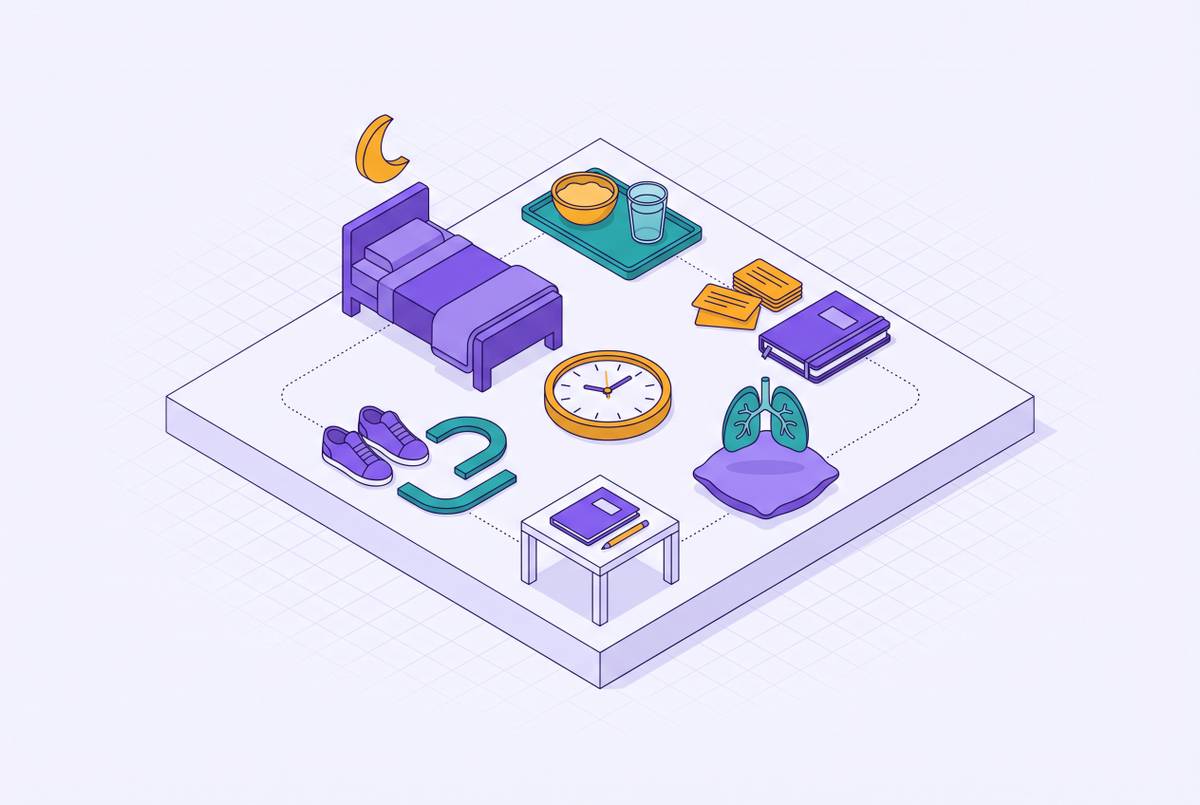
Serious preparation requires distributing study hours so that sleep is part of the plan. Consistent nightly sleep across the final four to six weeks before AP exams or the SAT is the planning target. Within that schedule, difficult work such as AP free-response practice and multi-step SAT math belongs earlier in the day. The aim is to give the hardest tasks a functioning workspace.
Students should note sleep hours with their practice scores and look for patterns of poorer results following poor sleep. Such a pattern is a reason to consider sleep while allowing for possible content gaps. Teachers can apply the same caution when free-response quality suddenly drops. This keeps an uncertain diagnosis from turning automatically into a heavier workload.
Targeted practice completes the strategy by directing limited time toward genuine gaps rather than repeatedly covering what is already understood. AI-powered tools can support that efficiency when their feedback attends to the student’s reasoning and recurring errors. Adequate sleep and smarter prep are complementary because one builds knowledge while the other helps keep that knowledge usable when the exam asks for it.
Sources
- Impact of Sleep Deprivation on Cognition and Academic Scores: A Three-Month Longitudinal Study Among Indian Medical Students - PMC
- lack of sleep and academic performance - Digital Commons
- Sleep quality and sleep deprivation: relationship with academic performance in university students during examination period
- (PDF) RELATIONSHIP BETWEEN SLEEP DURATION AND ACADEMIC PERFORMANCE AMONG GRADE 11 STEM STUDENTS