Anxiety and SAT Math Performance in Timed Conditions
Anxiety disrupts working memory, not knowledge itself.
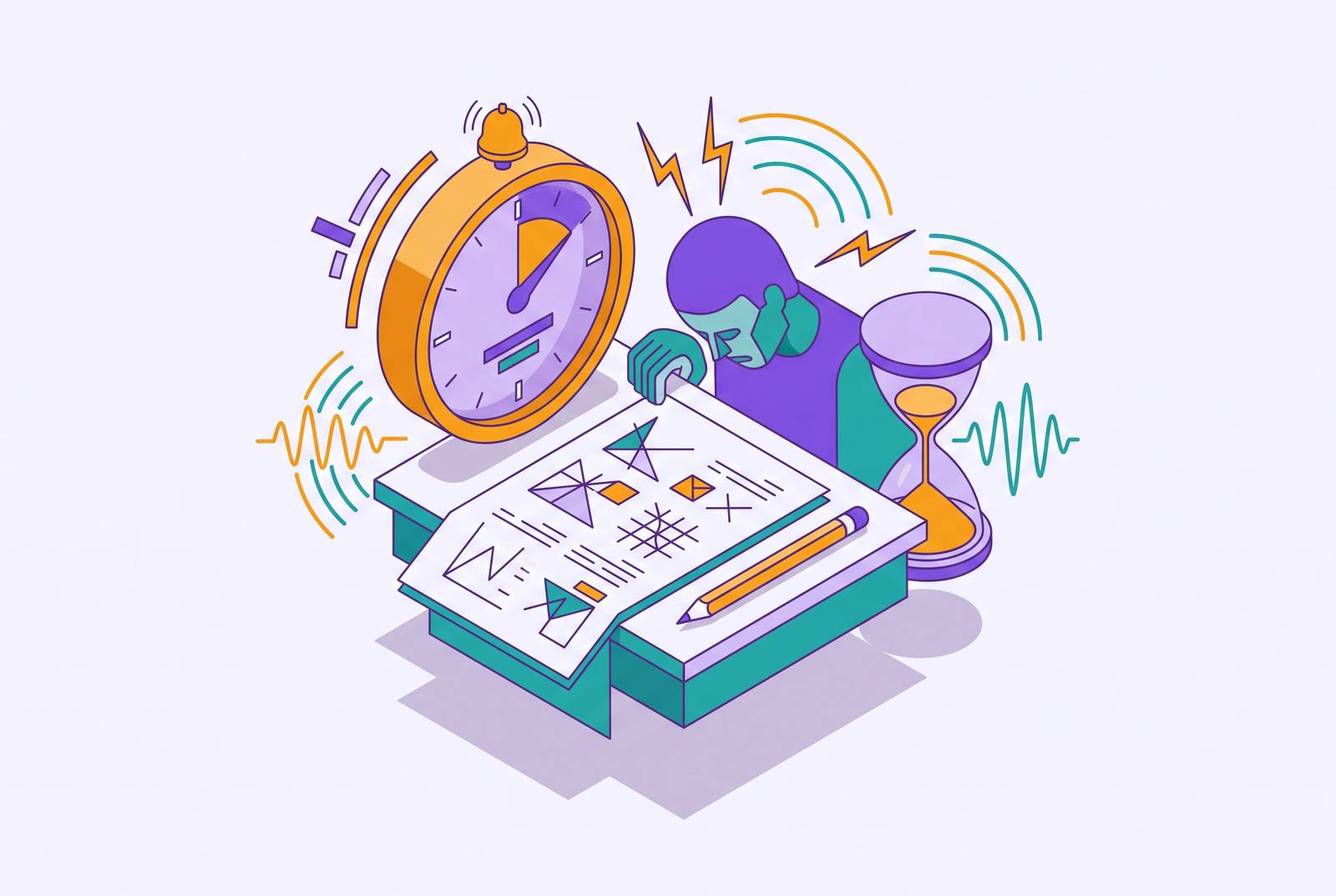
Math anxiety can hurt SAT scores without erasing a student’s knowledge. It consumes the working memory needed to use that knowledge under a clock. That makes effective preparation a two-part job, building mathematical fluency while reducing the mental load of doing math under test conditions. More problems and more minutes do not, by themselves, solve both.
Why math anxiety hurts SAT math scores even when students know the material
A student reaches a problem they solved correctly in practice and suddenly cannot see how to begin. The method was available yesterday, but today it seems to have left without a forwarding address. That moment need not mean the student never understood the material. It can mean that anxiety is interfering with execution by disrupting access to knowledge and the ability to use it.
This distinction changes what a disappointing score can tell a student or teacher. A wrong answer may mean a student has not grasped a concept, or that they struggle to keep track of the steps under pressure. If missing knowledge were the whole explanation, teaching the content and assigning more practice would address it. Because anxiety can interfere independently, preparation must also account for the conditions under which a student can apply that content.
How working memory becomes the chokepoint when anxiety meets a timed test
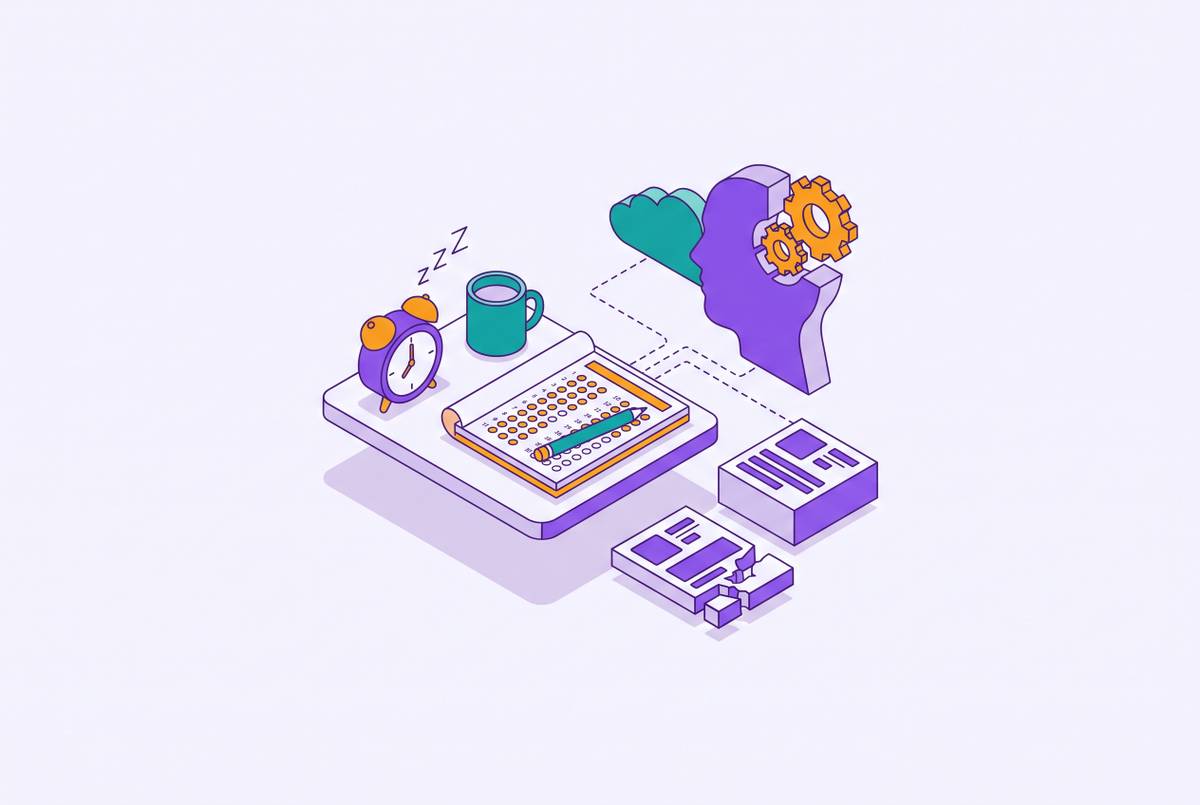
Working memory is the small amount of mental workspace that holds information while a student uses it. On SAT math, that means holding problem steps, retrieving algebraic procedures from long-term memory, and checking whether the reasoning still makes sense. These jobs have to share capacity. For a math-anxious student, encountering a math problem can trigger a competing demand. Anxiety distracts the student, leaving less working memory to hold, work with, and recall the information needed to solve the problem.
The important distinction is between emotional arousal and cognitive worry. Intrusive thoughts about failure, the clock, or the consequences of a poor score do more of the interference than the raw feeling of distress. They occupy the same workspace. A student can therefore appear calm, and even feel fairly calm, while worry is disrupting the reasoning needed to finish a problem.
A difficult task, fear of failure, and a deadline can each amplify anxiety, which further disrupts working memory. The resulting difficulty can then make the task feel more threatening. This is a compounding loop rather than a fixed penalty subtracted from an otherwise stable performance. The SAT math section brings all three pressures together.
What makes the SAT math format a particularly acute working memory stressor
The SAT combines strict timing with difficult or unfamiliar content and high stakes. Trait math anxiety is the more persistent tendency, while state anxiety rises in a particular situation. A student’s usual level of unease therefore does not set a ceiling on how anxious they may become during exam preparation.
Guo & Liao (2025) found that students with higher trait math anxiety took part less overall, while state anxiety rose specifically when students were preparing for an exam. Students with higher state anxiety facing difficult tasks experienced sharper cognitive interference. Yet the clock is not the only suspect. Research that compared complex and simple math tasks found that anxiety was higher on complex tasks, while timing alone made no significant difference.
The digital SAT adds another demand when its interface is unfamiliar. Students may be learning how the adaptive modules and online tools work while also trying to manage anxiety about the mathematics. That unfamiliarity adds cognitive load before the first problem has received their full attention. Learning the interface and understanding algebra both take some of the attention the student has to spare. A familiar procedure on an unfamiliar screen is not quite the same task.
Why the most common accommodations don't reliably break the working memory bottleneck
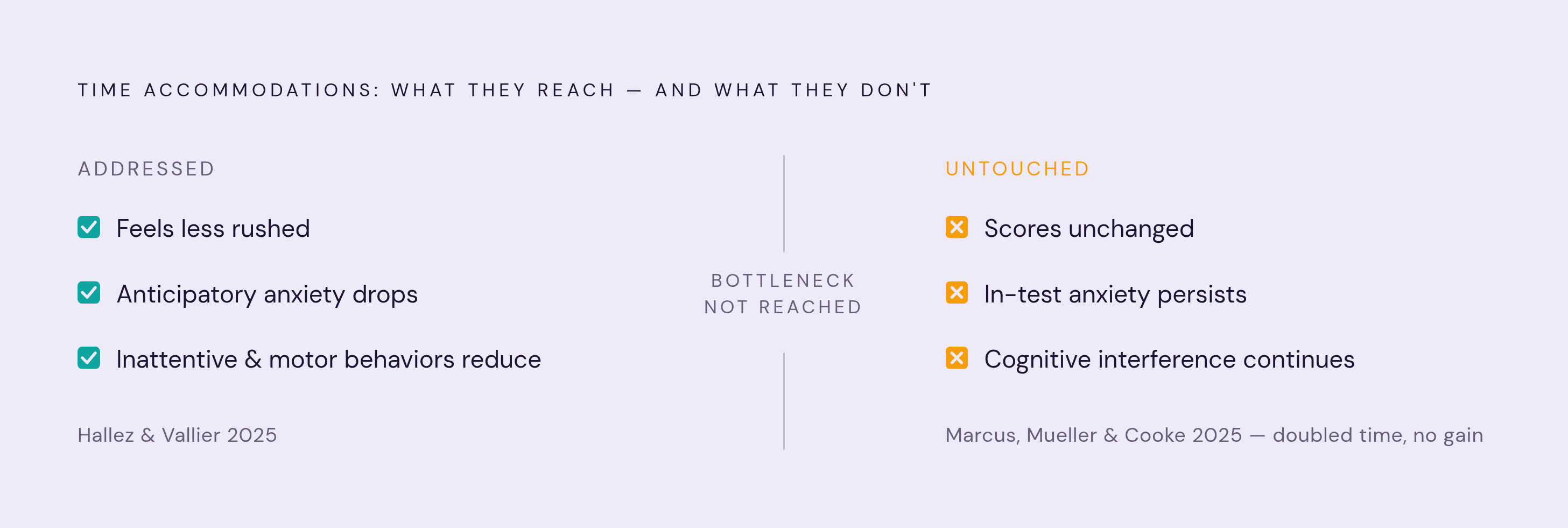
Giving an anxious student more time sounds like the obvious answer. It can address a real shortage of time, but that is not the same as relieving cognitive interference. Marcus, Mueller & Cooke (2025) found that giving students twice as much time on an already-unspeeded exam did not help them perform better or ease their test anxiety. Students felt less rushed, yet they did not score higher or become less anxious. Here, “unspeeded” means that the vast majority already finish within the standard time.
The finding shows that adding minutes when students already have enough does not necessarily reach the actual bottleneck. Marcus, Mueller & Cooke (2025) also found no significant difference in self-reported math anxiety between overt and covert timing. Students still knew they were being timed when the clock was hidden. The threat belonged to the situation.
Hallez & Vallier (2025) found lower anticipatory anxiety before a task when a Time-Timer was visible, as well as reduced inattentive and motor instability behaviors, but no improvement in math performance. Those behavioral benefits matter, especially for students at risk for attention and hyperactivity difficulties. A tool can help students regulate their behavior without freeing enough working memory to raise scores. The fair conclusion is that time-related accommodations have value and are an unreliable substitute for addressing the interference itself.
How anxiety avoidance widens knowledge gaps and makes the next timed encounter worse
The problem also develops between tests, when no clock is running. Doing math feels unpleasant, so an anxious student may do less homework, participate less in class, and avoid practice. Avoidance offers escape from the immediate discomfort. Over time, however, it reduces contact with the very skills that would make the next encounter easier. The relief arrives now, while the learning cost waits until later.
That cost is especially important for arithmetic and algebraic procedures that need to become automatic. Without enough practice, those skills remain more demanding to carry out. The next difficult timed task can therefore confront the student with both a genuine fluency gap and anxiety that interferes with using what they do know. What began as trouble accessing knowledge can become trouble acquiring it. By SAT preparation, the distinction between anxiety and missing knowledge is still useful, but neither can safely be assumed away.
Research published in 2026 found associations consistent with emotional and cognitive math anxiety feeding each other in their relationship with performance. This suggests that help should aim both to ease worry and to improve performance, since either may play a part in causing the other. The loop can also have a long history, since math anxiety is measurable in the first years of formal schooling. By the time SAT preparation begins, avoiding math may be an established habit. Addressing that habit requires making engagement more useful and less threatening.
What the evidence says actually helps through fluency and lower cognitive load
Fluency changes how much working memory a procedure needs. When algebraic steps become automatic, they take less mental effort, leaving more room to think through the parts of a problem that still need thought. Anxiety may continue to intrude, but it is competing against a less demanding task.
Low-stakes, frequent exposure to timed math addresses the other side of that competition. Short sessions in SAT-like formats can make timed work less tightly bound to the threat of evaluation. The framing matters because practice presented as another verdict on ability can reproduce the pressure it is meant to soften. Post-session discussion should therefore focus on process and error patterns. This is not simply more drilling with a friendlier label, since the feedback determines what the student learns from the attempt.
A 2025 study found that children who did dual n-back training had better verbal and visuospatial working memory, less math anxiety, and better Approximate Number System (ANS) accuracy. Those results support interest in cognitive training, but they do not establish that it raises SAT scores. Familiarity with the digital SAT format addresses a more direct preparation need. Practicing with screen-based platforms that replicate the adaptive format removes interface unfamiliarity as an extra source of cognitive load.
How targeted feedback on specific errors addresses the anxiety-gap loop at its source
Practice builds fluency better when it works on the right gap. A wrong answer identifies an outcome, but it does not explain whether the student misunderstood a concept or lost the reasoning along the way. Useful feedback locates that breakdown. Without it, a student may be just as confused on the next try. The student needs a route back into the problem.
Generic feedback such as “wrong — try again” supplies little information about that route. It may instead reinforce the sense that math is difficult and unrewarding, making avoidance more attractive. Supportive, non-judgmental feedback separates the reasoning error from a judgment of the student. That makes correction possible without adding fear of negative evaluation. Immediate personalized feedback is also a way AI interventions can support anxiety reduction, allowing students to correct course before frustration becomes withdrawal.
Quanzhi Fu, Qiyu Wu & Dan Williams proposed mining student–AI chat logs for automated knowledge gap detection in a 2025 preprint. The proposal illustrates how an exchange about a problem might reveal more than a record of right and wrong answers, though a proposed method is not proof of SAT gains. In practice, the useful principle is grading that tracks where thinking breaks down and builds a map of understanding. For teachers, real-time progress tracking and per-student error patterns can help surface gaps before a high-stakes date. For students, feedback that identifies the mistake and explains its correction addresses both uncertainty about the content and worry about being unable to improve.
What anxious students and their teachers should actually do differently in the weeks before the SAT
Preparation should begin with a diagnostic pass that identifies uncertain skills. The first task is to distinguish missing understanding from an error made while applying it. Feedback should then guide work on those specific gaps, especially the arithmetic and algebraic procedures that need fluency. Repeating problems from a weak area without knowing what went wrong can deepen avoidance. Volume is useful only when the practice is doing the right work.
The next task is short, frequent timed practice that feels like an investigation. After each session, the conversation should center on the error pattern and the process that produced it. Some of that practice should use the digital SAT format specifically, so the interface becomes familiar before test day.
Teachers should also look beyond the students who ask for help. Higher trait anxiety can appear as low engagement, which is easy to mistake for disinterest. Progress tracking and individual error patterns can help identify who is quietly avoiding the work and which gaps need attention. The student and teacher can then use the next session to work on a named weakness under manageable timed conditions, followed by a discussion of the reasoning.
Sources
- Time on Their Side: How Visual Timers Affect Anticipatory Anxiety, Performance, and On-Task Behavior in Elementary Math Assessments - PMC
- Frontiers
- The relationship between trait‐ and state‐math anxiety and math engagement: The role of math learning context and task difficulty - Guo - 2025 - British Journal of Educational Psychology - Wiley Online Library
- Math anxiety in elementary students: Examining the role of timing and task complexity - ScienceDirect
- The impact of mathematical anxiety and working memory on children's approximate number system and the n-back training effect - ScienceDirect
- Mathematics Anxiety, Working Memory, and Mathematics Performance in Secondary-School Children
- Math Anxiety and Working Memory Updating: Difficulties in Retrieving Numerical Information From Working Memory
- Strategies for remediating the impact of math anxiety on high school math performance