Question Sequencing Effects on AP Subject Mastery
Randomized question order boosts long-term retention more than forward sequencing does.
What the 2025-2026 research shows about forward versus randomized question order
Question order in AP practice sets looks like a logistics problem. Put the easy stuff first, mix it up a little, call it done. That assumption is wrong. The order questions come in changes what students learn, not just how they score on a given day, and treating it as an afterthought is the mistake most teachers and most practice tools still make.
The stakes are bigger than they look. In May 2025, 6,182,171 AP exams were taken by 3,243,979 students across 23,664 schools. Participation among public high school graduates hit 37.0% for the class of 2025, up from 34.3% a decade earlier. A program that size can't afford to treat question order as background noise. Even a small, systematic effect compounds across millions of test-takers, every single year.
AP exams also make sequencing harder to reason about than a normal test. Topics mix within sections. Cognitive demand shifts from recall to analysis to synthesis, sometimes on the same page. And the exam now runs in both digital and paper form, each with different rules for how questions get delivered. Order interacts with all of it.
Two recent studies looked at whether forward sequencing (questions in the order test designers intended) beats randomized order. They landed in different places, and the disagreement is instructive rather than a contradiction to resolve.
A study out of Radboud University looked at 16,127 multiple-choice scores from 12 microeconomics exams, judging each question on its own rather than the test as a whole. It found strong evidence that forward sequencing helps performance, and the effect compounded: a run of sequenced items in a row produced a bigger boost than any single item could deliver alone.
A study out of Arab Gulf University tells a quieter story. Researchers ran a 2x2 mixed repeated-measures design across 212 students in four courses, this time scoring at the level of the whole exam. There was no statistically significant main effect of question order. GPA didn't move the needle either. The trend leaned slightly toward forward sequencing, but too weakly to call it real.
Both studies are right, because they're measuring different scales. A priming effect, where one question sets up better performance on the next, can be real and strong locally, right where sequenced items sit next to each other. That same effect can wash out completely once it gets averaged across a full mixed exam with dozens of unrelated items in between. Order matters when you zoom in, right where sequenced items sit next to each other. The signal gets buried in noise when you zoom out to the whole test.
How conceptual-before-theoretical ordering affects what students learn
Teachers default to theory-first delivery. The research says that's backwards, and the gap between what teachers prefer and what actually helps students learn is the most useful finding here.
A McGill University study, run through the McLEAP research effort, tracked over 1,500 students across two years in electromagnetism and optics courses. Content was split into three types: conceptual, theoretical, and example-based. Students who saw conceptual material first showed stronger performance on later assessments than those who encountered theoretical material first.
That result lines up with constructivist learning theory: people build new understanding by attaching it to a mental picture they already have, not by memorizing formal rules in a vacuum. Giving someone the concept first gives the theory something to stick to.
The theory-first, concept-second order is a common arrangement, one that shapes how the material typically gets presented. But the students in the study learned better the other way around. The instinct to lead with formalism optimizes for how the material looks organized, not for how it actually gets absorbed.
That gap matters for AP courses generally. Physics, chemistry, biology, a national history course. history: all of them blend conceptual framing with theoretical or analytical depth, and the standard order (definitions and formalism first, concept second) is a convention nobody actually proved works best. It became the default because it's how a textbook lays ink on a page.
Why easy-to-hard scaffolding reduces cognitive overload during practice
Working memory has a ceiling. Hitting that ceiling too early with material that's too hard leaves nothing left over for the actual job of encoding new information. Overload a student in the first ten minutes, and the rest of the session suffers even if everything after gets easier.
A study published in Educational Technology Research and Development (Springer) tested this directly. Ninety undergraduates in an online public administration course went through quiz-based inquiry, where quiz prompts were spread out incrementally across live lectures instead of dumped at the end in one block.
The scaffolding worked in stages. Early sessions opened with simple prompts, quick surveys, easy polls, just enough to activate what students already knew without taxing them. Complexity built gradually from there, climbing toward the harder end of Bloom's taxonomy (applying, analyzing, evaluating) later in the sequence, once some mental bandwidth had freed up.
Formative performance on these staged, ramped-up quizzes strongly predicted final exam outcomes, with a standardized effect of β = 0.66, carrying through from what students build early all the way to the final test. That's not a number to wave away. Ease students in, and what they build early carries all the way through to the final test.
Interleaved versus blocked practice: the sequencing choice with the strongest evidence base
If there's one sequencing question the research has actually settled, it's this one. Interleaving wins, and it isn't close.
Blocked practice means working through every problem of one type before switching: all the quadratic equations, then all the systems of equations, then all the word problems. Interleaved practice mixes problem types together within the same session, so a student never knows what's coming next.
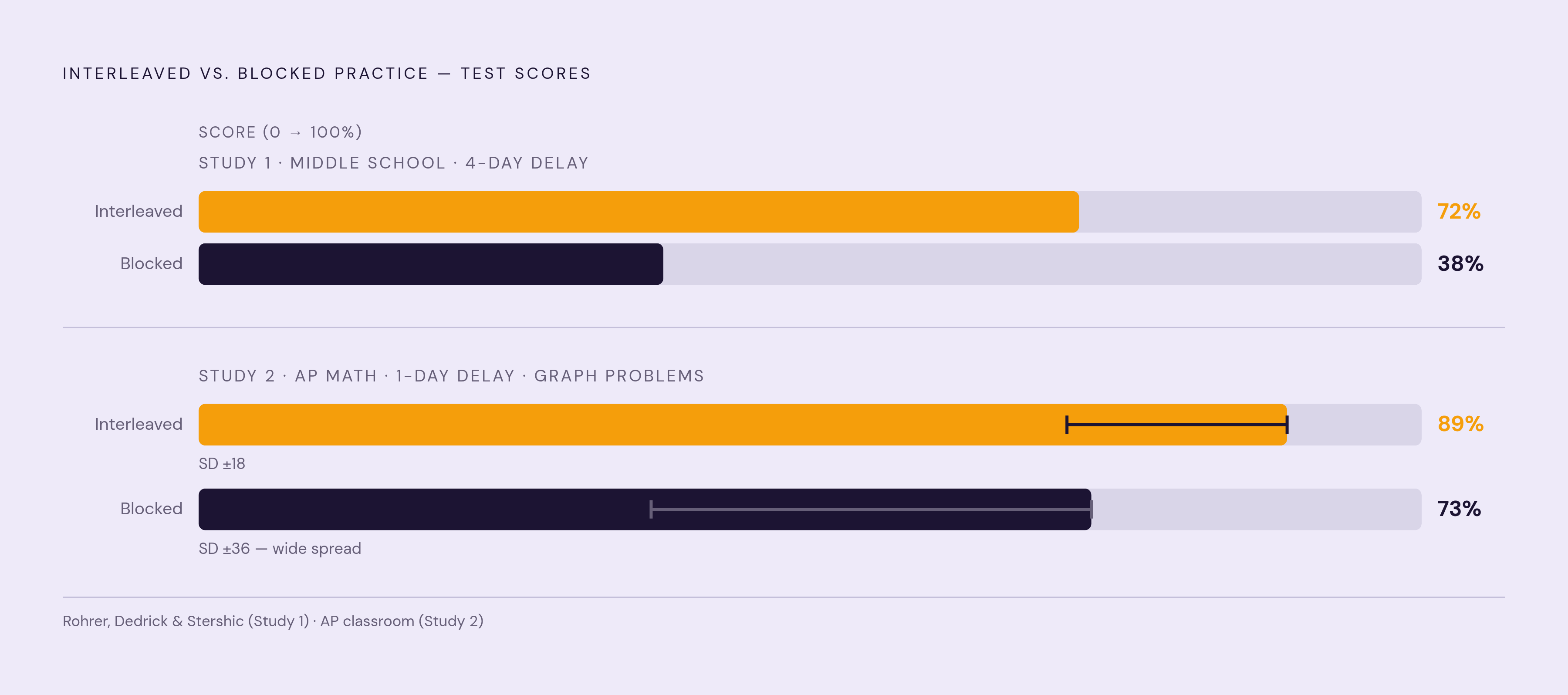
Rohrer, Dedrick, and Stershic ran this comparison with middle schoolers doing math practice. Four days after training, students who'd practiced interleaved scored 72% on a delayed test. Students who'd practiced blocked scored 38%. Nearly double, and the gap becomes visible specifically once time has passed. That's the tell: interleaving isn't about performing better in the moment, it's about what actually sticks.
A separate study run inside an AP math classroom found the same pattern on a shorter timeline. With a one-day delay before testing, interleaved practice on graph problems produced a mean score of 89% (standard deviation of 18%). Blocked practice on the same material scored 73% on average, with a standard deviation of 36%, meaning blocked practice wasn't just lower, it was far less consistent from student to student.
On a real AP exam, questions don't arrive sorted by type. On a real AP exam, questions don't arrive sorted by type. They come mixed, the way the material actually works. Knowing how to solve a related-rates problem is only half the skill. Recognizing that a given problem is a related-rates problem in the first place, buried among fifty other question types, is the other skill you need. Blocked practice never touches that second skill, because when every problem in a row is the same type, there's nothing to tell apart. Interleaving is the only format that trains the actual skill the exam demands.
What adaptive sequencing adds beyond simple interleaving
Interleaving beats blocking. Settled. Getting clever about how you interleave turns out to matter less than intuition suggests, so fancier is not always better.
A 2025 study published in ScienceDirect tested whether an algorithm could beat plain random mixing, by tracking which categories a given student tends to confuse and presenting those categories back-to-back more often. The logic: if a student keeps mixing up two concepts, put them next to each other on purpose, so the discrimination skill gets extra reps exactly where it's weak.
Both interleaved conditions, adaptive and plain random, beat blocked practice by a wide margin, but adaptive interleaving didn't significantly outperform plain random interleaving. Both interleaved conditions, adaptive and plain random, beat blocked practice by a wide margin. But adaptive interleaving didn't significantly outperform plain random interleaving. Mixing helps a lot. Getting clever about the mix, at least in this study, didn't add much more on top of that.
Which learner traits change how much someone benefits from interleaving is still an open question. Prior knowledge and working memory capacity are the leading candidates, but the evidence isn't conclusive. Adaptive interleaving might help students with lower working memory capacity more than others, because it shortens how long a confusing category sits in memory before getting reinforced. That's a hypothesis, not a settled fact.
There's a separate question of when a student should even move on to harder material. Bloom's mastery learning model, updated with evidence from a research body focused on education, sets a bar of 80 to 90% accuracy before advancing a student to the next difficulty level. The EEF's data ties mastery-based approaches to roughly five months of additional academic progress. And in Bloom's original tutoring research, students under a mastery-based, one-on-one tutoring condition outperformed conventionally taught peers by two standard deviations, a gap large enough to move an average student into the top few percent of a conventional classroom.
Adaptive sequencing in the Digital SAT
The Digital SAT's adaptive sequencing is the architecture of the exam. It's the architecture of the exam.
Each section splits into two modules. Performance on the first module determines which version of the second module a student receives.
That routing decision carries real weight. Landing in the harder second module opens access to a higher scoring range, and the most difficult questions within it determine where in that range a student lands. The second module a student receives therefore shapes how much of the score range remains available.
Which means every question in that first module is doing double duty. It's answering the question in front of a student, and it's deciding what range of questions that student ever sees again. A student who coasts through the early questions, saving focus for later, may already have limited their access to harder questions before those questions even show up. Consistent performance on core material in module one is the actual price of admission to the higher range.
That has a direct implication for how students should practice. Drilling isolated skills in a vacuum doesn't replicate this structure. Practicing under conditions where early performance determines what shows up next, the way the real exam works, does.
Sequencing strategies for AP classrooms
None of this requires new curriculum or new software. Four moves, each grounded in a specific finding above, cover most of it.
Sequence content type before difficulty. Introduce conceptual framing before theoretical formalism, the way the conceptual-before-theoretical research described above suggests. This is a structural choice in how reading assignments and problem sets get ordered, not a bigger lift than reordering a syllabus.
Use easy-to-hard scaffolding within a single session, not across an entire course. Open with lower-stakes questions that activate what students already know. Save analysis and evaluation tasks for later in the same session, once working memory isn't already maxed out.
Block first exposure, then interleave for review. The first session introducing a brand-new skill can reasonably stay blocked, since students need some initial repetition before they can tell problem types apart. But once that exposure is done, switch to interleaved review. Staying blocked too long lets students mistake short-term fluency for actual mastery, the exact trap the Rohrer interleaving research exposes.
Use formative checks as gates, not just grades. Apply an 80 to 90% accuracy threshold before letting a student move to harder material. The EEF's five-months-of-progress finding is the argument for why this is worth the classroom time it costs, instead of pushing forward on a fixed pacing calendar regardless of whether anyone's actually ready.
AI-powered practice tools and sequencing research for AP students
Most practice tools are built around volume: more problems, more reps, more questions answered. That's the wrong metric. A student can grind through a hundred blocked practice problems on the same skill and walk away feeling confident while quietly reinforcing the exact illusion of competence the interleaving research warns about. The discrimination skill, knowing which technique applies when problem types are mixed together, never gets built, because volume alone never builds it.
What the research calls for from a tool is specific: tracking at the level of individual items, not just overall test scores. Detecting which concepts a given student confuses with each other. Routing difficulty adaptively instead of following a fixed, generic order. Enforcing a mastery threshold before moving a student to harder content. Switching to interleaved review once a skill has been introduced.
A well-designed practice tool built around that list would offer adaptive AP practice problems with AI-powered grading, and the grading would do more than mark answers right or wrong. It tracks what a student actually understands at the level of individual concepts and individual items, and it's built to notice where a student's thinking breaks down.
That gap-detection logic is the same principle behind adaptive interleaving: find the specific concepts a student mixes up, and sequence the next problem to address that exact confusion, rather than marching through a syllabus in whatever order a textbook happens to print it. The research says order isn't neutral. Tracking confusion at the item level and adjusting what comes next is one concrete way of acting on that finding, one problem at a time.
Sources
- Mastery Learning: Definition, Examples and Evidence (2026)
- Exploring Question Order Effects in Multiple-Choice Assessments: Evidence from Undergraduate Education Courses | MDPI
- Quiz-based inquiry: embedding incrementally sequenced questions to enhance engagement and learning in synchronous online lectures | Educational technology research and development | Springer Nature Link
- Tailoring interleaved practice: Does adaptive sequencing boost the interleaving effect? - ScienceDirect
- Exploring Question Order Effects in Multiple-Choice Assessments: Evidence from Undergraduate Education Courses
- edisonos.com