Interleaving Versus Blocking in AP Exam Practice
Spacing and discrimination, not more hours, separate high scorers from the rest.
What blocking and interleaving mean, and how most students already use one of them without realizing it
More than 1.3 million students in the Class of 2025 sat for over 4.8 million AP Exams. Roughly a third of them, across every exam they attempted, failed to score a 3 or higher. Participation grew 7% from 2024 to 2025, so more students than ever are showing up. And still, a third of them walk away with a score most colleges won't touch.
If students are putting in the hours, the score isn't higher because of how that time is organized.
Most people assume the fix is more hours. It isn't more hours. How you organize practice time matters just as much as how much of it you log, and most students organize it in a way that feels productive without actually being productive. That gap has a name in learning science: blocked practice groups repetitions of one type together, while interleaved practice mixes different types within a session. Both are real tools. The mistake almost nobody catches is using blocking well past the point where it stops helping.
2025 was also the first year most AP end-of-course exams ran on College Board's digital testing platform, with 28 of 36 AP subjects moving their multiple-choice sections online. Format familiarity is now its own variable, stacked on top of content mastery. Practice has to account for both.
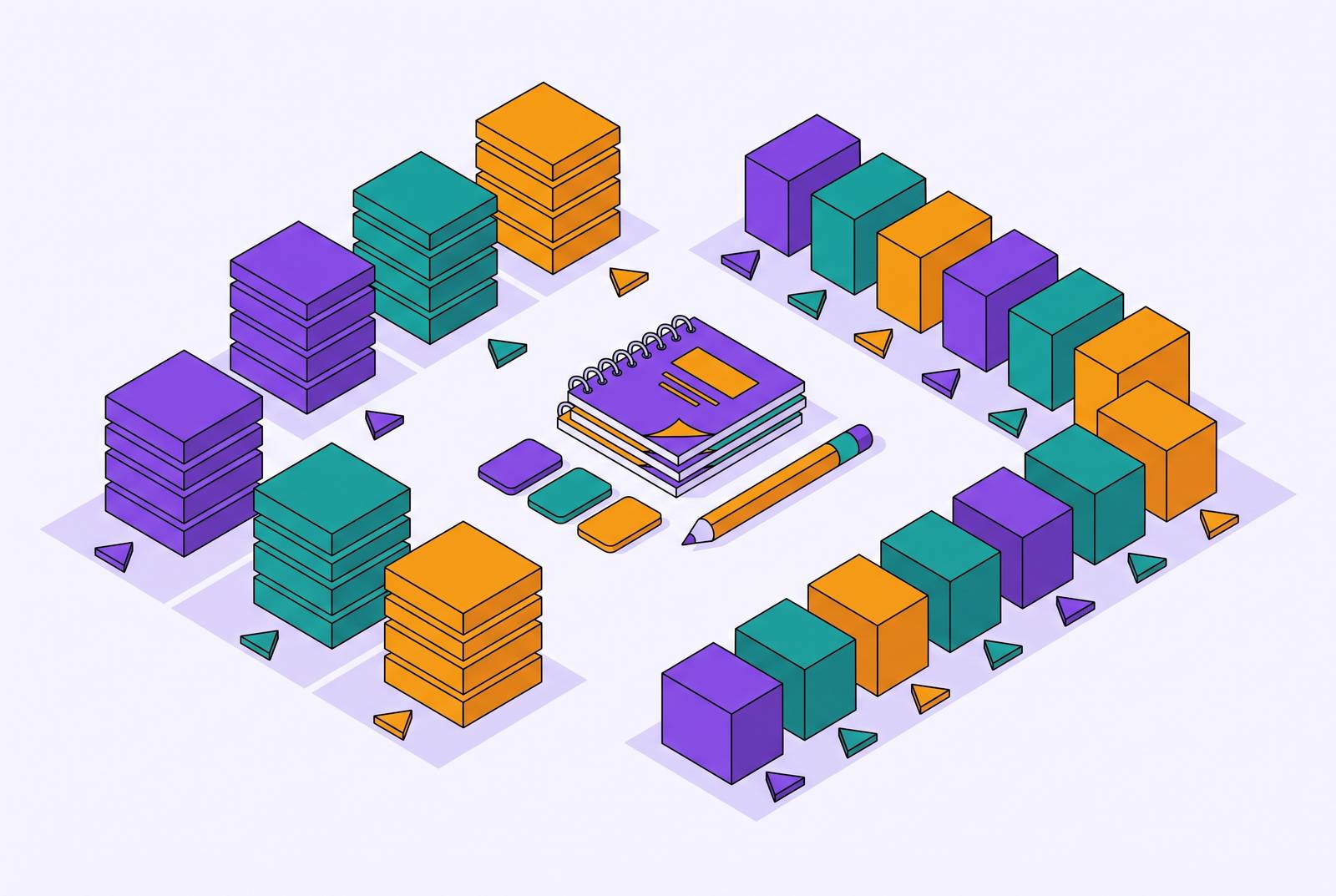
Blocking is simple. You do one type of problem, over and over, before moving to the next. Twenty quadratic equations. Then twenty linear equations. Then twenty exponential ones. One category at a time, in order.
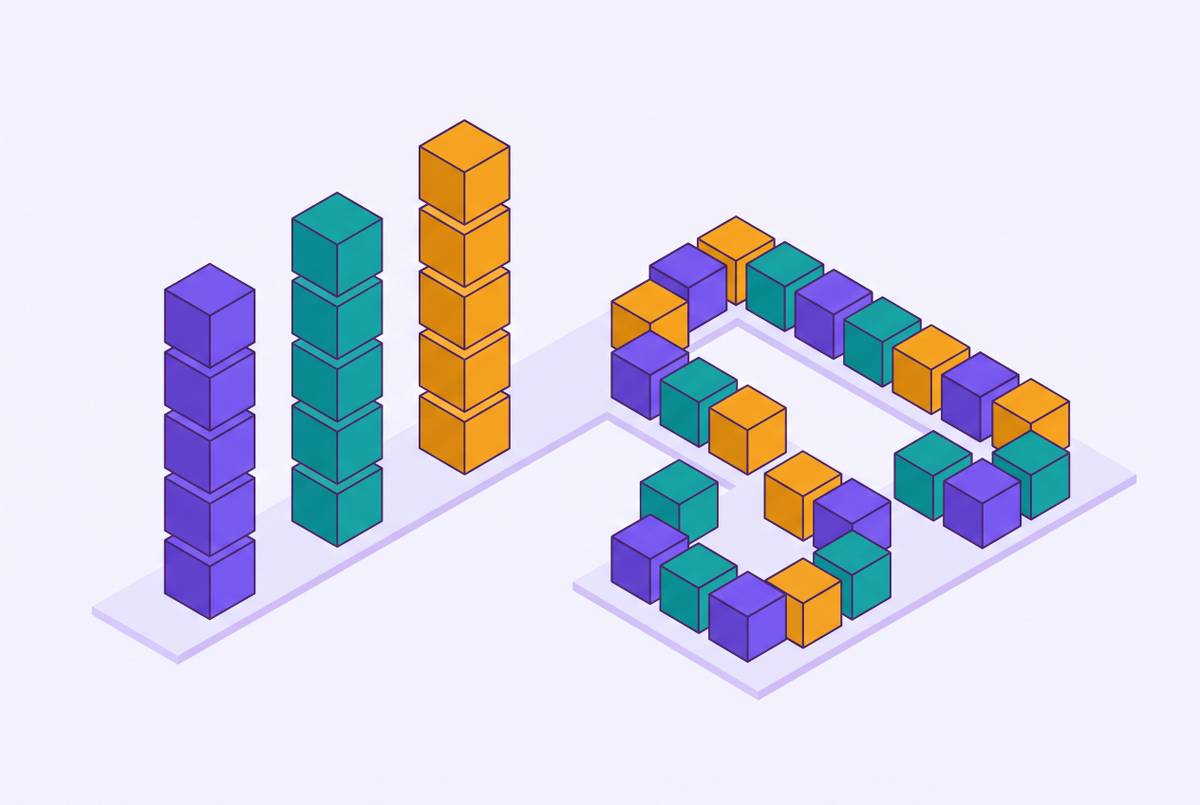
Interleaving mixes it up. Instead of A, A, A, A, B, B, B, B, you get A, B, C, A, B, C. Different problem types, shuffled together, inside the same session.
Almost every student defaults to blocking, and it's easy to see why. Textbooks are organized by chapter. Problem sets group similar items together. Even language apps teach vocabulary in themed units. The whole architecture of a typical curriculum is built in blocks. Nobody taught you to study this way. You inherited it.
Blocking also feels good while you're doing it. Solve twenty quadratics in a row and by problem twelve, you're flying. Fast, confident, accurate. That rhythm creates a real, seductive feeling of mastery. You leave the session thinking you crushed it.
Interleaving feels like the opposite. Progress seems slower. You make more mistakes, because you have to stop and figure out what kind of problem you're even looking at before you can solve it. Messier. Less comfortable.
That discomfort is the entire mechanism. It's the entire mechanism. Research cited by InnerDrive shows students overwhelmingly prefer blocked practice, and that preference barely moves even after they're told interleaving works better. People keep choosing the method that feels better over the one that works better. Closing that gap is the real subject here.
The three mechanisms that make interleaving produce stronger retention than blocking on delayed tests
Three separate mechanisms are doing the work, and each attacks a different weakness in blocked practice.
Spacing naturally spreads out repetitions of any single topic through interleaving. Blocking crams them together. The spacing effect, the finding that spread-out practice beats crammed practice, is one of the most replicated results in learning science. Interleaving builds spacing in automatically, just by the way it shuffles content.
Active discrimination matters most for AP exams specifically. When you interleave, you have to ask "wait, is this a permutation or a combination?" before you can even start solving. That identification step, the moment of figuring out what kind of problem you're facing, is exactly the skill AP exams test. Real exam questions aren't labeled by category. Nothing on the test says "this is a related-rates problem" the way your textbook chapter heading does. A student who only ever practiced blocked sets learned how to execute a category once it's already been named for them. A student who practiced interleaved sets learned how to name it themselves. Research from Carvalho and Goldstone (Frontiers in Psychology) backs this up: interleaved study improves learning of categories that look similar to each other, because it forces between-category comparison. Blocked study helps more when the learning goal doesn't require distinguishing between similar categories.
Blocked practice lets you hold a solution pattern in working memory and mechanically reapply it problem after problem. That produces shallower encoding. You aren't really retrieving anything from long-term storage each time, you're running the same script. Interleaving breaks that script every time, forcing conscious retrieval of the right strategy from scratch. That repeated retrieval is what drives deeper, more durable encoding.
The evidence isn't subtle. Controlled experiments show interleaving beating blocking on delayed tests by 40 to 60%. One published math learning study found an effect size of 0.42 on immediate tests, jumping to 0.79 on delayed tests, so the advantage grows over time. A separate study on undergraduates learning geometric concepts found an effect size of 1.34 at a one-week retention check, a large gap by any statistical standard. Research on math problem retention has found that the interleaving advantage persists well beyond the immediate test, holding up at longer delays. This isn't a short-term trick. It holds up.
A psychologist has a name for this pattern: desirable difficulty. Interleaving makes you worse in the room, and better a month later. That trade is the whole point.
The illusion of mastery: why blocked practice feels effective while quietly degrading retention
When you grind through twenty similar problems in a row, you aren't pulling the strategy out of long-term memory each time. It's sitting in working memory, and you're applying it on autopilot. That autopilot feeling is smooth and fast. It also isn't learning, in any durable sense.
Come back a week later and try those same problems cold, and performance often falls off a cliff. The material was never actually filed away into long-term memory. What felt like mastery was really just short-term fluency, and fluency evaporates the moment the scaffolding, the repetition, the sameness, the rhythm, disappears.
There's a cost during the session too. Research has found that people mind-wander more during blocked practice than during interleaved practice. A robotic, repetitive rhythm doesn't demand full attention, so attention drifts. Interleaving keeps you on edge, and that edge is where encoding happens.
Those two findings together produce the illusion of mastery: how a study session feels while you're in it is a bad predictor of how much you'll actually remember later. The extreme version of this problem is cramming. A survey cited by InnerDrive found that 99% of students admit to cramming at some point. Cramming is blocking taken to its logical extreme, and it's especially dangerous because the session ends before you ever get the chance to find out how much you forgot.
Translate that into AP terms. A student who spends a full two-hour session drilling nothing but AP Calculus derivatives walks out feeling sharp, ready, locked in. A student who spent that same two hours bouncing between derivatives, limits, and integration walks out feeling shakier, less confident, more scattered.
Which one scores higher on exam day? The second one, more often than not. The session that feels worse is the one doing more for you.
The cases where blocking genuinely wins in AP prep
None of this makes blocking a bad method. It makes it a method with one specific job, and the mistake is stretching it past that job.
Blocking earns its keep at the very beginning, when a concept is brand new. Before a student has any framework for telling problem types apart, throwing interleaved practice at them doesn't create desirable difficulty. It just creates overload. You can't discriminate between categories you haven't learned yet.
There's also a rule-based learning wrinkle. Research points out that when the goal is abstracting a general rule, blocking can help a learner isolate the one feature that matters. Interleaving isn't universally superior. It depends on whether the task is about memory and discrimination, or about pulling a rule out of material that doesn't look similar to begin with.
Sequencing matters too. Some research suggests blocked practice followed by interleaved practice may beat either one alone, because blocking first helps a learner build the initial link between a problem type and its solution method. Interleaving then strengthens that link by forcing repeated retrieval and comparison. Block to build it, interleave to lock it in.
Exam-day timing is its own case. If the test is tomorrow, evidence cited by InnerDrive suggests blocking can offer a small, legitimate boost in processing fluency, a last-minute confidence and speed edge, but only for a student who already interleaved earlier in prep. Cramming one subject the night before isn't the same failure mode if the deeper learning already happened weeks earlier.
A 2023 classroom study out of the University of Minnesota and Georgia Tech, done with 8th graders, found students who got interleaved instruction remembered more two weeks later, while students who got blocked instruction remembered more on a same-day test. The study's finding about individual differences is the more interesting one it produces, as shown by the results that follow. Some students may need more blocking as scaffolding before pure interleaving starts paying off.
The rule holds across nearly every case above: block to learn something new, then interleave to consolidate it.
A stage-based framework for using blocking and interleaving across a full AP prep timeline
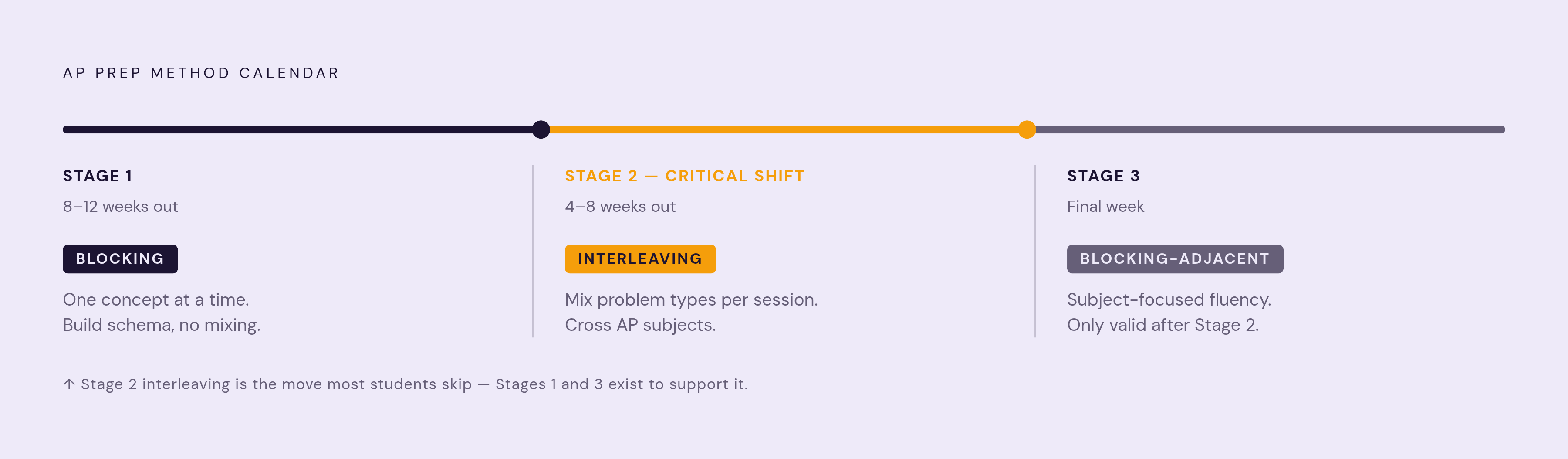
Lining all of this up against a real AP prep calendar reveals a pattern that falls out pretty naturally.
Stage 1: Content review (8 to 12 weeks out). New material is arriving unit by unit. Blocking belongs here. Go deep on one concept before moving to the next. The goal right now is building the schema, not testing discrimination between concepts you haven't fully met yet. Consistent weekly time investment per AP subject over that 8 to 12 week window adds up to meaningful total hours per exam. Test yourself right after finishing each unit, even in this early blocked stage. That small retrieval step reinforces encoding before you've even left the blocking phase.
Stage 2: Active practice (4 to 8 weeks out). The schema exists now. Time to interleave. Mix problem types inside a single session instead of clearing one type before touching the next. One concrete tactic: instead of two straight hours on one AP subject, alternate between two subjects in 25-minute chunks, timer-based. It'll feel less confident in the room. It tends to produce better scores. For students juggling multiple AP subjects, interleaving can stretch across subjects too, not just within them. Mixing across subject lines forces the same discrimination muscle the exam itself demands.
Stage 3: Final week. Shift back toward subject-focused, blocking-adjacent review. This is where same-day processing fluency actually matters. That benefit occurs only when the interleaving work already happened in stages one and two. Skipping straight to blocked cramming without that foundation leaves the fluency hollow, a confident feeling with nothing behind it.
A 2024 study of medical school candidates in France found that successful candidates used spaced repetition at more than double the rate of unsuccessful ones (44.8% versus 20.3%). Different exam, same underlying principle: structured, spaced practice over months beats a late sprint, whichever specific method is doing the spacing.
AP Physics 1's pass rate jumped from 47% to 66% in 2025, coinciding with a shift to a hybrid exam format. Exam structure and preparation strategy are the same conversation. They're the same conversation.
How AI-powered practice tools can automate the block-to-interleave transition that students rarely manage on their own
Knowing the theory doesn't mean a student can execute it. Managing a shift from blocking to interleaving, across multiple AP subjects, at the right moment, requires knowing exactly which concepts are consolidated and which are still shaky. That's a diagnostic problem that most students, working from a stack of practice books and a study planner, simply can't track by hand. Nobody's grading their own reasoning in real time.
Passionfruit is built to close that gap. The value isn't generating more practice problems. Plenty of tools do that. The value is grading in a way that identifies where a student's reasoning breaks down, including whether the final answer was right or wrong. A wrong answer might be a careless slip, or it might be a genuine conceptual gap, and only the second case needs blocked remediation before interleaving makes sense again.
For a student brand new to AP Calculus derivatives, the platform can serve blocked drill work until the underlying schema is solid. Once it is, the sequence shifts, introducing mixed problem sets that force the same discrimination skill the real exam demands. Feedback that points to where the thinking diverged, instead of a flat "wrong," recreates the identification step that makes interleaving work. On the teacher side, that same tracking lets educators see which students are still in the acquisition phase and need more blocked scaffolding, and which are ready for interleaved practice.
More practice problems was never the fix. Sequencing, matched to where a student actually is, is the lever that moves the number. InnerDrive cites a controlled study in which students in an interleaved condition scored almost 7% higher on final exams than students who studied in blocks, with the same number of hours in both groups. The only variable that moved was how the practice was arranged.
For 1.3 million students working through 4.8 million exams, that's not a small lever. It might be the cheapest one available.
Sources
- Effects of interleaved and blocked study on delayed test of category learning generalization - PMC
- Blocking or Interleaving: Which is better for revision?
- How to Study for AP Exams: Subject-by-Subject Guide (2026)
- The role of executive function abilities in interleaved vs. blocked learning of science concepts - PMC
- Interleaving vs Blocking: Which Study Method Actually Works?
- The Underappreciated Benefits of Interleaving for Category Learning - PMC
- The benefits of interleaved and blocked study: Different tasks benefit from different schedules of study | Request PDF