Desirable Difficulty in SAT Practice Problems
Practicing on easier tests feels productive but won't prepare you for test day's actual difficulty.

A student runs three full practice tests, gets three great scores, and walks into the real SAT feeling ready. Then the actual score comes back significantly lower than practice predicted, sometimes by a wide margin. That gap isn't bad luck. It's a direct result of how the practice happened, not whether the student worked hard enough.
That gap has a name in cognitive science: desirable difficulty. Understanding it changes how you should build a study plan, because easy practice quietly lies to you, and the right kind of hard practice is the only thing that produces gains that hold up on test day.
What desirable difficulty means, and what it is not
Psychologists Robert Bjork and Elizabeth Ligon Bjork have laid this out formally in peer-reviewed research. Their core claim: certain kinds of struggle during practice make learning stick. Easy, smooth practice feels good but often builds nothing durable.
The idea has a sweet spot. The difficulty has to be hard enough that a student really has to dig for the answer, but not so hard that the digging comes up empty. Review a flashcard right after seeing it, and there's no effort involved, so nothing sticks. Wait too long, and the student is basically relearning from zero. The gain appears in that middle zone, where retrieval is a genuine reach but still lands.
This connects to a related principle Bjork developed around memory disuse. Forgetting isn't a sign that studying failed. It's a signal. When a memory gets harder to pull up, that's the brain telling you it's time to revisit it, and pulling it back up after some forgetting builds a stronger memory than reviewing it while it's still fresh.
Desirable difficulty is not "make it as hard as possible." Desirable difficulty is not "make it as hard as possible." It's not frustration for its own sake, and it's not throwing a student at problems so far above their level that every retrieval attempt fails outright. What counts as the right difficulty depends on the student: how much they already know, how complex the task is, whether they're getting useful feedback, how motivated they are, how tired they are. A problem that stretches one student in exactly the right way might just break another.
How you perform today during practice and how much you actually retain weeks later are two different things, and they can move in opposite directions. A study session that feels smooth and confidence-boosting can produce almost nothing lasting. A session that feels rough and slow can be exactly the one that pays off on test day.
How the Digital SAT's adaptive structure already embeds difficulty calibration
The Digital SAT isn't a fixed set of questions handed to everyone. It's computer-adaptive. Performance on Module 1 of a section decides how hard Module 2 will be. Do well on Module 1, and the exam hands over a harder Module 2, which is where the top-end scores actually get earned.
That module-to-module jump in difficulty varies from test to test, and practice tests that simulate a big jump between modules do a better job of matching the real exam experience than ones that stay flat.
This changes the math of mistakes. Missing an easy question costs more than missing a hard one, because the scoring system calibrates around what you've already shown you can do. A wrong answer on a question matched to your level looks worse to the algorithm than a wrong answer on a genuinely hard one.
The format itself: Math is split into two 35-minute modules of 22 questions each, 44 total. Reading and Writing is two 32-minute modules of 27 questions each. Altogether, that's 98 questions across 134 minutes. And within Math, the content isn't evenly spread: Algebra makes up 35% of the test, Advanced Math another 35%, Problem Solving and Data Analysis 15%, and Geometry and Trigonometry 15%.
Put those two facts together, the adaptive jump and the content split, and a pattern falls out: a student who only ever practices one topic at a time, in a predictable order, has never actually trained for the decision the real test keeps forcing, which is figuring out what kind of problem you're even looking at before you can solve it. That's exactly why test selection and sequencing during prep can't be random. They need to mirror the same kind of calibrated difficulty climb the real exam builds in.
Choosing practice tests as a difficulty progression, not a random checklist
As of 2026, there are 8 official digital practice tests available through the practice app: Tests 4 through 11. Tests 1 through 3 were retired in February 2025, widely believed (though never officially confirmed) to be because they ran noticeably easier than the real exam.
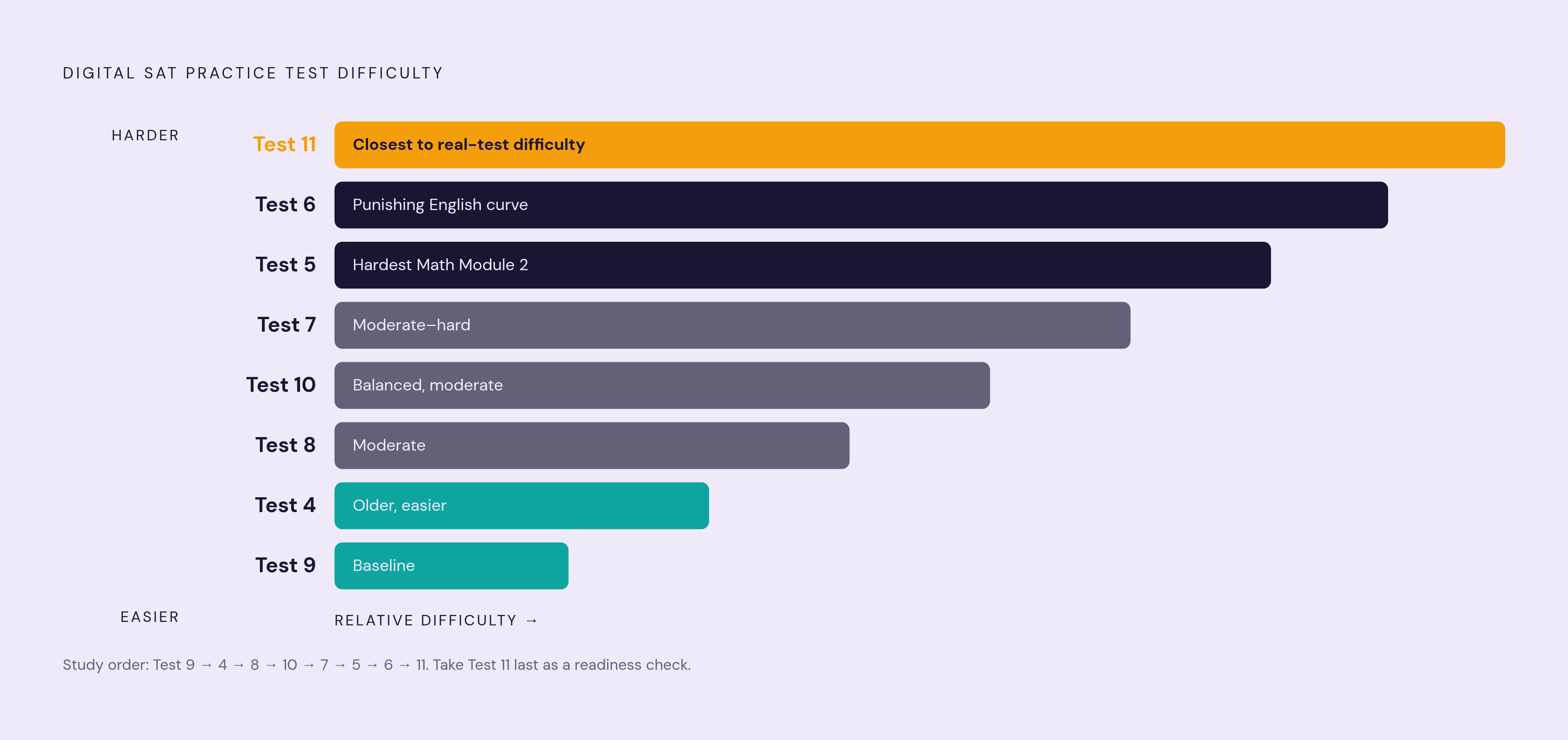
Based on current analysis from sources including larrylearns.com, strategictestprep.com, and oneprep.com (2026), the tests break down roughly like this:
Hardest: Test 11. Released in early 2026, closest to current real-test difficulty. Tougher vocabulary, multi-step math, a strict scoring curve. Best used as a final readiness check, not an early diagnostic. Hard: Tests 6 and 5. Test 6 has a punishing English curve. Test 5 has the hardest Math Module 2 in this group. Both came out in 2024 and both introduced regression-based Desmos questions. Moderate-Hard: Test 7. The only fully original test from the February 2025 batch, with no recycled questions from the retired tests. Leans on things like consecutive odd integers and complementary angle rules. Pairs naturally with Test 11 later in a study plan. Moderate: Tests 10 and 8. Test 10 is balanced across sections. Test 8's math runs a bit easy. Easier: Tests 9 and 4. Test 9 is a solid early baseline. Test 4 is the oldest and includes some math content no longer tested, so it's mostly useful for the Reading and Writing section now.
A sensible order, based on the sequence laid out on oneprep.com: Test 9, then 8, then 10, then 7, then 5, then 6, then 11. Start easy so early practice measures timing and habits rather than crushing confidence on a hard form too soon. Climb steadily. Save the toughest tests, 5, 6, and 11, for the end.
A student who only ever practices on the easier tests and treats those scores as predictive isn't measuring mastery. They're measuring fluency on questions that don't match what the real exam will throw at them. The harder Module 2 on test day exposes that gap fast.
One more wrinkle: Tests 8, 9, and 10 include some recycled questions from the retired Tests 1 through 3. If a student has already seen those questions, getting them right isn't retrieval, it's recognition. Recognition doesn't train the brain the way retrieval does, so it doesn't produce the same benefit.
Beyond the 8 Bluebook tests, the Question Bank holds hundreds of additional practice questions, including a new batch released in August 2025. Filtering out questions that overlap with already-completed practice tests avoids wasting review time on things already seen.
What the hardest questions test, and why students miss them
An 800 on SAT Math requires getting every question right. A 750 leaves room for just 2 or 3 misses across both math sections, according to prepmaven.com. At MIT, three quarters of admitted students scored at least 780 on Math. At Caltech, three quarters scored 790 or 800. Across top-30 schools generally, 750-plus is a common expectation. Meanwhile, the global average Math score is around 520 out of 800 (College Board, 2024).
That gap between average and competitive isn't mostly a content problem. It's a precision problem.
A lot of points get lost not because the algebra is too hard, but because misread constraints in the wording cause students to answer the wrong question. The word "integer" restricts an answer to whole numbers, and roughly 20% of students miss that word somewhere on a given test, according to satmatprep.com. That's not a knowledge gap. That's a reading-under-pressure gap.
The hardest questions tend to fall into a handful of recurring categories, per prepmaven.com:
Multi-step algebra: substitution problems, systems with no solution, systems with infinite solutions, solving for a constant. Functions and advanced math: functions plugged into functions, polynomial division, polynomial remainders, equivalent expressions. Geometry and visual reasoning: algebra disguised as geometry, angles inside circles, the equation of a circle, combined shapes. Word problem translation: ratios worked step by step, layered percentages, relationships between variables.
Test 11 leans into this on purpose. Its English section uses tougher vocabulary and more science-heavy passages; its math combines multiple concepts inside single questions. The difficulty isn't just about harder numbers. It's structural.
There's also the Desmos factor. Tests 5 and 6 introduced regression-based Desmos questions, and those are now a standard part of the real exam. A student who hasn't practiced that specific tool faces a kind of difficulty on test day that isn't desirable at all. It's just unpreparedness dressed up as hard math.
The practical point: recognizing what type of hard question is sitting in front of you takes having seen that type before. Practicing one topic in isolation, over and over, never builds that recognition muscle.
Why interleaving practice feels like failure but produces real gains
Blocked practice means working through one topic for a long stretch, like a worksheet of nothing but systems of equations. Interleaved practice mixes topics inside a single session: an algebra question, then a data analysis question, then geometry, then back to algebra.
The real SAT interleaves by nature. Questions arrive in random order across domains, so before a student can even start solving, they have to figure out what kind of problem this is. Blocked practice never trains that step, because the topic is already known before the first question is read.
Picture a student who scores well on topic-by-topic worksheets, feels confident, then scores noticeably worse the moment problems get mixed together. The instinct is to think the mixed version is just too hard. But look closer at where the wrong answers come from. Once the student correctly identifies which method to use, the execution is usually fine. The errors cluster almost entirely around choosing the wrong approach in the first place, not around the math itself.
That's the mechanism at work. Interleaving forces the brain to keep resetting, to keep asking "wait, what is this one asking for," and that mental reset is exactly the kind of load that tells long-term memory, "this matters, hang onto it." The struggle isn't a sign something's wrong. It's the signal doing its job.
This lines up directly with the adaptive Module 2 on the real test, which never announces what topic is coming next. A student who's only ever drilled in predictable blocks is walking into an exam environment they've never actually rehearsed.
A well-built interleaved session mixes multiple math domains at once, and it shouldn't just target weak spots. Even a student's strongest areas need mixed-order retrieval practice, because fluency under pressure isn't the same skill as fluency in a quiet, single-topic drill.
A lower score during an interleaved session is not a reason to retreat back to blocked practice. That dip reflects the added cognitive load of mixed-domain retrieval, which is precisely what builds durable skill. The score that matters is the one on test day, not the one during a Tuesday night study session.
Spacing and retrieval effort: why the gap between sessions is the active ingredient
Spaced practice beats massed practice for long-term retention by a meaningful margin, even when the total amount of study time is identical (Bjork and Bjork). The gap between sessions isn't dead time. It's doing the work.
The mechanism is retrieval effort: the harder the brain has to work to pull up a memory, the stronger that memory gets afterward. Reviewing a concept right after first seeing it takes almost no effort, and produces almost no lasting learning. It feels productive. It mostly isn't, because reviewing a concept right after first seeing it takes almost no effort and produces almost no lasting learning even though it feels productive.
Same-day re-reading creates an illusion of mastery. Spaced retrieval creates the real thing. Feeling like you know something in the moment is not the same as being able to pull it up cold, three weeks later, under timed pressure.
There's also evidence that attempting a problem before being taught the method can make the subsequent explanation stick better, a phenomenon sometimes called the pre-testing effect.
Applied to SAT prep: coming back to a weak skill after a gap of several days forces real retrieval, not recognition. Reviewing wrong answers the same day they were made isn't spacing. That's just re-reading with extra steps.
A 2024 study of medical school candidates in France found that students who passed used spaced repetition at more than double the rate of those who didn't, 44.8% versus 20.3% (cited via notesmakr.com). Different exam, different country, same underlying mechanism.
Taking a test, reviewing it once, and moving on captures only part of the available learning. The fuller workflow looks like this: take the test, review right away for basic comprehension, come back to the specific weak items after a gap of several days, then retest those exact items under timed conditions.
How to sequence a full prep plan around escalating difficulty and spaced return
Early phase: Begin with one full-length practice test under strict, real conditions, one sitting, timed modules, no pausing, no peeking at answers mid-test. This isn't about performance. It's a diagnostic baseline.
From there, break down the errors by type, not just by section:
Concept gaps: the same question type keeps tripping the student up. Careless errors: the concept is understood, but execution slips. Pacing errors: the concept is understood, but time runs out first.
Each of those needs a different fix, and lumping them together as "bad at math" wastes study time.
Middle phase: Tests 8 and 10 work as checkpoints. The right question at this stage isn't "what did I score." It's "did the specific weak spots I targeted actually improve, and are those errors showing up less often." Between full tests, sessions should mix domains rather than stay blocked, return to previously missed question types after a few days' gap, and include some pre-testing on upcoming topics before they're formally taught.
Late phase: Save Tests 5, 6, and 11 for after the foundational gaps are patched. Using them too early just exposes a shaky foundation instead of revealing genuinely high-level weaknesses. Test 11 fits best about a week before the real exam, with the remaining days used for light, targeted review rather than another full test.
Pacing matters too. The real exam runs 98 questions across 134 minutes, and endurance under that kind of fatigue only gets built through full-length simulation. Partial sessions can't substitute for it.
After every full test, log four things: total and section scores, accuracy patterns by skill, pacing data (questions rushed or left unanswered), and confidence level (answers reached through actual certainty versus a lucky guess). No single test score means much on its own. The trend across several tests is what actually tells the story.
Sources
- The Best Bluebook SAT Practice Tests Ranked (2026 Update)
- SAT® Practice Tests Ranked by Difficulty (2026) | OnePrep
- Which Bluebook SAT Practice Test Is the Hardest? All 8 Ranked (2026)
- 25 of the Hardest SAT Math Problems in 2026-2027 - PrepMaven
- Is SAT Math Hard? An Honest Look at Difficulty 2026
- Desirable Difficulties: Bjork's 5 Principles
- oneprep.xyz
- retrievalpractice.org