AP Exam Practice Apps With College Board Endorsement
College Board endorsement doesn't exist for most AP prep apps.
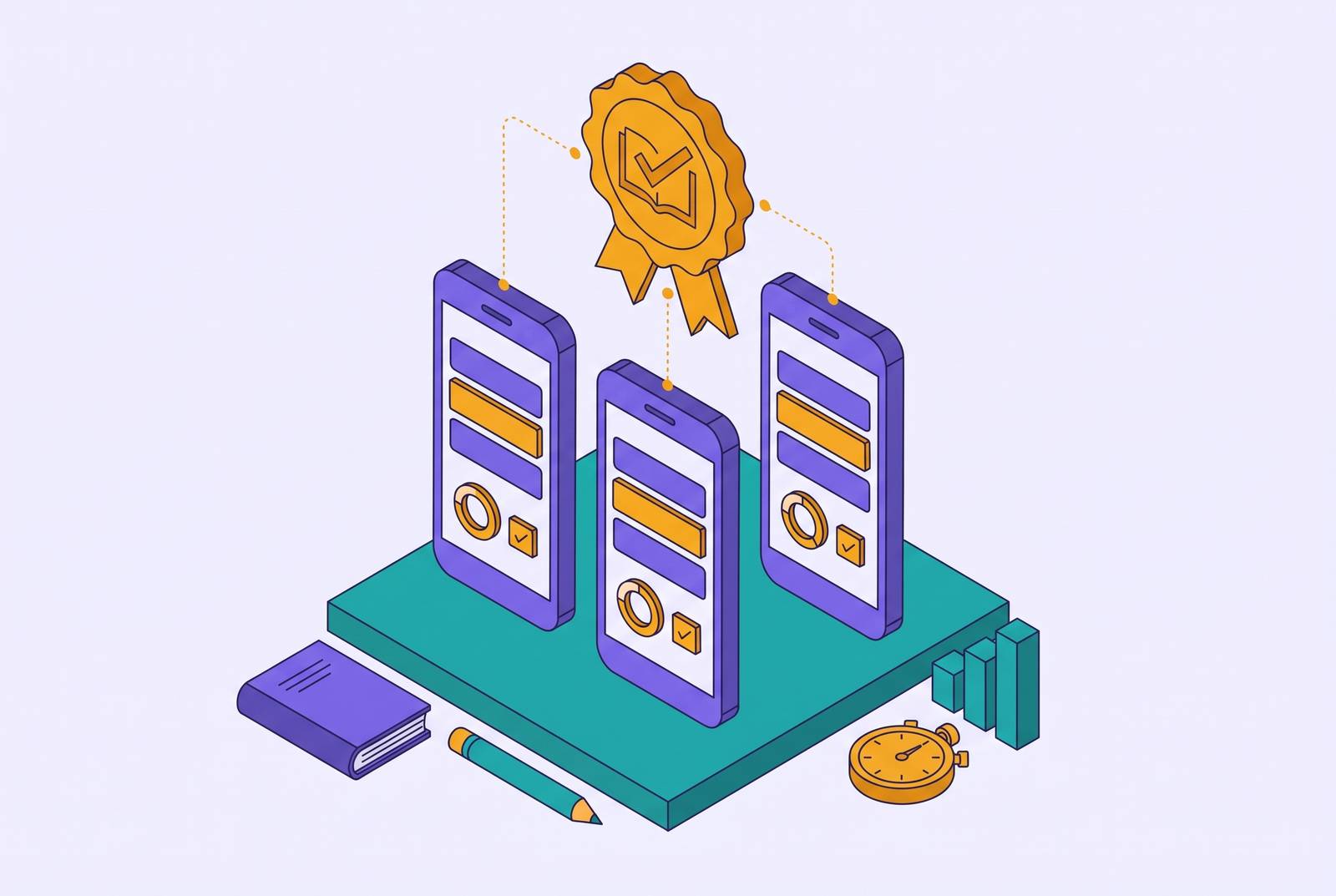
AP Classroom is College Board’s own AP prep platform, while third-party AI tools offer feedback without its endorsement. Official tools for authentic questions and exam practice work alongside outside tools for specific feedback gaps.
What "College Board endorsed" actually means — and why the term is routinely misapplied
A student sees “AP” in an app’s name and assumes some connection to the organization behind the exam. It is an understandable leap. The app names the course, promises practice for it, and may say its questions follow College Board curricula. Those statements describe the app’s coverage. A map of a city is not a permit from city hall.
College Board has no process for reviewing and approving third-party AP prep apps as a whole. It does have a formal Endorsed Provider program for third-party AP curriculum and professional development providers, which is a different category. That distinction keeps the word “endorsed” from becoming a stretchy marketing sweater. An app’s institutional relationship either exists or does not.
Crimsora states on its own pages that it is not affiliated with or endorsed by College Board. Ultra Prep’s AP Psychology Exam Prep 2026 makes a similar disclosure in its App Store listing, stating “We are not affiliated with any testing organization, certificate, any trademark or exam name”. These disclaimers usefully separate a claim about educational content from a claim about institutional backing. In the prep-platform category, AP Classroom alone is built and operated by College Board itself.
AP Classroom as the one platform with genuine institutional standing
AP Classroom’s provenance is most clearly visible in its question bank. It has questions from real past AP exams and official practice materials that students can search by course content and skills. No third-party question bank can claim that same standing. This gives students a reference point for the content and demands of official questions, rather than another provider’s attempt to approximate them. The questions are authentic, though some students may prefer to study with other tools.
AP Classroom is free for any student enrolled in an AP course, with access unlocked through the teacher’s account. AP Daily videos and progress checks are part of that official prep platform. For enrolled students, cost is not the access barrier. The teacher-linked setup does, however, distinguish it from an app a student selects and uses independently.
Its resources also track the expansion of AP courses. AP Cybersecurity and AP Business with Personal Finance materials will be available in AP Classroom starting July 2026, consistent with their national launch under the AP Career Kickstart initiative. The platform supports the courses as they enter the AP system, rather than building an outside interpretation of them.
Bluebook — the second official platform, and why interface familiarity is now a testable skill
Bluebook fills a different role from AP Classroom. It is the official testing platform, a role separate from the official prep-platform category. As of the 2025–2026 school year, 28 AP exams are delivered through Bluebook, with 16 fully digital and 12 in hybrid format. In hybrid exams, students read questions on screen but write free-response answers in a physical booklet. Knowing the material is only part of being ready.
Bluebook includes a built-in Desmos calculator for exams that permit calculator use, with graphing, scientific, or four-function versions depending on the subject. Reading-based sections also include annotation tools. Those tools need practice before exam day. A student should not have to learn the controls while also trying to demonstrate command of the course.
AP Classroom offers Bluebook-style practice assessments to build that familiarity, a direct connection between preparation and testing that outside tools cannot supply. The two new courses launching nationally in fall 2026 will be fully digital in Bluebook from day one. Student reviews of the app also reported connectivity failures, crashes, and a loading-screen outage during the AP Psychology exam on May 16, 2025. These reports show why practice on the actual platform offers a chance to encounter technical problems before the exam itself, while leaving the frequency of disruptions undetermined.
What College Board's AI policy does and does not govern — and the gap it leaves for third-party tools
College Board has no blanket AP-wide AI ban. Its published AI guidance for the 2026–27 academic year covers five course families, including AP African American Studies, AP Art and Design, AP Capstone, AP Computer Science Principles, and AP World Languages and Cultures. Every other AP course has no published AI policy, leaving permission to use AI in those courses unspecified. The guidance takes into account how AI can affect the fairness of assessment in each subject.
An AI tutor for AP Biology or AP U.S. History is not passing through a formal endorsement gate simply by offering study help. Nor does the absence of endorsement make that help prohibited. But using an AI tool after exam day to process questions seen on the exam risks score cancellation under the exam security policy.
For students, this separates two questions that are often tangled together. “Is this an official tool?” asks about institutional status, while “Is this use allowed?” asks about conduct. The answers need not be the same. Third-party providers legitimately occupy the space for preparation, feedback, and tutoring without receiving an official badge.
The third-party landscape — what AI tools can grade AP free-response questions accurately?
Historia AP evaluates SAQs, LEQs, and DBQs against official College Board rubrics and returns point-by-point breakdowns. CoGrader also provides rubric-based FRQ scoring with point-by-point feedback. Using the official rubric and matching the judgment of official readers are different claims.
AP free-response scoring awards points through detailed criteria, so a general comment such as “needs more detail” leaves much of the useful work undone. A point-by-point breakdown makes the scoring criteria part of practice. AP Classroom does not replicate that workflow for students practicing independently. In subjects with lots of essays, students can get useful feedback without a teacher there for every try.
MaxYourScore covers all 40 AP subjects with AI video lessons, spaced-repetition flashcards, five full practice exams per subject, and a Socratic AI tutor. Its tutor asks guiding questions to help students understand and remember what they learn. That is a different proposition from essay scoring. Its breadth should not be mistaken for evidence about how accurately it grades written responses.
The limits belong in the comparison too. Content made by users can have errors the platform cannot catch, and third-party practice questions cannot match the exact style and difficulty of official questions. Self-reported pass rates also describe self-selected users who studied consistently all year. The numbers may look persuasive without settling causation. A tool should match a specific gap, with its feedback treated as practice guidance.
Why the free-to-paid cost ladder has equity stakes, not just consumer-choice stakes
More than a quarter of U.S. AP takers in 2025 were low-income students. For that group, human tutoring at thousands of dollars a year is not a realistic fallback when independent practice becomes difficult. The available alternatives are narrower than an app-store comparison suggests. The quality of free and low-cost tools therefore helps set the practical limits of preparation. An optional upgrade for one student can be an unavailable form of help for another.
AP participation grew substantially from 2024 to 2025, expanding the population relying on free resources. Meanwhile, the preparation market spans free institutional access through school enrollment and expensive paid AI tools, with more sophisticated AI feedback tending toward the expensive end. Authentic practice can be free while personalized feedback costs extra. The two solve different problems, so access to one does not erase the absence of the other.
AP Classroom’s free access is therefore educational infrastructure. Yet a sizable share of enrolled students never log in to use what is there for them. That is a concrete, addressable access problem. It also complicates the idea that better preparation always begins with another purchase. Before the paid tier can supplement official practice, students need to be using the official practice already available to them.
How to build an AP prep stack that uses each tier for what it does best
The practical response is to assign each tool a job. Start with AP Classroom for real AP questions, AP Daily videos, and progress checks, and use Bluebook to practice with its controls. Download Bluebook early and take practice previews before exam day. Confirm the format for the subject, because fully digital and hybrid exams require different practice. These official tools form the base of the prep stack.
Next, identify what remains difficult after an answer is marked wrong. Is the student missing knowledge, making a mistake in their reasoning, or writing an essay that fails to earn rubric points? The distinction guides the purchase. Adaptive diagnostics aim to find where a student's thinking goes wrong, the central reason to add AI feedback.
Passionfruit is an option for that diagnostic role. It offers unlimited, high-quality practice problems with AI-powered grading built to learn what a student understands, where reasoning breaks down, and which knowledge gaps stand between the student and mastery. For essay-heavy work, Historia AP and CoGrader offer the separate benefit of official-rubric scoring and point-by-point breakdowns. Choose between these uses by the feedback needed.
Spaced-repetition flashcards, community decks, and content-drilling apps can support vocabulary and factual recall within the supplementary layer. They do not replace official question practice or rubric-level FRQ feedback. Keep exam security within the plan as well. The prep stack is a pre-exam resource whose use must respect protections on exam questions afterward. That boundary applies regardless of which provider supplies the AI.
Finally, check where the student needs the most help before adding a tool. AP Biology’s heavy memorization and some calculation call for a different mix from AP U.S. History’s historical thinking, essay structure, and rubric fluency. More apps are not automatically more preparation.