AP Exam Study Planning for Students With Learning Differences
AP exam planning for students with learning differences has to start with what the test itself looks like in 2026, because the test has changed shape. Twenty-eight AP exams now run through the Bluebook digital app. Sixteen of those are fully digital, with both multiple-choice and free-response sections typed directly into Bluebook. The other 12 run hybrid: multiple-choice on screen, free-response handwritten in a paper booklet.
That split determines which physical and cognitive tasks a student must perform under timed pressure, and whether they match what the student actually trained on. A student taking a fully digital exam has to type an essay response under timed conditions. For students with dysgraphia, motor coordination difficulties, or slow processing speed, that's a different physical and cognitive task than the one they may have trained on all year. For the hybrid exams, the burden appears differently: a student answers multiple-choice questions on a screen, then has to shift to a paper booklet for free response, mid-test. That's a modality switch in the middle of a high-stakes exam, and it asks for a mental reset exactly when attention is already strained. For a student with ADHD or executive function challenges, that reset is a real cost, not a formality.
The calculator situation adds another wrinkle. Bluebook now includes a built-in Desmos calculator for every calculator-permitted exam, and it's meant to replace or supplement a physical calculator. Only the Bluebook-embedded version of Desmos is allowed on the testing device, not the Desmos website, not the Desmos app. Students can still bring an approved physical calculator if they prefer. But a student who spent the year practicing on the web version of Desmos, or on a handheld calculator, needs to recalibrate before test day, not during it.
English Language and English Literature made a quieter but equally consequential change: multiple-choice questions now offer four answer choices. Fewer distractors means each wrong answer left on the page is more believable, and that changes the logic of process of elimination that students have spent years training. Any student who practiced on pre-2025 materials built habits for a five-choice format that no longer exists on test day.
The 2026 exam window runs May 4 through 8 and May 11 through 15, with late-testing dates available for students who can't test during those two weeks. None of this is presented to alarm anyone. It's presented because format familiarity is now a real part of AP prep, not a footnote to it, and because these particular shifts land hardest on the students whose processing, attention, or motor profiles are already working against the clock.
Formal accommodations as the starting floor for AP planning
Accommodations exist, and they cover a wide range of needs: extended time, stop-the-clock breaks, separate small-group testing rooms, text-to-speech and screen reader access, a word processor for essay writing, large print, Braille or audio formats, fidgets or noise-canceling headphones, and scribe or dictation support. That list looks generous on paper, and it is. But getting approved for it is harder than most families expect.
Approval runs on documentation, not on diagnosis. A clinical diagnosis by itself doesn't carry an application across the finish line. The file has to show, in specific terms, how the condition affects reading speed, processing, or timed output in an academic setting. A student with diagnosed dyslexia and strong verbal reasoning skills can still be denied accommodations if the school evaluation doesn't include AP-relevant functional documentation, even with an active 504 Plan already in place. Families who find this out late in the school year run into a documentation gap that simply can't be closed before May.
The subject matters too, not just the test day logistics. Students with dyslexia or reading fluency difficulties face a disproportionate time burden on reading-heavy exams like AP English Literature, AP U.S. History, and AP Government, which is exactly where extended time and text-to-speech access make the biggest difference. Knowing which exams will actually stress a student's specific profile should shape where planning energy goes first.
None of this is a complaint about how the accommodations system is built. It's a practical point: once accommodations are confirmed, the real work hasn't started. Every timed practice session between now and May needs to run under those exact same conditions, because the accommodation itself isn't preparation. Practicing under it is.
Why Standard AP Prep Methods Fail Students With Learning Differences
Most AP prep still runs on two defaults: reread the material, then cram hard in the final weeks. That model already underperforms for the average student. For students with learning differences, it breaks down faster and harder, because it ignores the exact variables that matter most for them.
Retrieval practice beats passive review, and the evidence isn't subtle. Students who practiced retrieval outperformed students who used concept mapping, even on inference questions that required applying knowledge. That result points to a specific problem with struggling students: usually effort isn't the issue, method is.
Cramming compounds that problem for a particular subset of students. Loading material in the final weeks before an exam is already one of the most common reasons capable students underperform relative to what they actually know. For students with working memory differences or slower processing speed, last-minute loading is harder to convert into usable performance under timed pressure, for the simple reason that cramming asks the brain to do in days what it's built to do over weeks.
Passive review, meanwhile, is a particularly bad match for attention difficulties. Rereading notes and textbooks demands sustained, voluntary focus on material that isn't new anymore, and sustaining focus on familiar, non-novel material is one of the hardest things to ask of attention regulation.
There's a financial stake that makes the choice of prep method matter, not just a theoretical one. Each AP exam costs $99 for most U.S. schools in the 2025-26 cycle. A score of 1 or 2 doesn't just sting. It means paying $99 again for a retake, or losing the college credit opportunity the exam was supposed to deliver. If passive review and cramming are the wrong tools for this population, the next question is what the right tools look like, and that's where the rest of this guide goes.
Restructuring a study schedule around how attention and processing work
Fixing the schedule means designing when those hours happen, how long each session runs, and in what order topics get covered, so the structure matches how a given student's attention and processing actually work.
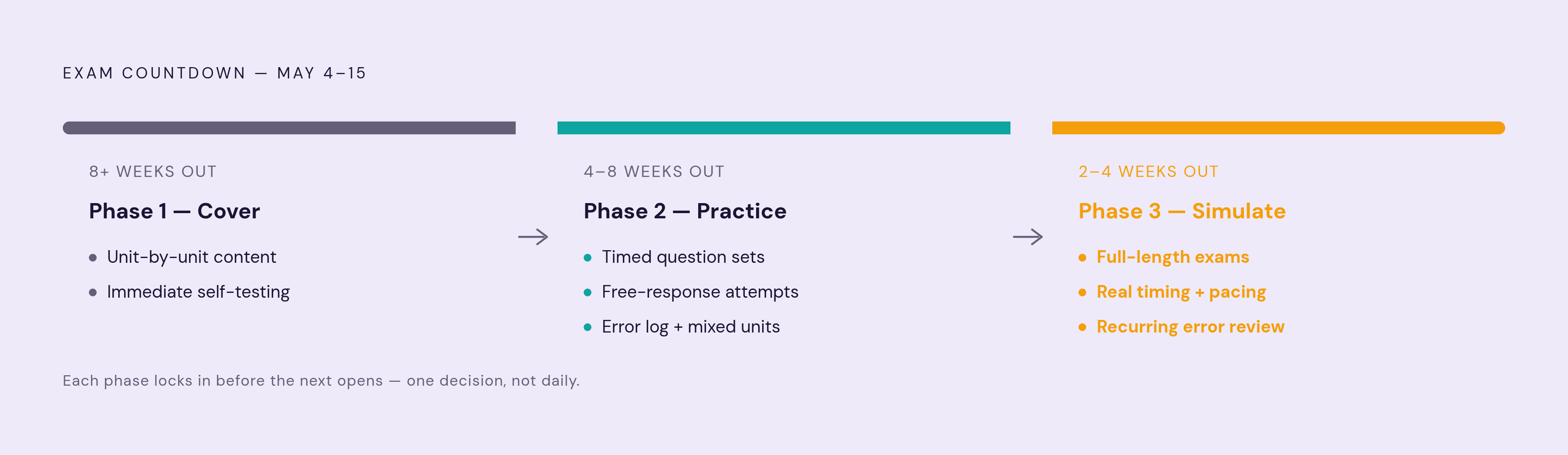
A three-phase timeline, built backward from the May exam window, gives students something more useful than a vague sense of "studying more": it removes the daily burden of deciding what to even do. That decision fatigue is a real cost for students with executive function challenges, and a fixed structure takes the decision off the table.
Phase 1, running roughly eight or more weeks out from the exam, covers content systematically, one unit at a time, with immediate self-testing after each segment.
Phase 2, roughly four to eight weeks out, shifts the emphasis from coverage to active practice: timed question sets, free-response attempts, error log review, and work that mixes units together.
Phase 3, the final two to four weeks, moves to full-length practice under real exam conditions, including accommodated timing, pacing work, and repeated review of recurring error patterns.
Inside each phase, the structure of individual sessions matters just as much for students with ADHD. Shorter sessions with a defined start and stop point outperform long, open-ended study blocks, because an open-ended block gives attention nothing to push against. Alternating subjects in 25-minute blocks, a method called interleaving, turns out to be both more effective for retention and more sustainable for attention than locking into one subject for two straight hours.
A weekly rhythm helps here too. Picture something like: Monday for content review, Wednesday for active practice, Thursday for correction work, Saturday for a longer mixed session. Three predictable session types, repeating on a known schedule, cut down the decision fatigue that often stalls students before they've even opened a book. For students juggling several AP exams at once, rotating which subject gets the heaviest focus each day prevents the fatigue that comes from pushing every single course at full intensity every single night.
Correction work deserves a specific callout, because it's the step most students skip and the one that matters most for anyone who tends to make the same type of error repeatedly. Skipping the review of what went wrong and why means practicing the mistake again.
Choosing practice formats that match how different learning profiles process and retain information
Scheduling covers when and how long. Format covers what kind of practice actually happens inside those sessions, and the format matters as much as the time spent, because the wrong format can turn hours of effort into frustration instead of retained knowledge.
Active recall, closing the notes and writing or saying out loud everything a student can remember before checking the answer, ranks as the single highest-utility method across subject areas. It carries a specific advantage for students with reading fluency difficulties: it shifts the task from decoding text on a page to retrieving meaning from memory, which routes around the exact bottleneck that slows these students down during passive review.
Spaced repetition, reviewing material on a schedule that spaces returns to each topic out over time instead of bunching them together, fits students with memory consolidation challenges particularly well. It builds retention gradually, which matters directly for students whose working memory limitations make last-minute loading harder to sustain.
Students with dyslexia need a different adjustment: text-heavy review formats work against the learning process. Audio-based review, text-to-speech, verbal explanation, recorded summaries, cuts the decoding demand out of the task and lets content engagement happen through a stronger channel instead. The 2026 Bluebook interface includes text-to-speech as a testing accommodation, and students should be practicing with that tool well before exam day arrives, not meeting it for the first time under a ticking clock.
Students with written expression difficulties need scaffolding built into free-response practice specifically. Outlining the argument's structure before writing anything reduces the load of generating ideas and transcribing them at the same time, two tasks that otherwise compete for the same mental bandwidth. Students approved for word processor accommodations should be writing essays on a word processor all year, not saving that adjustment for mock exams a few weeks before the real thing.
Interleaving comes back up here too, this time as a format choice rather than a scheduling one: mixing question types and topics within a single study session is harder in the moment than working through one topic at a time, but it produces better long-term retention. For students with attention difficulties, the added variety carries a second benefit: it keeps the material novel enough to hold attention.
Finding actual knowledge gaps
Students with learning differences tend to misjudge their own readiness in one of two directions. Some underestimate what they actually know, because retrieval feels slower and less certain than it should. Others overestimate it, because material that's been reviewed enough times to feel familiar gets mistaken for material that's actually been retained. Self-assessment alone is unreliable, which is why gap detection needs an external, criteria-based method.
A diagnostic baseline, taken before any study calendar even gets built, is more useful than jumping straight into content review. A short timed practice set, or a batch of released questions from each unit, sorts material into three buckets: what's solid, what's shaky under pressure, and what's genuinely missing. That sorting step saves weeks of review time that would otherwise go toward material a student already knows cold.
Weekly use of AP Classroom progress checks, rather than saving them for the end of a unit, reveals weak sub-topics in time to fix those gaps before they pile up into something bigger.
Tracking what a student actually produces under pressure tells you something different than tracking what they recognize while reviewing, because production under timed conditions draws on retrieval while review draws on recognition. Recognition and retrieval are separate cognitive tasks. A student with slower processing speed can recognize a concept easily on a review sheet and still fail to retrieve it fast enough on a timed question.
An error log makes that distinction usable day to day. It's a running record of not just which questions were missed, but what kind of error caused the miss. A content gap, not knowing the material, calls for targeted review and more retrieval practice on that specific topic. A reasoning error, misapplying something the student does know, calls for worked examples and guided process practice instead. A time-management failure, running out of time before finishing, often signals that accommodated timing hasn't actually been built into practice sessions yet. Three different problems, three different fixes, and no way to tell them apart without the log.
How AI-assisted feedback changes the gap-detection and free-response feedback loop
For students with learning differences, how fast feedback arrives matters almost as much as how good the underlying practice is. A gap that gets identified two weeks late is a gap that had two full weeks to grow into a bigger problem, and self-scored free-response work, graded by the student against no clear rubric, ranks among the weakest feedback loops available in AP prep.
AI-powered knowledge tracing changes that loop by modeling what a student actually understands in real time, based on patterns across many practice attempts. That approach can flag a weak sub-topic earlier than a student relying on self-assessment would ever catch it, simply because it's drawing on more data points than any one review session could capture.
A 2026 integrative review published in SAGE Journals identified five major themes in how AI supports students with disabilities: personalized learning, the benefits of AI-driven assistive technology, adoption challenges, institutional barriers, and best practices for implementation. The throughline across those themes is personalized feedback and earlier intervention, in place of generic, one-size-fits-all content delivery.
Free-response grading is where this appears most concretely, because it's the section that historically disadvantages students with writing-related learning differences the most, and where teacher feedback has always lagged furthest behind. Rubric-aligned feedback returned immediately after an attempt gives students a formative loop that actually builds skill before the exam, not just a number at the top of the page. For a student with written expression difficulties, knowing exactly which rubric criteria got missed, thesis clarity, evidence deployment, argument structure, is far more actionable than a general score or a vague comment in the margin.
Several AI grading tools now focus specifically on aligning with AP rubrics, aiming to close the gap between how a student scores their own practice essay and how an actual AP reader would score it. The value of those tools answers the two bottlenecks this section started with: feedback that arrives fast enough to matter, and feedback specific enough to tell a student what to fix next.