Topic Prioritization Frameworks for AP Exam Preparation
Focus study hours on high-weight units and question formats that actually appear on test day.
AP exams are not built to test everything equally, and treating them as if they are is the most common planning mistake a student can make. Every exam distributes its points unevenly across sections and topic clusters. A student who studies all units with the same intensity is, by the exam's own design, misallocating hours before the first flashcard gets made.
AP Chemistry shows how large that imbalance actually gets. Unit 3, Intermolecular Forces, carries far more exam weight than most other individual units. That makes it the single heaviest topic on the test, by a wide margin over almost everything else in the course. A student spending equal time on every unit is spending the same number of hours on the exam's biggest scoring opportunity as on one of its smallest.
The imbalance doesn't stop at unit weighting either. Question format matters just as much. The Chemistry free-response section includes two long questions and five short questions, and they are not interchangeable in value or difficulty. A student who drills short-answer practice and ignores the long-form questions, or the reverse, leaves points on the table in a very literal sense.
2026 adds another layer to this picture. The shift to digital testing is nearly universal this cycle. English, history, computer science, psychology, environmental science, art history, human geography, and government exams go fully digital. Math, science, and economics subjects run hybrid: free-response answers get written out in a paper booklet while the questions themselves appear on-screen in Bluebook. A student who hasn't practiced in the right format is rehearsing for a test that doesn't quite match the one in front of them on exam day.
None of this is a reason to panic. It's a reason to read the exam correctly before deciding how to spend study time. The unevenness is structural, and that structure is the starting point for every decision that follows.
Exam difficulty and prep time allocation
Once a student accepts that individual exams reward uneven effort, the same logic scales up to an entire AP course load. A student juggling four or five AP exams in the same May can't treat them as equally demanding, because they aren't. The hardest subjects, measured by how many students fail to clear a 3, deserve the largest share of total prep hours. Equal time across subjects is just as much a misallocation as equal time across units within one exam.
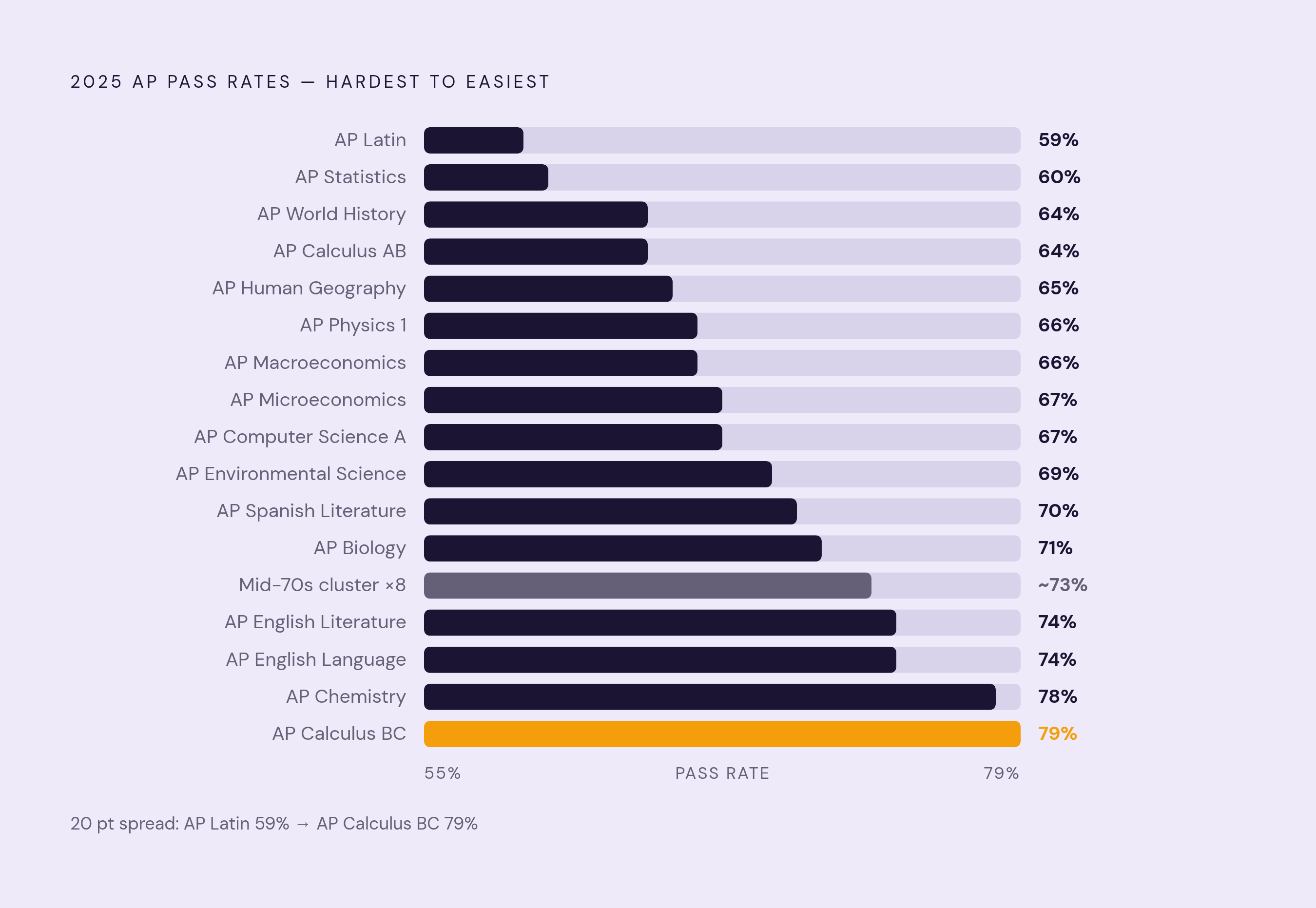
2025 AP Score Distribution data lays the difficulty gradient out. At the hard end sits AP Latin, with only 59% of test-takers scoring a 3 or higher, followed by AP Statistics at 60%, AP World History and AP Calculus AB both at 64%, AP Human Geography at 65%, and AP Physics 1 at 66%. A middle tier includes AP Macroeconomics (66%), AP Microeconomics (67%), AP Computer Science A (67%), AP Environmental Science (69%), AP Spanish Literature and Culture (70%), and AP Biology (71%). Toward the easier end, pass rates climb into the low-to-mid 70s for subjects like AP US Government & Politics, AP Psychology, both Physics C exams, AP Physics 2, AP European History, AP US History, AP French Language and Culture, and AP Comparative Government & Politics, with AP English Literature and AP English Language both at 74%. AP Chemistry is 78%, and AP Calculus BC tops the list at 79%.
That spread is a decision-making tool, not a list to memorize. A student staring down AP Latin at a 59% pass rate and AP Calculus BC at 79% in the same semester already knows, before opening either textbook, which one needs the bigger slice of the weekly calendar.
The 2026 exam calendar adds real scheduling pressure to this math. Exams run across two weeks, May 4 through 8 and May 11 through 15, and the hardest STEM subjects land on different days within that window: AP Chemistry on Tuesday, May 5 in the morning; AP Physics C: Mechanics on Wednesday, May 13 in the afternoon; AP Physics C: Electricity and Magnetism on Thursday, May 14 in the afternoon; AP Computer Science A on Friday, May 15 in the afternoon. A student needs to know not just which subjects are hardest, but when each one lands, so prep hours get front-loaded ahead of the right date rather than spread evenly across a calendar that doesn't actually treat every exam the same way.
Three variables should drive how many hours go to each subject: the subject's pass rate, the student's personal strength in that subject, and how much the credit actually matters for the student's intended college major. These interact in ways that can override the raw difficulty ranking. A student who's naturally strong in a historically hard subject may need fewer hours than a weak student grinding through something rated "easier." Difficulty data sets the starting point. Personal performance adjusts it from there.
Reading an exam's structure for high-leverage topics
Cross-subject prioritization answers the question of where to spend weeks. Within-exam prioritization answers the question of where to spend the hours inside those weeks, starting with reading the exam's own structure.
AP Chemistry again makes the clearest case. Unit 3, Properties of Substances and Mixtures, carries 18 to 22% of the exam. That's nearly triple the weight of most other individual units, which puts it at the top of the study queue before a student has run a single diagnostic test. Units 7 and 8, Equilibrium and Acids and Bases, cluster together conceptually and together represent a significant chunk of exam weight. Studying them in sequence, rather than as two unrelated topics separated by a few weeks on a syllabus, is a more efficient use of time, since the underlying concepts overlap.
Format weight matters here too. The two long free-response questions are worth considerably more per question than the five short ones. A student who can't finish a long FRQ is losing more points per question than one who skips a short one. That's a reason to make sure long-form fluency isn't the thing left until the last week, alongside continued short-form practice.
This same method generalizes to any AP exam a student is taking. Read the official course and exam description for the unit weight table. Identify the top one or two units by percentage. Then check which section format, multiple choice or free response, long or short, carries the most points. Where a high-weight unit and a high-value question format overlap, that's where study hours compound fastest.
Format accuracy needs to be built into this reading, not bolted on afterward. Under the 2026 digital rollout, students taking fully digital exams type every response directly into Bluebook. Hybrid-format students in math and science write their free responses in a paper booklet while the questions themselves appear on-screen. A student who only practices one of those formats is preparing for a test that doesn't match the one they'll actually sit for. The unit weight table and the section breakdown are the two documents every AP student should read before making a single study decision. Together they turn prioritization into a structural exercise.
Personal knowledge gaps as the missing variable
Everything up to this point treats the exam as the only variable that matters, but exam weights only tell half the story. They show where the points are. They say nothing about where a given student's points actually are.
Consider two students preparing for the same Chemistry exam. One already has a solid handle on Unit 3's intermolecular forces. Studying that unit harder gains them close to nothing, even though it's the heaviest-weighted material on the test. The other student has a shaky grasp of a lower-weight unit, something worth a fraction of what Unit 3 is worth, and is quietly losing more points there than the first student is losing anywhere on the exam. The unit weight table alone treats these two students identically. It treats them identically, even though their actual study priorities should look nothing alike.
That's the limit of a structure-only framework. The real question driving a study plan is which unit carries the most weight where the student personally has the most gaps. Those two questions produce very different answers depending on the student answering them.
Closing that gap requires a diagnostic step, and the diagnostic has to come before the study plan gets built, not after. A full-length or section-based practice test taken at the start of prep generates the data a real schedule needs. Studying first and discovering the gaps later, at a practice exam a few weeks before test day, wastes the exact hours a student can least afford to waste.
Running a reliable self-diagnostic
A reliable self-diagnostic can't rest on a single overall score. It has to break results down by unit and question type, so the gaps it reveals map back onto the exam's own structure.
A three-pass method handles this well. The first pass is a timed, full-length practice exam taken under realistic conditions, using Bluebook for digital-format subjects, scored by section and unit. The second pass goes through every wrong answer and sorts it into one of three categories: a concept the student never understood at all, a concept the student misunderstood and needs to unlearn before relearning, or a case where the concept was understood but the execution broke down under test conditions. Each category calls for a different fix, so lumping them together defeats the purpose of running a diagnostic. Unknown concepts carry the biggest potential score gains once addressed, since they represent points currently lost. Misunderstood concepts carry medium gains, because unlearning takes time before relearning can start. Execution errors carry smaller, more targeted gains, since the underlying knowledge is already there. Time pressure tends to resolve on its own as conceptual fluency builds, which makes it the last thing to address. The third pass clusters those categorized errors by unit and lines them up against the unit weight table. A gap in a high-weight unit caused by an unknown concept goes to the top of the study queue. A gap in a low-weight unit caused by a minor execution slip goes to the bottom.
Once the gaps are mapped, group related units that share underlying concepts and study them together. It's faster than treating each unit in isolation, and it mirrors how the exam itself tests interconnected material.
Adaptive tools built for this kind of gap detection can speed the process up considerably. Rather than waiting for a scored practice exam to reveal a weakness, platforms built on AI-powered grading can flag at-risk areas as a student works, surfacing patterns earlier and in finer detail than a single test score ever could. This is exactly the layer where a tool like this earns its keep: not by replacing the three-pass method, but by doing the second-pass categorization work, sorting unknown concepts from misunderstood ones from execution errors, in something closer to real time. That's the specific job AI-assisted grading is suited for inside this framework.
It helps to keep expectations realistic here too. Reasoning-first systems tend to post higher actionable detection rates and lower false-positive rates than retrieval-based systems, so not every AI tool performs the same way or deserves the same level of trust. The goal on a first pass is a directionally accurate gap map that sharpens as more practice data comes in.
Translating diagnostic results into a weighted study schedule
Everything in this framework, exam structure and personal diagnostic alike, exists to answer one question: where should the next study hour go? Hours go where the unit weight and the size of the personal gap multiply out to the largest number, even though it takes real tracking to execute.
At the subject level, that means difficulty tier still drives the big allocation decisions. High-difficulty subjects like Latin, Statistics, Calculus AB, and Physics 1 warrant the largest total share of prep hours. Medium-difficulty subjects get a moderate share. Subjects that are easier relative to a given student's own strengths warrant maintenance review rather than intensive new study, since the hours spent there return less than the same hours spent on a harder subject or a bigger personal gap.
Inside each subject, the schedule should front-load whatever sits at the intersection of high unit weight and unknown-concept errors, then work backward from there. A sustainable version of this aims to finish core content review by March, leaving April for practice exams and May for targeted review. That timeline isn't arbitrary. It builds in enough room to run multiple diagnostic cycles before exam day, which matters more than finishing content review early for its own sake, by leaving space to retest and adjust as gaps close. Reviewing one or two units a week at a steady pace beats cramming whole subjects into the final stretch, both for retention and for stress levels heading into May.
The final week before an exam should function as consolidation, not as a learning phase. New material introduced that late competes directly with retrieval of everything already learned, and it typically produces a smaller score gain than confident review of high-weight topics the student has already mostly mastered. Format practice has to be built into the schedule the same way, not treated as an afterthought squeezed in once content review wraps. Students sitting for fully digital exams should download Bluebook early and run through practice previews so the graphing calculator and annotation tools feel familiar well before test day. Students in hybrid-format subjects, math and science, need timed free-response practice in the actual paper-booklet format, not just reading questions off a screen.
An error log holds the whole schedule together. Tracking every wrong answer by unit, error type, and date builds a running picture of which gaps are closing and which ones are sticking around. The schedule shifts as the data shifts, with hours re-prioritized week over week as gaps close. That's the real value of building the framework this way. It doesn't hand a student one fixed plan in January and call it done. It gives them a method for re-prioritizing as their own gaps close, week over week, so the hours keep moving toward wherever they're worth the most.