Metacognitive Feedback and SAT Score Plateau Breaking
Targeted metacognitive feedback reveals hidden reasoning gaps that generic test prep cannot surface.
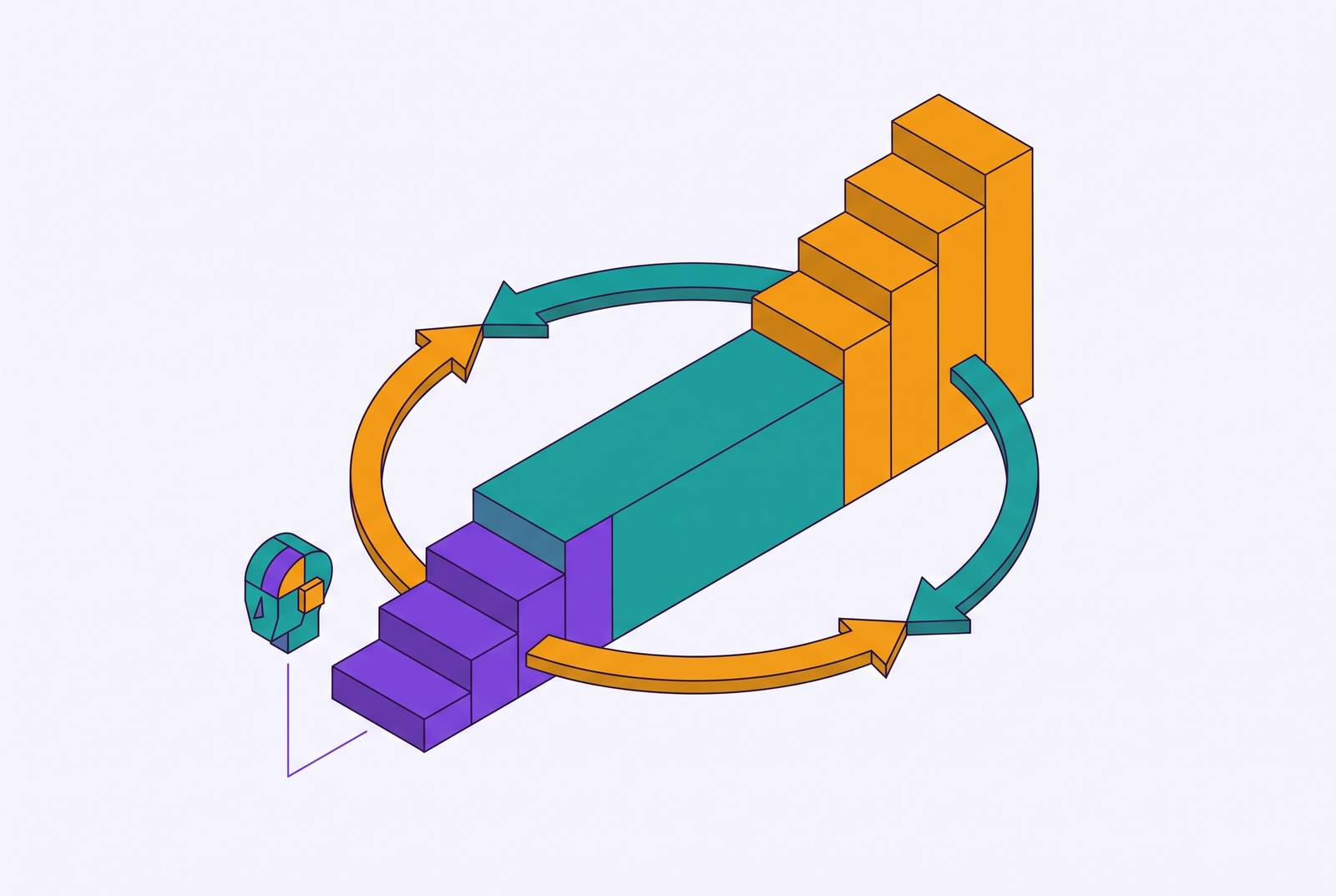
A student studies for weeks. Full-length practice tests, review chapters, flashcards on repeat. The next score comes back nearly identical to the last one. That pattern, the same narrow score range across two or more attempts despite continued preparation, is what a plateau actually is. It is not a sign of laziness or a lack of grit.
According to the SAT Annual Report, more than half of students score in the lower-to-mid range, and many of them are studying consistently without crossing the threshold, so effort alone cannot be the explanation. If effort were the missing ingredient, that number would look different. Something else is going on.
The plateau bands cluster at recognizable ceilings, roughly 1100–1200, 1300–1400, and 1450–1550, each for a structurally different underlying reason. Each ceiling has its own structural cause, which later sections unpack in full. A plateau is a diagnostic signal about where reasoning breaks down. Students hit these walls because they keep reviewing what they already understand while the actual gaps in their reasoning stay invisible. That is a fixable problem, one that just requires figuring out what to fix.
The Digital SAT's Adaptive Structure and the Score Ceiling
The Digital SAT is built in stages. Both the Reading and Writing section and the Math section run across two modules each, and the difficulty of the second module is set by how a student performs on the first. Strong performance on Module 1 unlocks a harder, higher-scoring Module 2. Weaker performance routes the student into an easier version of Module 2, and that easier version caps how high the final score can go, no matter how well the student finishes it.
This is where an unexamined gap stops being a minor deduction and starts acting like a ceiling. A student's Module 1 performance decides which scoring track becomes available for the rest of the section, so any gap in reasoning that goes undiagnosed there does not just cost a few points. It compounds, because it locks the student out of the score range where those points even exist.
That makes precise self-assessment more than a nice habit. A student who cannot pinpoint why specific Module 1 questions were missed cannot fix the pattern before it triggers the downgrade, and that exposure is sharper here than on any earlier, static version of the SAT. The 1300–1400 wall is predominantly a Module 2 routing problem, not a content-knowledge problem, so piling on more content review is the wrong fix.
Metacognitive calibration, and why most prep tools skip it
Most SAT prep tools do one thing: mark the answer right or wrong, then show the correct choice. That approach leaves the actual reasoning that led to the wrong answer completely unexamined. Students end up memorizing that a specific problem has a specific answer instead of understanding the thinking that would get them to the right answer on a problem they have never seen. On test day, unfamiliar problems expose that gap immediately.
Metacognitive calibration is the accuracy of a student's own self-assessment: knowing what is actually understood, what is not, and why. Metacognitive tutoring approaches, as described by the MetaCLASS framework, work by prompting a learner through planning, monitoring, debugging, and evaluating their own thinking, rather than simply feeding them content. That difference matters because a student who can accurately judge their own understanding stops wasting time on comfortable, already-mastered material and starts spending it where the actual gaps are.
Even AI-driven tutoring is not automatically good at this. The MetaCLASS benchmark tested current LLM-based tutoring systems and found what researchers call a "compulsive intervention bias": these systems jump in with explanations almost every time, and chose strategic restraint, staying quiet so the student could work through the struggle, in only 4.2% of cases where restraint was the right call. A tool built to constantly explain fills the space where a student's own thinking should be developing. That is the exact failure mode a genuine metacognitive tool has to avoid.
The three error types a real diagnostic surfaces
Every question a student misses on the SAT falls into one of three categories, and treating them as the same thing keeps generic practice from working.
The first is a conceptual gap: the student genuinely did not know the underlying skill, such as setting up a system of equations, following transition logic in a Reading and Writing passage, or interpreting a quadratic. Re-reading a review chapter does not fix this. Targeted drilling on that specific skill does.
The second is a careless error: the student actually knew the material but misread the question, dropped a negative sign, or rushed under time pressure. The fix is a slow-down protocol built around the specific question types where the mistake keeps happening.
The third is pacing loss: questions left blank or rushed through in the final minutes of a module. The student may know the content perfectly well. The clock simply won. That calls for pacing benchmarks and a skip-and-flag protocol, not additional review of material the student already understands.
Mixing these categories together, treating a pacing loss as a conceptual gap, for example, is the mechanism by which generic prep stalls. An error log built from a single timed, full-length diagnostic test, using official Bluebook materials rather than third-party simulations, which miscalibrate difficulty and question style, makes this triage possible in roughly an hour. That error log becomes the map for where to actually spend study time.
Why accurate self-assessment requires external feedback, not just self-review
Students are not reliable judges of their own understanding, and that is precisely why self-review alone tends to reproduce the same blind spots that caused the plateau in the first place.
Researchers at Georgia Tech built a knowledge graph that maps prerequisite concepts against curriculum topics, and found that the volume of questions students asked about a topic correlated with how difficult they said that topic felt. A student struggling with a downstream topic, like quadratic word problems, often cannot trace that struggle back to an upstream concept, like factoring, that is the actual root cause, because the direction of cause and effect runs the opposite way. The graph's prerequisite edges can point to that upstream concept directly, surfacing candidate root causes that the student's own self-assessment would miss. Most commercial prep tools tag questions by subject area alone, so they lack this kind of dependency mapping.
A 2025 ACM Learning at Scale paper, by Mak Ahmad, Prerna Ravi, David Karger, and Marc Facciotti, tested what happens when practice exams require students to explain their answers and declare their confidence before seeing whether they were right. Across 28,313 question-student interactions, that requirement changed how students studied, because forcing them to state their confidence out loud made the gap between what they believed and what they actually knew impossible to ignore.
Diagnostic tools that mimic the SAT's own adaptive logic work on the same principle. One such tool maps a student's readiness quickly and highlights knowledge gaps instantly, and the value there is not the practice questions themselves but the external signal about where reasoning is actually breaking down. Self-review cannot generate that signal. It takes an outside structure, whether a graph, a confidence prompt, or an adaptive diagnostic, to correct a bias that students cannot see from the inside.
Metacognitive feedback in student platforms
"AI feedback" covers a wide range of things in practice, from tools that simply grade a diagnostic to tools that trace a wrong answer back to its root cause.
Some platforms have added a 30-minute adaptive diagnostic that estimates a student's starting skill level, then build a personalized practice plan based on test date and target score, with skill-specific drilling targeting the two to three weakest skills and spaced repetition to schedule reviews before forgetting occurs. Reported outcomes from this kind of approach show meaningful point gains for students who complete the recommended plan.
Elsewhere, free full-length practice tests have started appearing with timed sections, instant feedback, and AI-assisted study plans, built using content grounded in expertise from established test-prep organizations. That kind of access lets students who could not previously afford structured prep get it.
Other integrations are earlier-stage: AI added to help students who get stuck on a question, offering feedback and general guidance, without being built from the ground up as a metacognitive system.
At the more purpose-built end of the spectrum sits AI-powered grading designed to go past marking an answer right or wrong, aiming instead to learn what a student actually understands, where their thinking breaks down, and what specific gaps separate them from mastery. That is the same prerequisite-mapping, reasoning-surfacing logic described in the Georgia Tech research, applied directly to test prep.
The spread across these approaches makes one thing clear: a system that only marks answers and a system that maps reasoning breakdowns and adjusts the next practice session accordingly are doing fundamentally different jobs, even if both get called "AI feedback."
The real objection: AI feedback can create dependency rather than building the self-regulation it promises
The strongest case against relying on AI for metacognitive feedback is that it can quietly undermine the very skill it claims to build.
Research published in Frontiers in Education shows that a plain answer-providing AI removes the "desirable difficulties" that force real learning, and when the AI routinely hands over the correct solution path, students lose the drive to try something, observe what happens, and adjust, the core of learning through reflection. A 2025 arXiv longitudinal study found that students learning with teacher presence reported significantly higher emotional and agentic engagement than those learning without, and flagged "metacognitive laziness" as a genuine risk, since GenAI usage can lead students to outsource the metacognitive work rather than internalizing it. Prep Expert's Dr. Shaan Patel makes the practitioner's version of the same point: students who lean entirely on generative AI will not build real skills, and AI on its own cannot teach strategy.
The MetaCLASS framework resolves this by formalizing "No_intervention" as a first-class pedagogical action, since effective metacognitive coaching is partly defined by strategic restraint that allows productive struggle rather than disrupting with a hint, and current LLMs over-intervene in the vast majority of turns where restraint was the correct move, exactly the over-intervention the objection predicts.
The finding points to a design flaw in how these tools are built, an argument for fixing AI feedback rather than avoiding it. MetaCLASS's own resolution treats "no intervention" as a legitimate pedagogical choice in its own right, a formal option a coaching system should reach for on purpose. The objection lands hard against tools that are really just content delivery wearing a coaching label. It does not weaken the case for tools built specifically around metacognitive scaffolding: prompting a student to explain an answer, declare confidence in it, then gradually pulling that scaffold back as the student's own judgment improves. The practical test for a student choosing a tool is simple: does it explain, or does it sometimes wait?
Score-band playbook: what metacognitive feedback should target at each ceiling
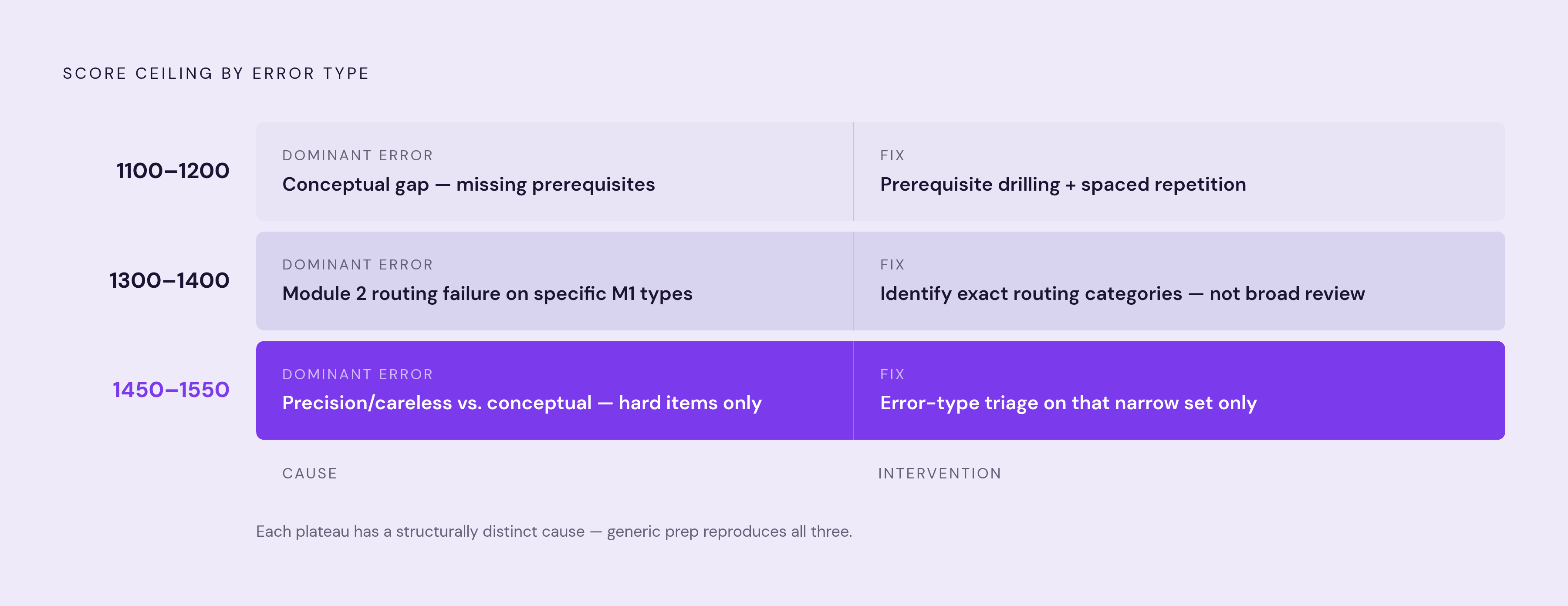
The three common plateau bands each have a dominant error type, and the metacognitive feedback a student needs is specific to which ceiling they are hitting.
In the 1100–1200 band, the wall is foundational content and the dominant error type is conceptual gap; metacognitive feedback at this level should surface which prerequisite concepts are absent, rather than routing more foundational-level practice indiscriminately. Working only easier material is a known way to get stuck at this ceiling: moving into a higher band requires practice that is proportionately more challenging. Cramming study into short, compressed bursts instead of spacing it out over time is a documented reason students plateau here, and spaced repetition, not sheer volume, is what actually breaks that pattern.
In the 1300–1400 band, the wall is Module 2 routing, and the dominant error type is a cluster of specific question types that consistently route the student to the easier module. Metacognitive feedback at this level needs to identify exactly which Module 1 question types are causing that routing, rather than simply reporting overall accuracy. Performing well on easy questions leaves this ceiling in place. The feedback has to pinpoint the exact question categories failing at Module 1 difficulty, because that is the only thing routing responds to.
Students stalled in the 1450 range are dealing with a precision wall: a small set of genuinely hard question types they have not yet isolated, where the dominant task is telling apart a careless slip from a real conceptual limit. At this band, generic practice produces almost nothing in the way of new gains. Only the same error-type triage described earlier, sorting conceptual gaps from timing errors from careless mistakes on that narrow set of hard items, actually moves the score.
Sources
- MetaCLASS: Metacognitive Coaching for Learning with Adaptive Self-regulation Support
- How Adding Metacognitive Requirements in Support of AI Feedback in Practice Exams Transforms Student Learning Behaviors
- Detecting Knowledge Gaps from Conversational AI Interactions Using Curriculum Prerequisite Graphs
- Designing Against Deskilling: Metacognitive Feedback Reduces Cognitive Offloading to LLM Assistants
- Frontiers | The cognitive mirror: a framework for AI-powered metacognition and self-regulated learning