Weekend Versus Daily SAT Study Session Structures
Spacing study across weekdays embeds concepts deeper than cramming them into one weekend block.

Daily SAT practice and weekend cramming are not interchangeable ways to spend the same hours. Put ten hours into five short weekday sessions, or put the same ten hours into one Saturday marathon, and the spacing effect produces measurably different outcomes for retention. The hours are identical. The results are not.
Memory consolidation starts during a study session, but the real work happens in the gap afterward, especially during sleep. That gap is when new material actually moves toward longer-term storage. A student who studies for 40 minutes and then stops, sleeps, and comes back the next day is giving the brain time to do work that a four-hour cram session never triggers. The cram session just keeps information circling in short-term memory, which feels productive while it's happening. Recall during a cram session is effortless because the material is still sitting in working memory. That ease is called fluency, and fluency fades fast, often within days, because the information was never pushed into long-term storage to begin with.
Effortful retrieval after a delay is what actually strengthens a memory. During a cram session, the answer sits right there on the page or in recent memory, so the student never has to reach for it. A student revisiting a missed grammar rule two days later, without the material in front of them, has to actually retrieve it. That small, slightly uncomfortable effort is the mechanism that makes the memory durable.
For the SAT specifically, the test rewards pattern recognition and reasoning skills, not facts that can be loaded in overnight. Spotting a modifier error, recognizing a system-of-equations setup, reading a dense passage quickly: these are skills that take weeks to build, not single evenings. The Digital SAT sharpens the stakes here too, since Module 2's difficulty is calibrated by how a student performs on Module 1. The ceiling a student reaches depends on how deeply the underlying concepts are embedded.
The Spacing Effect in a Real SAT Study Week
Translate that mechanism into an actual week, and it stops sounding abstract. A student doing 30 to 45 minutes a day will typically retain more and score higher than one doing a single multi-hour block on the weekend, even when the total number of hours studied is the same.
A daily session that works tends to follow a simple order. It opens with a short retrieval pass: working through recently missed questions, not rereading notes or re-watching an old explanation. Only after that retrieval work does new practice material enter the session. The error log is what connects one day to the next. Mistakes get logged, and the student returns to those exact mistakes across multiple future sessions, which forces the spacing effect onto precisely the content that needs it most.
The Digital SAT's own structure makes this easier to organize. The test runs through Reading and Writing, then Math, each split into two adaptive modules, and that split gives students a natural way to rotate focus across the week without dropping either section. Alternating days, say English on Monday and Wednesday, Math on Tuesday and Thursday, keeps both sections in active rotation without trying to cram both into every single session.
This matters most for the kinds of skills that genuinely need distributed retrieval: vocabulary-in-context, grammar rules, algebra patterns. These are not one-and-done topics. A student who drills punctuation rules for one long hour on a Tuesday retains less than a student who touches the same rules in four separate 15-minute windows spread across two weeks. Short sessions, repeated often, beat long sessions attempted once, which is the entire case for building a daily habit.
When weekend-heavy prep hits a ceiling
Studying beyond a sustainable daily threshold produces diminishing returns, and eventually it produces burnout. A weekend-heavy plan that tries to make up for five missed weekdays with one marathon Saturday session is working against its own goal, even though it can feel like the responsible move.
Consistency beats intensity as an operating principle here. A student logging three focused hours five days a week is building something structurally different than a student who grinds out eight hours on a Saturday. The five-day student gets five separate consolidation windows, five nights of sleep working on the material, five chances for effortful retrieval. The Saturday student gets one. Four or more hours of daily study sustained over months carries a real risk of burnout and test-day exhaustion, which can undercut months of otherwise solid preparation.
None of this means the weekend-heavy student is lazy or undisciplined. The instinct to put in a big block of time when the schedule finally opens up is a reasonable one, and it often comes from a genuine desire to make real progress. The SAT is not a memorization test. It requires skill development and pattern recognition, and that means raw hours of exposure produce less per hour than hours deliberately structured around retrieval and spacing. A student can sit with practice problems for six straight hours and still walk away having built less durable skill than a student who spent half that total time spread across a week.
A missed day carries a real psychological cost for pure daily practice. The streak breaks, and the "I'll just start again tomorrow" trap opens, which can quietly turn into a lost week. But that argues for building a sustainable floor into the plan while keeping daily structure in place. A brutal day doesn't require a full session. Ten minutes, one passage, five math problems, a quick pass through the error log, keeps the habit alive and keeps the student in active contact with the material. The floor protects the continuity of the habit, not the ten minutes of studying itself, so the following week doesn't start from zero.
What weekends are for in a well-structured SAT plan
Weekends simulate the full cognitive load of test day and reveal whether weekday learning has actually converted into performance under pressure, something daily sessions structurally cannot do.
Full-length timed practice tests belong on weekends, not weekdays. The Digital SAT itself runs just over two hours, and once the break is factored in, the full sitting stretches to nearly two and a half hours. Fitting that into a weekday routine would displace the targeted, retrieval-based work that drives most of the actual improvement, so for most students, a weekend block is the only realistic place to simulate that length honestly. Once full-length tests are introduced into a plan, a cadence of one every two to three weeks is what most plans converge on, not one every single weekend.
The weekend after a practice test carries its own job too: deep error review. That means more than glancing at a score. It means sorting every missed question into a category, a content gap, a careless error, a timing problem, a misread question, and logging each one so the coming week's daily sessions have something specific to target.
Full timed tests also build something daily drills simply can't replicate: stamina. Daily sessions build knowledge and skill. Full-length tests build the endurance and pacing required to hold that skill together across two sections and four modules without the quality of thinking collapsing in the final twenty minutes. So the real distinction isn't that daily study is good and weekend study is bad. Daily sessions and weekend sessions are doing two different jobs, and a plan that only has one of them is missing half the picture.
Sequencing Daily and Weekend Sessions Across a Realistic SAT Timeline
The structure of the months before test day shapes outcomes more than the raw hour count, and the right sequencing shifts depending on how much time a student actually has.
The general shape holds steady across most timelines. Early weeks open with a diagnostic test to establish a baseline, followed by daily sessions aimed squarely at whatever gaps that diagnostic revealed, with no full-length tests yet. Middle weeks shift to daily targeted practice by section, alternating Reading/Writing days with Math days, and this is where a full-length test gets introduced for the first time, once the foundational concepts are solid enough to make the test meaningful, reviewed in real depth the day after. Final weeks increase the frequency of timed full-length tests, while daily sessions pivot away from new content and toward error review and retrieval practice on whatever weak spots keep resurfacing.
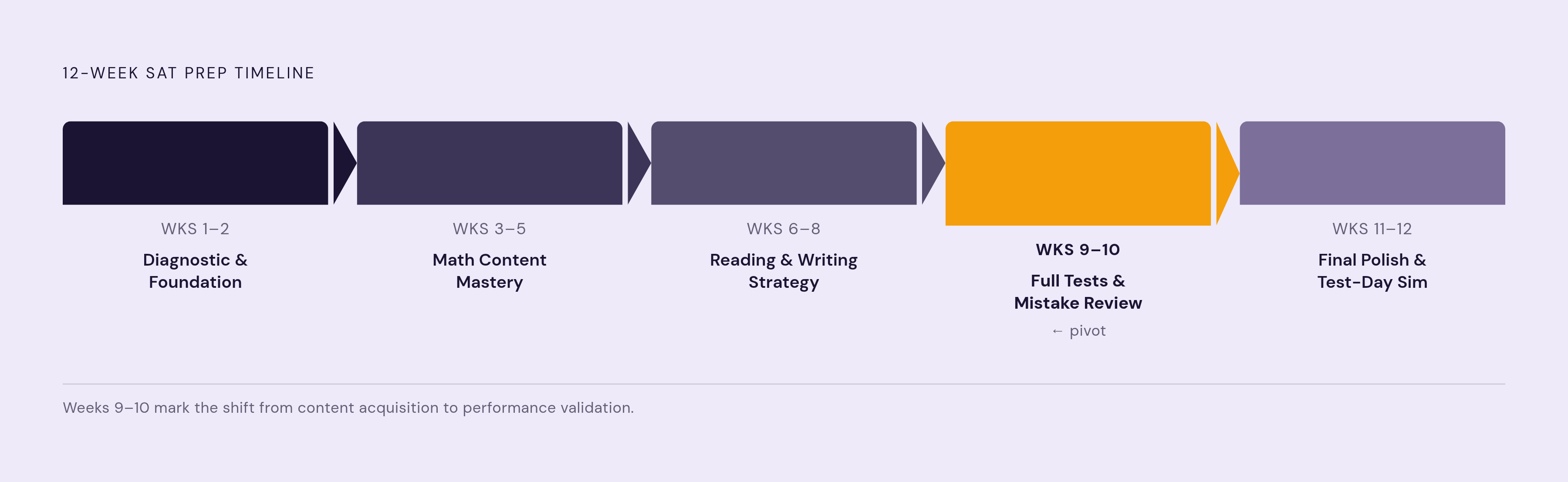
Three months tends to be the sweet spot for most students, long enough to produce real improvement, short enough to keep focus from slipping. A twelve-week version of this plan breaks down cleanly: weeks 1 and 2 for diagnostic testing and foundation-building, weeks 3 through 5 weighted toward Math content mastery, weeks 6 through 8 weighted toward Reading and Writing strategy, weeks 9 and 10 for full practice tests and mistake review, and weeks 11 and 12 for final polish and test-day simulation.
Daily volume should scale with how much time a student actually has, not with ambition. Two hours a day is enough room for a concept block and a practice set in the same sitting, which allows for meaningful distributed practice without pushing anywhere near the hours where burnout risk starts to climb. Past four or five hours a day, returns start shrinking fast. At that point, the better move is adding a weekend block rather than stretching daily sessions past the point where the brain is still absorbing anything useful.
How Knowledge Gap Detection Changes "Consistent Practice
Consistency without targeting is just logging hours. Students who improve the most are the ones whose daily sessions go toward the specific gaps standing between them and their goal score, not toward content they've already mastered weeks ago.
The Digital SAT's adaptive structure raises the stakes on getting this right. Because Module 2's difficulty is calibrated by Module 1 performance, a student whose actual weakness is punctuation but who spends weekday sessions drilling geometry is misallocating time that could be closing the gap that's actually holding the score down. Closing the right gap can unlock a meaningfully harder, higher-scoring second module. Closing the wrong one doesn't move anything.
Daily practice also generates far richer diagnostic information than weekend-only study ever can: accuracy broken down by concept, time spent per question, which errors keep recurring across sessions, how all of that shifts as test date approaches. A student who only shows up on weekends produces sparse, scattered data, and gaps that should be obvious stay hidden far longer than they need to.
This is where an AI-powered tool does something a static study plan can't. Passionfruit Learning, for instance, tracks not just whether an answer was right or wrong, but where a student's thinking actually broke down, and adjusts what comes next based on that. Unlimited AI-generated practice questions built around retrieval across multiple sessions turn each day's work into something more than a score to log. Students return to missed questions days or weeks later, which forces the exact kind of distributed recall the spacing effect depends on, rather than leaving that scheduling work to the student.
A student who actually understands a concept retains it differently than a student who is pattern-matching their way to a right answer without real comprehension underneath it. That gap is exactly where some students plateau and others keep climbing. For a student running short 30 to 45 minute sessions, that kind of targeting is what makes the session count at all: time spent on the highest-leverage gap in front of them, not on material that already feels comfortable.
Adapting the Daily-Plus-Weekend Structure When Life Does Not Cooperate
The spacing effect survives a disrupted schedule as long as the student protects the floor. A shorter daily session is structurally better than a skipped day followed by a long compensatory weekend block trying to make up the difference.
Four focused days a week is enough for students who genuinely cannot study daily, and it's the cadence often recommended for summer prep, where balancing SAT work against everything else in a student's life matters as much as raw intensity. The distribution of those four days affects how well spacing is preserved, more than which four days get picked. Monday, Tuesday, Thursday, Saturday preserves spacing. Tuesday, Wednesday, Thursday, Friday clusters everything together and loses most of the benefit, even though it's technically still "four days a week."
Front-loading is a useful tool for a known rough patch ahead. A student who knows a brutal week of exams or travel is coming can run slightly longer sessions in the calm days beforehand, banking extra work while still keeping every single day above the minimum floor. An error log that's automated and personalized makes that floor easier to hold onto under pressure: AI-powered tutoring platforms that flag and resurface mistakes across sessions let a student focus on what actually matters without manually rebuilding a retrieval schedule by hand. And on the days that barely have ten minutes to spare, tools that give instant feedback on a quick mini-session remove the friction of checking work by hand, which is often the difference between a sustainable floor and a floor that only exists on paper.
For students who are closer to their target score, the balance between daily and weekend work shifts again. Once content knowledge is largely in place, the bottleneck moves from learning new material to retrieving it quickly under pressure, a skill built more by full timed tests than by daily drills. That's a reasonable case for an advanced student to lean more heavily on weekends, trading some daily concept work for timed section practice and full-length tests. The structure bends to fit the student. The spacing principle underneath it stays fixed.
Sources
- (PDF) Repetition, Retrieval, and Spaced Practice
- Evidence of the Spacing Effect and Influences on Perceptions of Learning and Science Curricula
- Spaced Practice
- Using Spacing to Enhance Diverse Forms of Learning - ERIC
- DAS3H: Modeling Student Learning and Forgetting for Optimally Scheduling Distributed Practice of Skills
- META-ANALYSIS A Meta-Analytic Review of the Benefit of Spacing
- Memdora: Designing Cognitively-Grounded Flashcard Interactions for AI-Powered Spaced Repetition
- Artificial Intelligence and Learning Gaps: Evaluating the Effectiveness of Personalized Pathways