Skill-Gap Identification as the Core Differentiator in High-Value SAT Tutoring
Personalized SAT prep must diagnose exact skill gaps, not just cover content broadly.
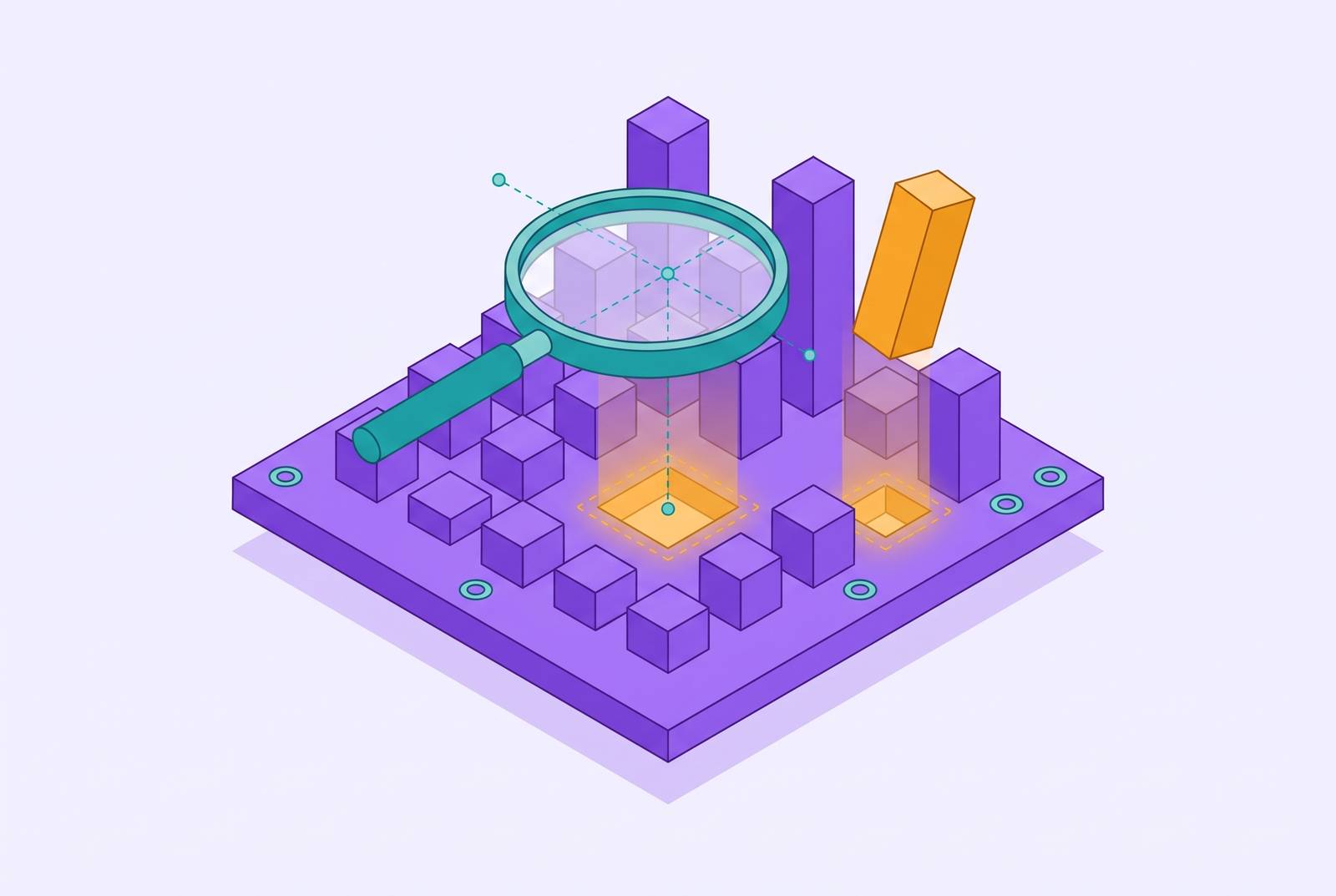
High-value SAT tutoring identifies the exact concepts a student does not understand, explains why errors recur, and uses that diagnosis to choose the next task. SAT prep with personalized knowledge mastery is a continuous process of finding and closing specific skill gaps, made especially important by the Digital SAT’s adaptive format.
Why the Digital SAT made broad-coverage prep obsolete
The Digital SAT changes the route through the exam based on how a student performs. Performance in the first module determines the second module, so students no longer all follow the same fixed sequence. The test branches. A static syllabus does not. Preparation that covers every domain at equal depth, regardless of the learner’s strengths, ignores the very differences the exam uses to shape its next stage.
That shift also changes what useful practice looks like. A student who works only at a uniform difficulty has not practiced the conditional difficulty jump that shapes the second module. Familiarity with the content is still necessary, but familiarity with one steady level of challenge is not enough.
This is no longer a niche preparation problem. More than 2 million students in the Class of 2025 took the SAT, with the overwhelming majority taking the digital version. Broad coverage remains a way to encounter the curriculum, but it is an inadequate organizing principle for personalized prep. Because the test adapts to the student, preparation must adapt to the student first.
What skill-gap identification actually means, beyond getting answers wrong
A wrong answer is evidence. It shows that something went wrong, but it does not establish whether the student misunderstood a concept, chose the wrong method, or made an arithmetic mistake while using the right method. Those possibilities demand different responses. Calling all of them a weakness in “Advanced Math” is like telling someone with a flat tire that the problem is transportation.
ALIGNAgent research distinguishes identifying a weak topic from identifying the exact skills or concepts within it that cause difficulty. Its framework processes quiz performance and gradebook data to estimate topic-level proficiency, then uses concept-level diagnostic reasoning to identify misconceptions and knowledge deficiencies. The second step gives the first its instructional value.
GenMentor approaches the same problem through “goal-to-skill mapping.” Before it assigns content, its framework works out which skills a learner needs to reach a goal and checks them against what the learner already knows. Its gap-identification output is a set of skill-and-level gaps.
For SAT tutoring, this distinction turns personalization into something testable. Does the feedback distinguish a student who knows the method but mishandles the arithmetic from one who applies the wrong method entirely? More explanation of the concept may miss the first student’s problem, while more repetitions of the same mistaken approach may leave the second student stuck. Diagnosis earns its place by changing the instructional response.
Why broad content coverage, even delivered well, fails the student who is close to their target score
A student close to a target score presents a different problem from a student who needs an introduction to much of the curriculum. The remaining obstacles may be narrow, even when their effect on performance is stubborn. Equal coverage then becomes an unequal use of time. Time spent on material the student already understands could have gone to the concepts that still cause errors.
Consider a student who struggles with systems of equations but already commands much of the surrounding material. A general review that gives every skill equal time leaves little time to work on systems of equations. The lesson might be clear, lively, and beautifully organized. A good explanation of the wrong thing is still the wrong lesson.
The distinction becomes sharper near the top of the SAT math range, where remaining gaps may involve specific function and trigonometry concepts. “Review math” is too blunt an answer to that problem. Even “review functions” may leave the central question unanswered, because it names a topic without identifying what the student misunderstands within it. More coverage can conceal the lack of a diagnosis.
A self-paced video course that shows the correct answer after an error may show what should have happened without explaining why this student went wrong. A group bootcamp calibrated to the average learner faces a similar constraint. Both formats can be useful, but teaching content well does not by itself make either one fit the student’s gaps. As the gaps get smaller, teaching must focus more closely on them.
How a diagnostic-first tutoring session differs structurally from a content-delivery session
In a content-delivery model, the tutor arrives with a planned lesson. In a diagnostic-first model, the tutor arrives with recent performance data already analyzed and a hypothesis about the underlying gap to test. The opening task is therefore not simply to begin teaching. It is to establish whether the proposed explanation for the student’s errors is right.
Life Skill Learnings describes an assessment-led structure that considers the student’s current skill level, strengths, areas for improvement, learning style, and goals before instruction begins. It then reviews each practice test to identify skill gaps and redirect preparation. The plan changes because the evidence changes.
In this structure, independent practice supplies much of the volume between sessions, while paid tutor time goes toward interpreting the difficulty and responding to it. The hour is not merely supervised drilling. ALIGNAgent builds a related feedback loop into its framework, assigning resources aligned with diagnosed deficiencies and intervening before the learner advances to the next topic. The diagnosis determines the handoff from one task to another.
The session’s output changes as a result. Instead of ending only with a record of content reviewed, it produces a revised gap map and targeted work that will supply evidence for the next session. Engaged-time measurement and a live progress dashboard can also make the work more visible to families than a text saying which topics were covered. But visibility needs substance. A record of activity is useful only if it helps show what the student understands and what remains unresolved.
What separates coarse gap maps from the concept-level diagnosis that actually changes instruction
A colorful dashboard can still offer a coarse diagnosis. “Weak in Problem-Solving and Data Analysis” tells a student where to spend time, but not what to change in their thinking. The label groups together problems that may need quite different explanations. A map can be accurate at the country level and still be useless for finding the front door.
Misreading what a scatterplot’s slope represents is not the same misunderstanding as confusing correlation with causation. Both may fall under data-analysis, but the next explanation should focus on the confusion the student has. After reading the feedback, does the student know which part of their reasoning needs repair, or only which subject needs more practice?
ALIGNAgent formalizes that distinction through a Skill Gap Agent that identifies misconceptions and knowledge deficiencies, rather than stopping at topic-level performance shortfalls. Its language-model-based agents were validated against actual exam performance for knowledge proficiency estimation. That gives evidence for the estimation layer, but it does not show that every AI-generated explanation is correct. The useful capability is the connection between granular evidence and an instructional response.
GenMentor also requires a step before measuring gaps: mapping the learner’s goal to the exact skills they need. A broad goal such as improving an SAT math score must be broken down enough to show what the student still needs to learn. Without that step, “personalized” can mean little more than changing question difficulty. The strongest diagnostic output changes what happens in the next study session.
How do you find SAT tutoring that identifies specific skill gaps?
Families can judge how deeply a program diagnoses gaps by looking at five features, starting with how specific the diagnosis is before teaching begins. The useful question for a tutoring center is whether it produces a concept-level proficiency map before the first instructional session or only broad topic labels. Timing is part of the test. A program that needs several weeks of generic practice before describing the student’s difficulty has not started from the diagnosis.
The second feature is the quality of feedback on wrong answers. Families should ask whether the explanation identifies the thinking that produced the error and distinguishes procedural mistakes from conceptual misunderstandings. The third feature is adaptive sequencing tied to that finding. Does the next assignment target the diagnosed gap, or does the student return to the same fixed curriculum? A diagnosis that never changes an assignment is decorative.
The fourth feature is continuous re-diagnosis. A strong program updates its gap map as new work shows that an old weakness has closed or another has emerged. The fifth is visibility for the student or parent. Families should be able to see what the program believes the student does not yet understand and how that picture changes over time.
Life Skill Learnings offers a human-tutoring example through its assessment process and practice-test reviews, which redirect preparation around identified gaps. That is evidence of a diagnostic-first structure. It does not, by itself, establish how finely every misconception is described, so the same questions about concept-level feedback still apply.
EdisonOS gives tutors tools for diagnosis, including skill analysis, skill trends across multiple tests, and performance by difficulty. Those features give tutors data for diagnostic-first sessions, which the tutors still need to interpret. The distinction is useful when considering options. One program may teach based on assessments, while another gives a tutor tools to look into how a student performs. The decision should turn on whether the complete setup connects evidence, diagnosis, and the next targeted task.
Why human tutors and AI diagnostic tools are most effective when they divide labor rather than compete
Continuous diagnosis and responsive teaching are related jobs, but they are not identical. AI diagnostic tools can work through performance data between sessions and make concept-level gap maps, which give the tutor a more specific place to start than raw scores alone. A human tutor can then interpret that picture in conversation with the student. Better information makes room for better judgment.
Human tutors also notice things that an app does not. A student may nod through an explanation without understanding a step, or stop engaging because the material feels discouraging. Reading that confusion, sustaining accountability, and adjusting strategy around the student’s emotional state are genuine human advantages. For students who shut down around screens, those advantages can be central to whether difficult work happens at all.
GenMentor splits the work among parts of its learning system. Its agents each have their own jobs: skill-gap identification, including goal-to-skill mapping, adaptive learner modeling, and content tailoring. Each layer feeds the next. The same approach works in tutoring when AI does the diagnostic data work between sessions and the human tutor uses it to guide teaching during them.
That arrangement need not make frequent human tutoring a requirement for useful diagnosis. AI-first systems that genuinely deliver concept-level feedback can provide the diagnostic layer independently of premium-priced tutoring. The condition is important, because an automated topic score is not the same service. Whether a program is AI-first, human-first, or hybrid, the investment standard is the same. At any point, it should be able to name the concept the student does not yet understand and the next targeted step toward mastering it.