Knowledge Retention Decay Rates in AP Subject Areas
Forgetting happens differently across AP subjects, and cramming won't fix structural gaps.
This piece looks at why "forgetting" in AP prep isn't one phenomenon, and why spreading review time evenly across subjects is a strategic mistake. The popular intuition says every subject fades the same way, at the same rate, if you just stop touching it long enough. That intuition is wrong. How fast knowledge erodes, and how much damage that erosion does by exam day in May, depends on what kind of thinking the subject actually demands.
A forgotten vocabulary term costs a student one multiple-choice question. A forgotten foundational skill in calculus can cost an entire section of the exam, because everything above it was built to depend on it. Those are not the same kind of gap, and they don't call for the same kind of fix. The subject's structure decides how a gap forms and how far its damage spreads, whether the discipline asks for hierarchical reasoning, procedural fluency, conceptual transfer, or raw vocabulary recall.
2026 AP score distributions make the point without much interpretation needed. AP Calculus BC's score distribution leans hard toward the high end, with most scores clustered there. Same subject area, but the shapes are opposite, because the skills each exam tests decay on different schedules. That gap between two math exams shows that "AP prep" is four different strategies, depending on what the subject is actually asking a student's brain to do.
How hierarchical subjects make early gaps catastrophic downstream
Some AP subjects stack. Each new unit sits directly on top of the last one, and there's no way around a broken foundation once the course moves on. In hierarchical subjects, a forgotten concept lower in the stack can't be skipped or bypassed. It collapses everything built above it, so a gap that opens in October can turn into total unreadiness by the following May.
Calculus, chemistry, and physics all work this way. If a student has lost either foundation, they don't struggle with one question type. They can't access that part of the exam. This is what separates hierarchical decay from the vocabulary kind: a forgotten term costs a point, a forgotten foundational procedure costs an entire category of points.
AP Calculus BC's top-heavy distribution partly reflects who takes it. But the same data shows that when students arrive without that chain fully intact, they perform severely, not moderately, worse. The selection effect is doing real work here: the BC population skews toward students who've kept their foundational skills reinforced continuously, year over year. A student with any gap in that chain starts the exam at a structural disadvantage, and a few extra review weeks before May won't repair years of missing scaffolding.
AP Precalculus tells a related story from the other direction. Students who build genuine mastery in precalculus carry durable footing into calculus. Students who pass the class without that mastery carry a hidden gap forward, one that appears only when a future unit depends on it.
The intervention that follows from all this isn't "review everything before the test." You have to find the specific foundational node that's missing and rebuild from there, because in a hierarchical subject, one broken link can explain failure across five unrelated-looking topics. Generic practice sets treat every wrong answer as equally informative. A hierarchical subject needs something that can trace a wrong answer on, say, a related-rates problem back to a gap in function behavior from two years earlier, and map the whole prerequisite chain that connects them.
How procedural subjects decay through disuse rather than forgetting
A different kind of subject fails for a different reason. In procedural AP subjects, students usually haven't forgotten what to do. They've lost the automaticity to do it fast and accurately once the clock is running, which is a different problem and needs a different fix.
AP Statistics shows this pattern in its 2026 distribution: nearly flat across the middle and lower score bands, an unusual shape for a math exam. That flatness suggests a large share of students understand the concepts well enough to engage with a problem, but can't execute the full reasoning chain under pressure. Students who learned confidence intervals in October often can't run one fluently in May because they haven't repeated the full procedure since, even though the concept hasn't left them.
AP Music Theory splits the same way, just in a different medium. The skills most at risk, melodic dictation, harmonic dictation, sight-singing, part-writing, Roman numeral analysis, and aural recognition, all depend on motor and perceptual automaticity. That kind of automaticity doesn't come back from passive review. A student can describe what a t-test does and still fail to execute one under time pressure. The concept is intact. The procedure is just slow, and slow is often the same as wrong when the clock runs out.
The fix is practice volume and active retrieval; re-reading concepts won't do it. If a student reviews Statistics notes in April but hasn't run a complete inference problem since January, procedural decay has already set in, even if they feel fully prepared when they walk into the exam.
Conceptual subjects and invisible gaps that aggregate across units
A third category of subject hides its gaps until the exam forces them into view. In conceptual AP subjects, an inability to transfer reasoning into a scenario the student hasn't seen before is what actually tanks a score, and that gap stays invisible until the exam hands over something unfamiliar.
AP Psychology is a clean example. The 2024 redesign made this sharper: older prep resources trained recall, while the current free-response format requires building and defending a claim using provided summaries of peer-reviewed research. That's a different cognitive task than naming a term correctly, and it exposes gaps that recall-based prep never would have caught.
AP English Language and AP English Literature have nearly identical pass rates, but the skills underneath them have moved in opposite directions. Language has rebounded sharply since 2023. The reasoning: Language centers argument and synthesis, a transferable skill that improves with structured practice on new prompts. Two exams that look the same on a scoreboard are testing two different kinds of thinking, and those two kinds of thinking decay on different timelines.
History exams add one more layer to this pattern. Students in that 2-band likely have enough evidence and timeline knowledge to nearly clear the bar, but weak argumentative structure, the ability to organize evidence into causation and comparison claims, pulls them back under the passing line anyway. That argumentative skill decays faster than the underlying factual knowledge does; a student might know more history in May than they can actually argue with.
None of these gaps respond to re-reading. A student who can define confirmation bias cleanly but has never applied it to an unfamiliar study has a conceptual gap, and flashcards will not touch it. What closes it is repeated exposure to new, unfamiliar application scenarios, built on purpose.
Vocabulary-based subject decay in the weeks before the exam
Vocabulary-heavy AP subjects behave the most predictably of all four types, and that predictability cuts both ways. Individual terms and definitions are modular, each one its own small unit of memory, which also means they drop out of active recall fast once review stops. That same modularity is what makes late-stage, high-frequency retrieval practice unusually effective here, more so than in any of the other three subject types.
AP Human Geography shows how uneven this decay can get inside a single exam. Unit 7 performance improved markedly in the 2026 data, and that points to uneven review coverage as the real cause, not uneven difficulty between units. Others get touched once in October and never again before the test.
AP Art History runs on the same mechanics. It's a course built on knowledge, analysis, and visual evidence, where specific works, periods, and formal terms need to be actively retrievable, not just vaguely familiar, the moment the timer starts. If a student reviewed heavily in the fall but left a long gap before May, they tend to show the most severe late-stage vocabulary decay of any group, because the terms they learned months ago simply haven't been touched since.
AP Psychology belongs here too, in a narrower sense. Its deeper gaps are conceptual, as covered above, but its vocabulary layer, the terminology itself, decays on this same fast, modular pattern and needs the same kind of late-stage attention.
Vocabulary-based subjects reward distributed, high-frequency retrieval in the weeks right before the exam more than any other subject type does. This is where spaced repetition and active flashcard practice pay off fastest and most visibly. A student who hasn't reviewed since January faces the steepest recovery curve of any subject type, but also the most responsive one: a few weeks of focused retrieval can undo months of drift, in a way that simply isn't true for a hierarchical subject like calculus.
Aggregate AP pass rates and the masked subject-level decay problem
A rising pass rate feels like good news, and sometimes it is. But if a pass rate climbs across many AP subjects at once, that doesn't mean retention has gotten better. In several high-volume exams, changes to the scoring model account for a meaningful share of that apparent gain, and a student treating the headline pass rate as a proxy for their own preparation is reading a distorted signal.
One piece of evidence for this comes from exams that didn't adopt the new scoring model: less-common AP exams that stayed on the old model show no comparable score increase over the same period. An analyst named Peterson uses that comparison as the basis for an argument that some of the recent gain is methodological. The argument is contested and is presented in the source material as analysis and opinion, worth reading as a reason to look closely at score data.
AP Physics 1's 2025 redesign offers a parallel case. A structural change to an exam's format can move the pass rate by a wide margin in a single year, and that raises a real question: how much of a "knowledge gap" closing is actually students learning more, versus the exam itself measuring differently than it used to? The physics didn't get easier. The score went up anyway, which suggests the measurement changed more than the underlying skill did. None of this means students are learning more across the board, and it doesn't mean they aren't either. So the signal got noisier, and when a signal gets noisier, it gets harder for any individual student to self-diagnose using pass rates alone.
The practical consequence follows directly: a headline pass rate is the wrong resolution for figuring out your own decay risk. Unit-level performance gaps, and the structural type of the subject itself, tell a student far more about where they actually stand than whether an exam's overall rate cleared the passing threshold this year or last.
Building a subject-type-aware review schedule for each decay pattern
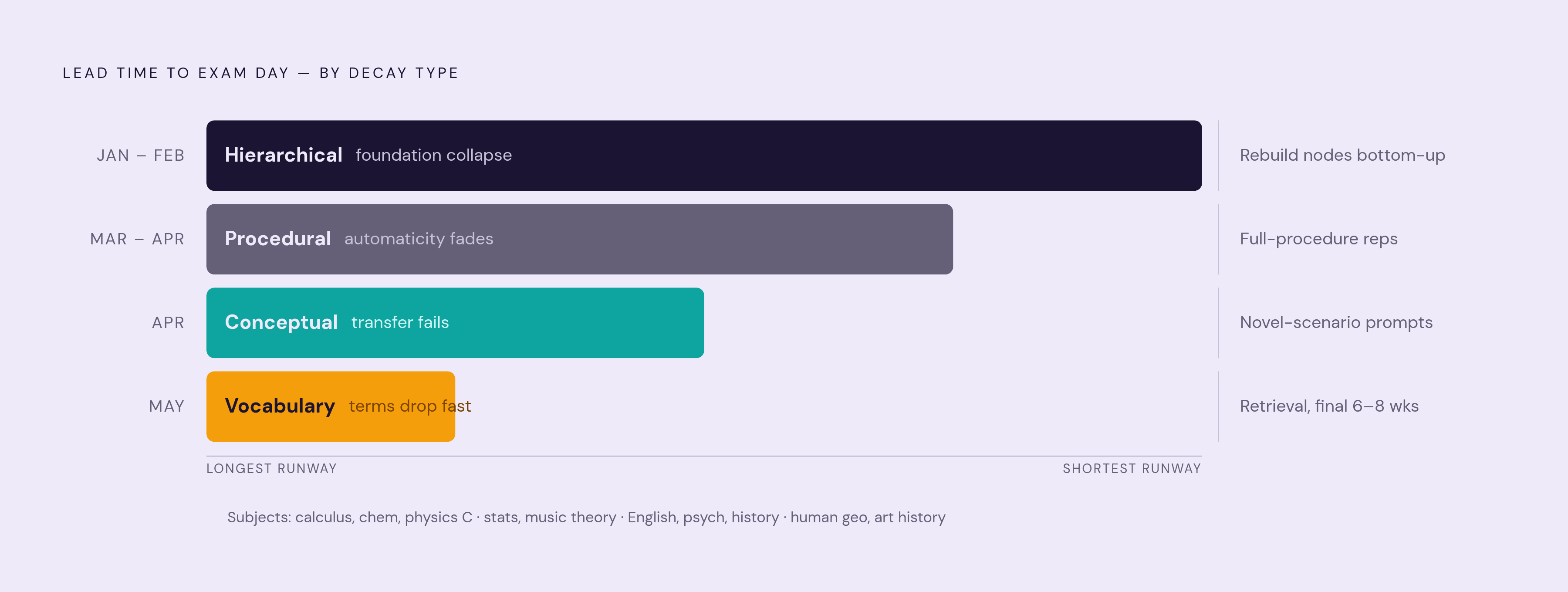
Once the four decay types are on the table, a review schedule becomes a targeting problem: it has to aim at the specific mechanism behind each one. If you organize review around structural subject type instead of spreading hours evenly across a planner, you counter the specific decay mechanism at work in each discipline and get more out of the limited study time before the May exam window opens.
Hierarchical subjects, calculus, chemistry, physics C, need the earliest start. The gap audit for these should begin in January or February, because a missing foundational node can't be patched in the final weeks before the test. The whole downstream chain depends on finding the lowest broken link first and rebuilding from there. Finding which missing prerequisite is making several later topics fail at once is the key diagnostic question.
Procedural subjects, statistics and music theory among them, need regular timed practice on full procedures running throughout the spring semester, not crammed into the final review period. Automaticity only comes back through repetition at speed. Re-reading notes or watching a video explainer doesn't touch procedural decay. The student has to actually execute the full procedure, start to finish, over and over, not just recognize it when they see it worked out.
Conceptual subjects, English, psychology, history, respond best to novel application: new scenarios and new prompts the student hasn't encountered before. Conceptual transfer is the actual skill being tested, and you only build it through contact with unfamiliar contexts. History exams add one more specific priority here: argumentative structure practice, organizing evidence into causation, comparison, and continuity-and-change claims, matters more in the final stretch than reading additional content ever will.
Vocabulary-based subjects, human geography and art history, call for a shift into high-frequency retrieval practice in the six to eight weeks before the exam. Spaced retrieval of specific terms works fastest here of any subject type, and because vocabulary decay responds quickly to recent exposure, late-stage review on these subjects pays off in a way it simply doesn't for something like calculus.
The hardest part of this whole framework, for any one student trying to run it alone, is knowing which gaps are actually theirs. Not which topics feel unfamiliar in a general sense, but which specific knowledge nodes are broken and feeding failures elsewhere. This is where AI-powered diagnostic tools built to map student responses against prerequisite knowledge, rather than simply tallying right and wrong answers, change what a review plan can actually accomplish. Tracking the pattern across a student's errors, not just the errors themselves, reveals where understanding actually breaks down, and a subject-type-aware schedule needs that precise map of where a subject's structure first gave way, not a longer list of things to review.
Sources
- Variability in knowledge retention of medical students: repeated and recently learned basic science topics
- (PDF) Adaptive Forgetting Curves for Spaced Repetition Language Learning
- (PDF) Spaced Repetition and Retrieval Practice: Efficient Learning Mechanisms from a Cognitive Psychology Perspective and Their Empowerment by AI